


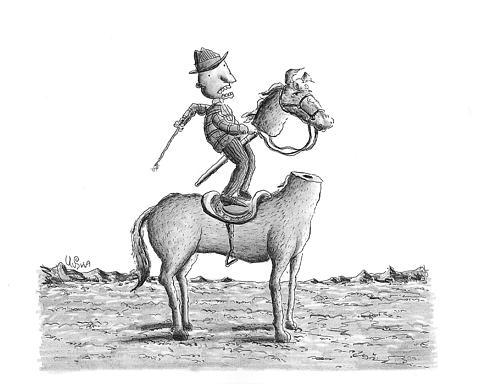
With its increasingly inflexible approach to cross-strait relations, China has painted itself into a corner. The repeated use of military threats, increased missile deployments, insistence on its definition of the "one China" principle and talk of imposing a deadline for reunification are designed to threaten and intimidate Taiwan, and to warn other countries of China's resolve on the Taiwan issue.
But these tactics also leave little room for negotiation and even less for compromise. China's inflexibility and harsh rhetoric toward Taiwan's leaders do not provide much optimism for improved cross-strait relations. It has trapped itself in a tight corner, and may find it difficult to accommodate Chen Shui-bian's (陳水扁) recent overtures, even if it wants to.
Although China has trapped itself and demands that Taiwan accept its terms as preconditions for talks, there is no reason for Taiwan to fall into the same trap. China expects Chen to explicitly adopt Beijing's definition of the "one China" principle in his inauguration speech, but Chen should not oblige. Inauguration speeches should set the tone for the incoming administration, but need not make new policy pronouncements, especially one as politically and emotionally charged as the "one China" principle. Moreover, for Chen to adopt the "one China" principle in his inaugural speech would set exactly the wrong tone. It would give away a valuable trump card while getting little in return, and leave him with little to negotiate with in the future.
Patience is a virtue
The US has sent several missions to Beijing in recent months urging China's leaders to be patient toward Taiwan, especially in light of Chen's victory. Chen should also be patient toward China.
It may take several months until China figures out how it will respond to a Chen administration and the overall change in the political dynamics in Taiwan. During that time, China is likely to repeatedly test Chen's mettle, and he should refuse to play their game. He should resist their intimidation, but more importantly he should resist the temptation to give up on efforts to improve relations with China even if China does not immediately return the favor.
Tang Shubei's
The White Paper in March proposed that the CCP and the KMT hold party to party talks on an equal basis, and now Tang has taken the next step by suggesting government to government talks on an equal basis. That could be the basis for a new round of talks, even if at a level below that of Koo Chen-fu (
But this apparent softening of China's position was matched by a hardening. These equal talks can only occur if Chen accepts the "one China" principle. Furthermore, Xinhua's Chinese language service quoted Tang as saying that if Chen did not accept the "one China" principle, "the result will not be peace but war." China's official media later claimed Tang had been misquoted and amended his statement to say the result would be "disaster instead of peace, confrontation instead of harmony and hostility instead of goodwill."
This confusion over Tang's language suggests China is still divided on how strong a threat to make toward Chen, and what mix of carrots and sticks it should utilize.
In responding to Tang's comments, Chen should seize upon the carrot and ignore the stick. He should welcome the offer to negotiate as equals without bending on the "one China" issue. If he accepts Tang's formula of equal talks in exchange for "one China," he will fall into China's trap and be unable to negotiate on behalf of Taiwan's interests.
How can China and Taiwan get out of this trap? To begin with, their focus should be on the independence issue, rather than reunifi-cation. Chen has said he will not declare Taiwan's independence, will not hold a referendum on the issue (unless China is about to attack), will not revise the constitution to include language on "special state-to-state relations" or popular referendums, and will continue using the "Republic of China" as Taiwan's formal name. The DPP has discussed, so far without resolution, dropping the call for independence from its platform. These are major concessions for Chen and his party, and show that they have no intention of provoking a conflict with China by moving toward formal independence.
This willingness to not declare formal independence should be enough to satisfy Beijing, but it apparently is not. Beijing has grown impatient with the status quo, in part because Taiwan has sought a more flexible interpretation of the status quo during the past ten years. Its efforts to raise its international profile, and to gain acceptance of the reality of its separate if not independent status, has sparked fears of "creeping independence" in China.
Flexibility the key
Taiwan and China already agree that Taiwan should not formally declare independence at present, either because it is not necessary (from Taipei's perspective) or because it is unacceptable (from Beijing's perspective). This could be the common ground needed to improve other dimensions of their relationship, but only if China stops insisting on discussing terms of reunification. For the foreseeable future, there seems little hope of finding a mutually acceptable resolution of Taiwan's relationship with China. Under these circumstances, there is little to be gained by insisting on talking about it. Taiwan and China could simply accept the status quo for the time being, even without "interim agreements," and leave a final resolution to the future, whenever that may be and whatever it may entail.
Chen and other Taiwanese leaders have shown great flexibility in stepping back from the independence issue. It is now up to China to step back from the reunification issue. Chen and his new administration may have to be patient until this happens, but must also be vigilant in looking for possible openings in China's posture. As Tang Shubei's mixed message indicates, it will take careful attention to distinguish the conciliatory signals from the bombastic noise in China's messages. Chen should patiently endure China's noise while watching for the signal that China is ready to move forward.
Bruce Dickson
After more than a year of review, the National Security Bureau on Monday said it has completed a sweeping declassification of political archives from the Martial Law period, transferring the full collection to the National Archives Administration under the National Development Council. The move marks another significant step in Taiwan’s long journey toward transitional justice. The newly opened files span the architecture of authoritarian control: internal security and loyalty investigations, intelligence and counterintelligence operations, exit and entry controls, overseas surveillance of Taiwan independence activists, and case materials related to sedition and rebellion charges. For academics of Taiwan’s White Terror era —
On Feb. 7, the New York Times ran a column by Nicholas Kristof (“What if the valedictorians were America’s cool kids?”) that blindly and lavishly praised education in Taiwan and in Asia more broadly. We are used to this kind of Orientalist admiration for what is, at the end of the day, paradoxically very Anglo-centered. They could have praised Europeans for valuing education, too, but one rarely sees an American praising Europe, right? It immediately made me think of something I have observed. If Taiwanese education looks so wonderful through the eyes of the archetypal expat, gazing from an ivory tower, how
China has apparently emerged as one of the clearest and most predictable beneficiaries of US President Donald Trump’s “America First” and “Make America Great Again” approach. Many countries are scrambling to defend their interests and reputation regarding an increasingly unpredictable and self-seeking US. There is a growing consensus among foreign policy pundits that the world has already entered the beginning of the end of Pax Americana, the US-led international order. Consequently, a number of countries are reversing their foreign policy preferences. The result has been an accelerating turn toward China as an alternative economic partner, with Beijing hosting Western leaders, albeit
After 37 US lawmakers wrote to express concern over legislators’ stalling of critical budgets, Legislative Speaker Han Kuo-yu (韓國瑜) pledged to make the Executive Yuan’s proposed NT$1.25 trillion (US$39.7 billion) special defense budget a top priority for legislative review. On Tuesday, it was finally listed on the legislator’s plenary agenda for Friday next week. The special defense budget was proposed by President William Lai’s (賴清德) administration in November last year to enhance the nation’s defense capabilities against external threats from China. However, the legislature, dominated by the opposition Chinese Nationalist Party (KMT) and Taiwan People’s Party (TPP), repeatedly blocked its review. The


 RSS
RSS