


To milk a camel, you need warm hands, a gentle touch and quick timing — camels give milk only in 90-second bursts.
Gil and Nancy Riegler, owners of the nation’s largest camel dairy near San Diego, say the extra work pays off with milk that is therapeutic, nutritious and delicious.
It’s also illegal to sell in the US.
That hasn’t stopped the Rieglers’ enthusiasm for their unusual dairy, selling other products such as camel milk soap, giving tours and taking their 22-camel herd on the road to educate others.
In a few years, they hope, the US Food and Drug Administration (FDA) might establish a test on camel milk that would allow them to make money in other ways.
“If we could sell camel’s milk right now, we would have to charge US$40 to US$60 a liter,” says Nancy Riegler, who lives with her husband on their 13.8 hectare dairy in Ramona, northeast of San Diego.
That’s because there are only a few thousand camels in the US — mostly at zoos and wild animal parks — and few of them are breeding, which makes camel milk a rare commodity.
It costs about US$12,000 to buy an adult female camel and US$5,000 for a baby.
Still, the Rieglers are sold on what they say are the benefits of camel milk over cow milk. They say it has more vitamin C, more anti-bacterial, anti-viral and anti-inflammatory properties and contains an insulin-like protein that works well in the digestive tract.
Most camel milk is traded informally around the world, but in the future it could be worth roughly US$10 billion, says Anthony Bennett, dairy officer for the Food and Agriculture Organization of the UN.
“In Russia, Kazakhstan and India, doctors often prescribe it to convalescing patients while, in Africa, it may be recommended for people living with AIDS,” Bennett says. “Research is also ongoing into the role claimed for camel milk in reducing diabetes and coronary heart disease.”
The FDA allows people to drink camel milk, but it can’t be imported or sold in the US until a test for drug residues is validated, FDA spokesman Michael Herndon says.
That could take a while, Herndon says, noting water buffalo milk was allowed in 2003, but it took another six years before all the tests were validated and accepted.
Can’t wait? A Dubai company offers a camel milk chocolate bar, but it sells at a San Francisco shop for US$12 for just 71g.
Despite the price, shop owner Jack Epstein says the camel bar is a steady seller. He favors it over bars made with milk from goat and sheep.
“The camel milk doesn’t have any kind of earthy taste,” says Epstein, owner of Jack Epstein’s Covered Chocolate. “In fact, it seems a little caramelly.”
Experts caution, though, against expecting a boom in US camel milk sales, in part because they produce so little milk.
A cow produces 23 to 26.5 liters of milk a day while the Rieglers are lucky to get 4 liters a day from one of their camels.
“Camels are the most adaptive hoof stock on the planet, but they are not designed for bulk production,” says Rod Owlett, an animal care manager at the San Diego Zoo. “Cows have been specifically bred for giving vast amounts of milk.”
Until the FDA approves camel milk sales, the Rieglers are finding other ways to make a living — he cuts gems and she shows birds.
Together they do monthly open houses, offer camel rides, fair exhibits, private parties, turkey stampedes and school visits.
Jomay Stillman of San Diego had seen the Rieglers’ show at a fair and liked it so much she took her family to the dairy on Mother’s Day this year.
“They are happy camels. They reminded me of a bunch of Labrador dogs with their dispositions and how they follow them around,” she says.
Joan Bradley, her three sons, their wives and 10 grandchildren also have visited the camel dairy.
“We learned that if a camel’s lip is not sticking out, it is getting agitated. The further its bottom lip is sticking out, the happier it is,” says Bradley, who lives in Poway, California.
Besides the camels, the Rieglers have four donkeys, seven sheep, a miniature cow, four horses, 24 turkeys, 17 exotic birds, five cats, four dogs and one pig.
They bought their first dairy camels — a bull and two females from a private owner in Indiana — in 2001, then spent a month training on a camel dairy in Israel. “We got up every day and helped them milk their camels,” Nancy Riegler says.
“It was like nothing in America. But we were stepping in and doing what those camels already knew,” she says. “Our camels didn’t know what we wanted them to do. We went slow and the training worked out great for us and the camels.”
They just finished a two-week “Camel Milk Challenge” at the San Diego County Fair, eating nothing but dried dates and drinking only camel’s milk and bottled water.
They are planning a month-long California desert trip next year.
They will use the milk-and-date diet and take along a lactating camel, two riding camels and a pack camel to show off the milk and the advantages of camels as companion animals, she says.
They also sell homemade soap — 25 percent of which is camel milk — that usually sells out quickly after being posted online.
“The suds behave differently,” Nancy Riegler says, “and it is great for the skin.”

A signaling system malfunction disrupted high-speed rail (HSR) services beginning at 8am today, with trains temporarily reduced to three northbound and three southbound trains per hour as authorities conduct inspections. The malfunction occurred on a section of track in Miaoli County during pre-operation checks early this morning, forcing northbound and southbound trains to use a single track, the HSR operator said. The regular schedule has been replaced with three hourly trains offering only nonreserved seating in each direction, stopping at every station, it said, adding that business class cars would still have reserved seating. Departures from terminal stations are scheduled at the top

DRONE CENTRAL: Taiwan aims to become Asia’s democratic hub for drones, with most exports focused on high-quality military-grade models, an official said Taiwan’s drone industry is expected to expand significantly by 2030, producing 100,000 units per month and exporting half of them, the Ministry of Economic Affairs said yesterday. Current drone production capacity is about 15,000 units per month, but the industry can quickly scale up as demand increases, Industrial Development Administration Director-General Chiou Chyou-huey (邱求慧) told a news conference in Taipei. Taiwan’s drone output grew 2.5-fold last year to NT$12.9 billion (US$408.3 million) under a government program to develop the uncrewed vehicle sector, he said. The Executive Yuan in October last year approved plans to invest NT$44.2 billion into domestic production of uncrewed aerial

VERBOSE VESSELS: A CGA cutter and a China Coast Guard exchanged verbal barbs for more than a day in Taiwanese-controlled waters before the Chinese vessel left The Taiwanese and Chinese coast guards had a standoff near the strategically located Pratas Islands (Dongsha Islands, 東沙群島) in the north of the South China Sea, the Coast Guard Administration (CGA) said yesterday. The two sides engaged in intense radio exchanges over sovereignty claims during the 33-hour standoff. China Coast Guard vessel 3501 eventually left the restricted waters, 26.6 nautical miles (49.2km) west of the Pratas Islands, at 5pm yesterday, the CGA said. Lying approximately between southern Taiwan and Hong Kong, the Taiwan-controlled Pratas are seen by some security experts as vulnerable to Chinese attack due to their distance — more than
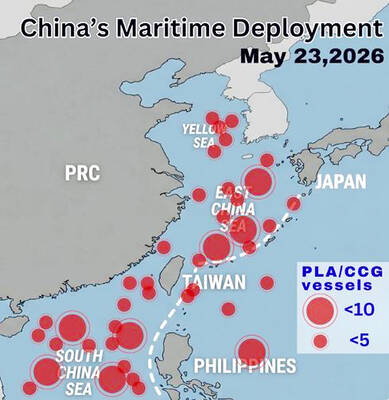
WARNING: China should stop engaging in actions that undermine regional peace and stability, as it would only build resentment among people across the Strait, the CGA said China has deployed more than 100 navy, coast guard and other vessels in waters from the Yellow Sea to the South China Sea and the western Pacific since US President Donald Trump and Chinese President Xi Jinping (習近平) met in Beijing, National Security Council Secretary-General Joseph Wu (吳釗燮) said yesterday. “In this part of the world, #China is the one & only PROBLEM wrecking the #StatusQuo & threatening regional peace & stability,” Wu wrote on X. In a separate post, he said Beijing was coercing Taiwan’s maritime domain, calling it illegal and provocative, after the Coast Guard Administration (CGA) expelled a


 RSS
RSS