


Taiwan is forcing some of its largest companies — including China Steel Corp (中鋼) — to cut emissions in return for permission to expand in the country, where greenhouse-gas output per capita is almost three times the world average.
The biggest polluters must either slash gas discharges, invest in emissions-reduction projects or buy carbon credits in global markets. The government will set up an offshore company to help them get the credits, Stephen Shen (沈世宏), head of the Environmental Protection Administration, said in an interview in Taipei.
The government is negotiating with companies while pushing them to compete with European and Japanese buyers in the US$120 billion global carbon market. The policy is a stopgap until permanent emission limits are set under the Greenhouse Gas Reduction Act (溫室氣體減量法) being debated in the legislature.
“For heavy industries, such as electricity, steel and petrochemical, costs will rise,” said Peter Tzeng (曾耀德), an analyst at Polaris Securities Co in Taipei. “Producers of alternative energy, including wind and solar, will benefit” because they may attract investment to offset emissions by heavy industry.
Reducing companywide emissions by an amount equal to half of what a new plant would produce may become a benchmark in government approval of large industrial projects, Shen said.
That policy may be applied to the NT$280 billion (US$8.7 billion) plan to expand energy and chemical production in Mailiao Township (麥寮) by Formosa Plastics Group (台塑集團), parent of Taiwan’s only publicly traded refiner, he said.
The government’s proposed offshore company, most likely in Japan, will help Taiwanese companies accrue carbon credits certified by the UN in a “cost-effective way,” Shen said, without elaborating.
Taiwan remains outside UN-set carbon controls because it’s not a member of the world organization, but President Ma Ying-jeou (馬英九) has pledged to cut carbon emissions to 2008 levels between 2016 and 2020 and to 2000 levels by 2025.
Local companies, so far not bound by law to offset greenhouse-gas output, already may voluntarily buy credits in non-UN markets such as the Chicago Climate Futures Exchange or sponsor carbon-cutting projects such as wind farms.
Taiwan Power Co (台電) is requesting that the environmental agency retract its Sept. 2 demand that the state-owned company start estimating the amount of carbon credits it needs to buy over the next 15 years, chief engineer Tu Yueh-yuan (杜悅元) said by telephone on Wednesday. The company accounts for about 30 percent of the country’s emissions.
Carbon credits may increase the cost of output by “tens of billions” of New Taiwan dollars, which the utility will have to pass on to customers, Tu said.
“It’s like throwing money overseas,” she said. “How could we do something like that?”
The government could potentially allow companies to acquire as much as half of their carbon credits overseas under the Greenhouse Gas Reduction Act, Shen said.
The legislation, which may become law next year, may impose a cap-and-trade program in Taiwan in five to six years. Voluntary reduction and emissions limits based on energy efficiency will precede that, Shen said.
Dragon Steel Corp, a unit of China Steel Corp, the nation’s largest steel producer, has pledged to cut emissions and may buy carbon credits as it doubles production capacity, Shen said.
The expansion to 5 million tonnes a year may come on stream in 2013, said Chung Le-min, executive vice president of China Steel.
The company has no estimate of additional costs, he said by telephone on Thursday.
The China Steel unit aims to meet the requirement by deploying high-tech emissions-reduction technology, Chung said.
“I’m confident we don’t need to buy carbon credits,” he said.
CPC Corp Taiwan (台灣中油), the state-run oil refinery, will plant trees to help reduce emissions as it expands capacity to produce petrochemicals, said Lin Maw-wen (林茂文), a vice president at the company.
Taiwan, responsible for 1 percent of the world’s carbon output, emitted about 3 percent less last year, Shen said.
Emissions more than doubled from 1990 to 2007. Taiwan Power has erected wind-power turbines since 2002, while Formosa Plastics has planted more than 1 million trees in Mailiao.
Taiwan’s carbon-dioxide emissions reached 13.2 tonnes per capita in 2006, compared with the world average of 4.5 tonnes, Bloomberg data showed.

The nation’s fastest supercomputer, Nano 4 (晶創26), is scheduled to be launched in the third quarter, and would be used to train large language models in finance and national defense sectors, the National Center for High-Performance Computing (NCHC) said. The supercomputer, which would operate at about 86.05 petaflops, is being tested at a new cloud computing center in the Southern Taiwan Science Park in Tainan. The exterior of the server cabinet features chip circuitry patterns overlaid with a map of Taiwan, highlighting the nation’s central position in the semiconductor industry. The center also houses Taiwania 2, Taiwania 3, Forerunner 1 and
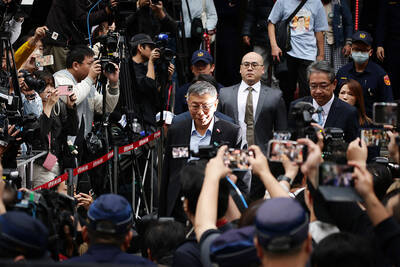
FIRST TRIAL: Ko’s lawyers sought reduced bail and other concessions, as did other defendants, but the bail judge denied their requests, citing the severity of the sentences Former Taipei mayor Ko Wen-je (柯文哲) was yesterday sentenced to 17 years in prison and had his civil rights suspended for six years over corruption, embezzlement and other charges. Taipei prosecutors in December last year asked the Taipei District Court for a combined 28-year, six-month sentence for the four cases against Ko, who founded the Taiwan People’s Party (TPP). The cases were linked to the Core Pacific City (京華城購物中心) redevelopment project and the mismanagement of political donations. Other defendants convicted on separate charges included Chinese Nationalist Party (KMT) Taipei City Councilor Angela Ying (應曉薇), who was handed a 15-year, six-month sentence; Core Pacific
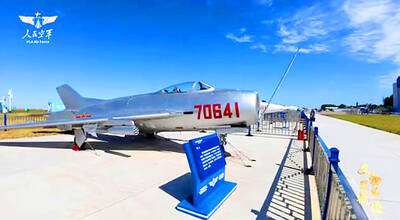
J-6 REMODEL: The converted drones are part of Beijing’s expanding mix of airpower weapons, including bombers with stand-off missiles and UAV swarms, the report said China has stationed obsolete supersonic fighters converted to attack drones at six air bases close to the Taiwan Strait, a report published this month by the Arlington, Virginia-based Mitchell Institute for Aerospace Studies said. Satellite imagery of the airfields from the institute’s “China Airpower Tracker” shows what appear to be lines of stubby, swept-winged aircraft matching the shape of J-6 fighters that first flew with the Chinese People’s Liberation Army (PLA) Air Force in the 1960s. Since their conversion to drones, the aircraft have been identified at five bases in China’s Fujian Province and one in Guangdong Province, the report said. J.

China used fake LinkedIn profiles to harvest sensitive data from NATO and EU institutions by soliciting information from staff, a European security source said on Friday. The operation, allegedly orchestrated by the Chinese Ministry of State Security, targeted dozens of employees at the military alliance or EU organizations through fictitious accounts, the source said, confirming reports in French and Belgian media. Posing as recruiters on the online professional networking platform, Chinese spies would initially request paid reports before later soliciting non-public or even classified information. One particularly active fake profile used the name “Kevin Zhang,” claiming to be the head


 RSS
RSS