


The wide open oilfields of West Texas are ripe pickings for thieves these days.
Some drive up to one of the thousands of pump jacks that dot the countryside and siphon crude out of the storage tanks.
Some pull up to a drill site after the crews have gone for the night and haul away tools, pipes and equipment.

PHOTO: AFP
Others take kickbacks, file false invoices or just plain steal knowing their bosses are too busy riding the oil boom to keep a close eye on accounting.
It’s become so bad that the FBI is launching a joint task force to tackle oilfield theft next month.
And the lawmen who have been through the last boom and bust cycle say it is only going to get worse.
“There’s oilfield theft running rampant,” said Midland County Sheriff Gary Painter. “A lot of it we don’t even know about because with the boom going on and people making so much money there’s not time to go over every invoice.”
Tracking down the stolen property is tough. Few companies take the time to brand their pipes or put microscopic tags into their oil to identify it.
It also sometimes takes months before managers realize something has been stolen.
So far nobody has been foolhardy enough to try to steal from an actual pipeline. It is a lot easier, and safer, to dip into the crude in isolated, above-ground tanks.
But there have been cases of operators who bypassed the quality controls and pumped used motor oil or even water into the pipeline to mask the losses, which causes big problems for the refineries at the end of the line, Painter said.
“Thieves don’t care. All they’re after is the almighty dollar,” he said.
The FBI joint task force will focus on shutting down the fencing operations which deal in critical parts and clamping down on the white collar crime, said Special Agent Matt Espenshade.
“We think a lot of this theft is organizationally driven — it’s groups of 10, 12 people,” Espenshade said.
“The case doesn’t end with the guy who steals one load of pipe,” he said. “We’re going to watch where that person goes when he’s selling the pipe and when we take it down [the network] it’ll be all the people who are involved.”
There were more than 500 reported cases of oilfield theft in Texas from 2005 to last year and the losses came close to US$78 million, Espenshade said.
But the loss to the oil companies often goes far beyond the value of the stolen goods.
Parts are in short supply and if a key piece of equipment is stolen drilling or production can grind to a halt for days or even weeks until a replacement can be found.
“Any little hiccup in the supply and demand process has an impact on people when they get to the pump,” Espenshade said.
And with parts in such short supply, there’s a great deal of temptation to buy from less than reputable dealers, said Al Mitchell, manager of investigations for David H. Arrington Oil and Gas.
“This thing is running so wide open, they’re making so much money, the [hired] hand situation is so critical,” Mitchell said. “They’ve got all they can say grace over just keeping the operations together.”
A former Texas Ranger who got into private oilfield security in 1978, Mitchell thinks the bulk of the thefts have not yet been reported because — just like last time around — managers do not want to admit they have lost control.
And a lot of companies, though not Mitchell’s, would rather just fire a thief than go through the trouble of prosecution.
“Maybe we’re getting 20 percent of the crime reported. It might be closer to 10,” he said in an interview in his Midland, Texas office. “There’s coming a time when the young management people are not going to be able to not report these crimes. The floodgates are about to open again.”
Back in the boom of the late 1970s and early 1980s equipment theft got so bad that night watchmen had to be posted at drilling sites — and that may have to happen again, Mitchell said.
But with more than 150,000 oil wells scattered across Texas, it’s just not possible to protect every pump jack. And theft is a problem that won’t go away when the boom goes bust.
“Way back when I first became a Ranger, crude oil was three dollars a barrel and we had crude theft,” Mitchell said. “It’s almost impossible to catch every thief that steals a piece of pig iron. What we can do is try to lessen the impact.”
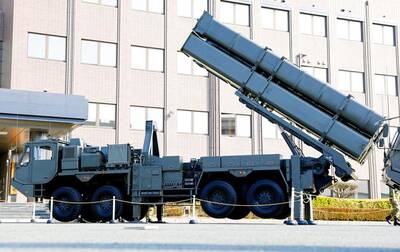
Japan has deployed long-range missiles in a southwestern region near China, the Japanese defense minister said yesterday, at a time when ties with Beijing are at their lowest in recent years. The missiles were installed in Kumamoto in the southern region of Kyushu, as Japan is attempting to shore up its military capacity as China steps up naval activity in the East China Sea. “Standoff defense capabilities enable us to counter the threat of enemy forces attempting to invade our country ... while ensuring the safety of our personnel,” Japanese Minister of Defense Shinjiro Koizumi said. “This is an extremely important initiative for

The nation’s fastest supercomputer, Nano 4 (晶創26), is scheduled to be launched in the third quarter, and would be used to train large language models in finance and national defense sectors, the National Center for High-Performance Computing (NCHC) said. The supercomputer, which would operate at about 86.05 petaflops, is being tested at a new cloud computing center in the Southern Taiwan Science Park in Tainan. The exterior of the server cabinet features chip circuitry patterns overlaid with a map of Taiwan, highlighting the nation’s central position in the semiconductor industry. The center also houses Taiwania 2, Taiwania 3, Forerunner 1 and

MORE POPULAR: Taiwan Pass sales increased by 59 percent during the first quarter compared with the same period last year, the Tourism Administration said The Tourism Administration yesterday said that it has streamlined the Taiwan Pass, with two versions available for purchase beginning today. The tourism agency has made the pass available to international tourists since 2024, allowing them to access the high-speed rail, Taiwan Railway Corp services, four MRT systems and four Taiwan Tourist Shuttles. Previously, five types of Taiwan Pass were available, but some tourists have said that the offerings were too complicated. The agency said only two types of Taiwan Pass would be available, starting from a three-day pass with the high-speed rail and a three-day pass with Taiwan Railway Corp. The former costs NT$2,800

FIRST TRIAL: Ko’s lawyers sought reduced bail and other concessions, as did other defendants, but the bail judge denied their requests, citing the severity of the sentences Former Taipei mayor Ko Wen-je (柯文哲) was yesterday sentenced to 17 years in prison and had his civil rights suspended for six years over corruption, embezzlement and other charges. Taipei prosecutors in December last year asked the Taipei District Court for a combined 28-year, six-month sentence for the four cases against Ko, who founded the Taiwan People’s Party (TPP). The cases were linked to the Core Pacific City (京華城購物中心) redevelopment project and the mismanagement of political donations. Other defendants convicted on separate charges included Chinese Nationalist Party (KMT) Taipei City Councilor Angela Ying (應曉薇), who was handed a 15-year, six-month sentence; Core Pacific


 RSS
RSS