


Quintessentially cute, and incredibly lucrative, Hello Kitty is turning 30, and what better place to celebrate than atop Venus de Milo.
The playful character with the yellow nose and ribbon in her hair, as seen through the eyes of about 60 artists, is celebrating on the road in traveling exhibitions taking her into new territory -- to the excitement of fans.
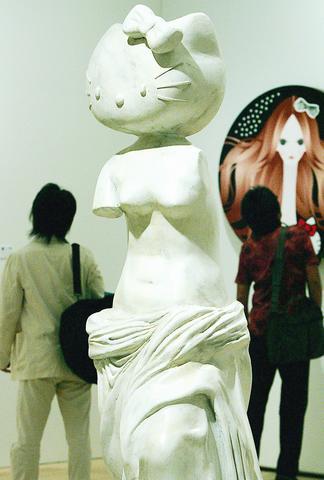
PHOTO: AP
"We asked the artists to create their own version of Kitty because we wanted to create a new dimension," said Yo Kato of Digital Hollywood Entertainment, which planned the shows that opened July 31 at Tokyo's Mori Art Museum and the Laforet Museum.
US fashion designer Jeremy Scott created "Hello De Milo," a replica of "Venus de Milo" with Kitty's noggin in place of its own. In another piece, Japanese artist Nagi Noda made a stuffed doll with half its body as Hello Kitty and half a panda.
Created in 1974 by Yuko Shimizu, a Sanrio Co designer, Hello Kitty started out adorning purses and exploded into an alternative universe of commercial goods that are popular among young people around the world.
There aren't many consumer segments where the Kitty doesn't pop up. She adorns clothing, housewares, cosmetics, jewelry, toys, paper goods and electronics from waffle irons to computers.
Hello Kitty had her first hit as a coin purse and more products followed. A turning point came in 1987, when a high school girl sent Sanrio a letter bemoaning the dearth of Kitty products for teens.
Trying to tap into an older market, Sanrio launched a line of products in more somber black and white, then in the 1990s came out with cell phone carrying cases and other products that set off the broad-based "Kitty Boom."
Mariah Carey and Britney Spears, among other stars, are on record as Kitty admirers, and Sanrio has allowed cities to put the character's face on cookie packages, stationery and cell phone straps with local logos.
Sanrio says the strength of the Kitty cult is unusual.
"Characters' popularity usually begin to ebb after five years. We have been trying to do new things with Kitty every five years," said Kyoko Obata, a company spokeswoman.
The art exhibits are now traveling Japan, and Kitty remains big money. The character generated about half of Sanrio's total ¥104 billion (US$9.5 billion) in sales in the fiscal year 2003, which ended March 2004. Every year, there are about 50,000 kinds of Hello Kitty goods sold in about 60 countries, including licensed merchandise.
Hello Kitty birthday events and special edition goods abound this year. On Nov. 1, her official birthday, celebrations are planned at Sanrio's theme park in Tokyo.
Fifty sets of gold coins priced at ¥500,000 (US$4,500) have been sold out, and Sanrio is taking orders for a ¥1 million Hello Kitty platinum and diamond tiara.
The cat is also serving as Special Friend of Children for the US Fund for UNICEF, to help get more girls in school in developing countries this year.
Typical among Hello Kitty's fans is Airi Isobe, 16-year-old high school student who has collected 400 Hello Kitty cellphone straps with her mother. Despite the wide range of products on display at the Mori Museum in Tokyo, Isobe said she's a bit of a traditionalist.
"I like the regular Kitty best," she said.

A signaling system malfunction disrupted high-speed rail (HSR) services beginning at 8am today, with trains temporarily reduced to three northbound and three southbound trains per hour as authorities conduct inspections. The malfunction occurred on a section of track in Miaoli County during pre-operation checks early this morning, forcing northbound and southbound trains to use a single track, the HSR operator said. The regular schedule has been replaced with three hourly trains offering only nonreserved seating in each direction, stopping at every station, it said, adding that business class cars would still have reserved seating. Departures from terminal stations are scheduled at the top

DRONE CENTRAL: Taiwan aims to become Asia’s democratic hub for drones, with most exports focused on high-quality military-grade models, an official said Taiwan’s drone industry is expected to expand significantly by 2030, producing 100,000 units per month and exporting half of them, the Ministry of Economic Affairs said yesterday. Current drone production capacity is about 15,000 units per month, but the industry can quickly scale up as demand increases, Industrial Development Administration Director-General Chiou Chyou-huey (邱求慧) told a news conference in Taipei. Taiwan’s drone output grew 2.5-fold last year to NT$12.9 billion (US$408.3 million) under a government program to develop the uncrewed vehicle sector, he said. The Executive Yuan in October last year approved plans to invest NT$44.2 billion into domestic production of uncrewed aerial

VERBOSE VESSELS: A CGA cutter and a China Coast Guard exchanged verbal barbs for more than a day in Taiwanese-controlled waters before the Chinese vessel left The Taiwanese and Chinese coast guards had a standoff near the strategically located Pratas Islands (Dongsha Islands, 東沙群島) in the north of the South China Sea, the Coast Guard Administration (CGA) said yesterday. The two sides engaged in intense radio exchanges over sovereignty claims during the 33-hour standoff. China Coast Guard vessel 3501 eventually left the restricted waters, 26.6 nautical miles (49.2km) west of the Pratas Islands, at 5pm yesterday, the CGA said. Lying approximately between southern Taiwan and Hong Kong, the Taiwan-controlled Pratas are seen by some security experts as vulnerable to Chinese attack due to their distance — more than
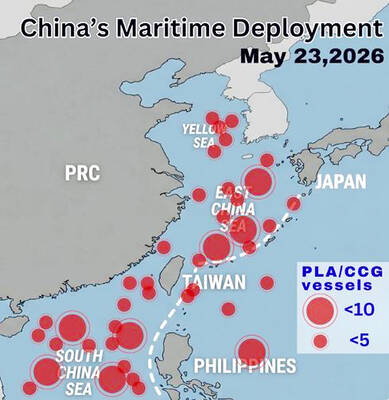
WARNING: China should stop engaging in actions that undermine regional peace and stability, as it would only build resentment among people across the Strait, the CGA said China has deployed more than 100 navy, coast guard and other vessels in waters from the Yellow Sea to the South China Sea and the western Pacific since US President Donald Trump and Chinese President Xi Jinping (習近平) met in Beijing, National Security Council Secretary-General Joseph Wu (吳釗燮) said yesterday. “In this part of the world, #China is the one & only PROBLEM wrecking the #StatusQuo & threatening regional peace & stability,” Wu wrote on X. In a separate post, he said Beijing was coercing Taiwan’s maritime domain, calling it illegal and provocative, after the Coast Guard Administration (CGA) expelled a


 RSS
RSS