


A self-balancing scooter billed as heralding a revolution in the way people travel could run into an obstacle in Japan, where a robotics professor wants recognition for inventing a nearly identical machine 15 years ago.
The claim comes a little more than a month after US inventor Dean Kamen unveiled the "Segway Human Transporter" and Segway LLC, the company founded to make and sell it, ending a year of speculation and secrecy over the invention that kept the high-tech world in thrall.
"I'm not saying that they took the idea but I want people to know that it existed before the Segway was developed," Kazuo Yamafuji, Professor Emiritus at Tokyo's University of Electro-Communications, told Reuters.
"I made this machine 15 years ago."
More importantly, Yamafuji applied for a patent for his machine in 1987, which was granted in 1996.
Legal experts say that while it may be difficult for Yamafuji or anyone else to challenge Dean Kamen's US patent, the award-winning US inventor could run into trouble if Segway decides to sell the scooter in Japan.
With its densely packed cities and enthusiasm for high-tech gadgets, Japan could be an ideal market for Segway's machine.
Transforming urban landscapes
The motorized scooter, which went under the code names "Ginger" or "It" before it was revealed to the public, is a device that Kamen believes has the potential to transform urban landscapes, allowing people to zip over short distances instead of driving their cars.
Users stand on a small platform between two wheels and hold on to a handle similar to that on a bicycle. Leaning forward moves the scooter forward, leaning back reverses course and turns are made by twisting the handle.
While Professor Yamafuji admits he never took his invention beyond the research phase and into commercial development, he insists that the basic ideas incorporated in the Segway scooter are the same: a computer processor to detect minute shifts in balance to keep the machine upright on two parallel wheels.
"I call it a `parallel bicycle,'" said Yamafuji, a robotics scientist for more than 30 years and now in semi-retirement.
"The Segway is essentially a motorized parallel bicycle, with wheels side by side instead of front to back. If they claim that they did it first, it wouldn't be fair to me or my university. We did the research."
But when asked if he was considering legal action, Yamafuji said: "I will not fight this."
Obstacle course
A 45-cm high parallel bicycle made by Yamafuji and his research team 15 years ago has the same two-wheel arrangement as the Segway scooter, but is too small for a rider and lacks a platform.
The upper section is a hollow rectangular box set at an slightly tilted angle to hold motors, processors and a pendulum that helps maintain balance.
A small rod attached to one of the wheels rests against the ground to sense the tilt of the machine, a contrast to the Segway, which uses gyroscopes to mimic the human ear's sense of balance.
The similarities may be enough, said Joseph A. Calvaruso, a litigation partner at intellectual property law firm Morgan & Finnegan LLP in New York, to make it difficult for Segway to sell the machine in Japan.
"Kamen could have a problem in Japan if the Japanese patent challenges any one of the claims on his patent," Calvaruso said.
Segway said it is still is still evaluating plans for specific countries and has no details on strategy outside of the US, according to Senior Vice President Gary Bridge.
Within the United States, Calvaruso said it would be very difficult -- but not impossible -- for Yamafuji or anyone else to invalidate Kamen's US patent.
That's because Kamen's 1999 patent has a reference to Yamafuji's Japan patent application -- meaning Kamen's machine was nonetheless deemed worthy of a patent by the United States Patent and Trademark Office.
"We're aware of Professor Yamafuji's work," Bridge said, but added that "it is important to note that the technology underlying the Segway Human Transporter is a significant advance over prior technologies."
In a further twist, Yamafuji was granted a second patent in 1998 for a four-wheeled version of his machine which expands on his original invention.
Cat twist
The later version has a counterweight that would allow users use a switch to move forwards and backwards without having to lean.
"With this version a person can stand on the unit and push a button to move," Yamafuji said.
Another prototype climbs stairs.
The ideal form for the machine's wheels, Yamafuji says, is to have a sphere with built-in mechanics that can go in any direction from a standing start.
While none of his prototypes were built with space for a human operator, Yamafuji said that his former students went on to develop usable versions for research at the corporate level.
A working human-operated scooter was built by one of Yamafuji's students for Sony Corp, which has already made a name for itself in home robotics with the AIBO "pet" robot, while another built a scooter on a sphere that balanced itself like a unicycle for Honda Motor Co Ltd.
Yamafuji has created other machines, including a robot that replicates the quick twist that helps falling cats land on their feet.
"The US Air Force was interested in our cat-twist robot," he said.
Yamafuji admitted that he was eager to meet Kamen and share ideas. "It is a matter of pride for me, not money."
"I would hand over my patent for one dollar if Mr. Kamen admitted that we were first."
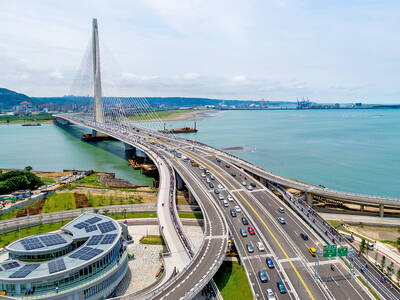
The Ministry of Transportation and Communications yesterday inaugurated the Danjiang Bridge across the Tamsui River in New Taipei City, saying that the structure would be an architectural icon and traffic artery for Taiwan. Feted as a major engineering achievement, the Danjiang Bridge is 920m long, 211m tall at the top of its pylon, and is the longest single-pylon asymmetric cable-stayed bridge in the world, the government’s Web site for the structure said. It was designed by late Iraqi-British architect Zaha Hadid. The structure, with a maximum deck of 70m, accommodates road and light rail traffic, and affords a 200m navigation channel for boats,

Taiwan Semiconductor Manufacturing Co (TSMC, 台積電), the world’s largest foundry service provider, yesterday said that global semiconductor revenue is projected to hit US$1.5 trillion in 2030, after the figure exceeds US$1 trillion this year, as artificial intelligence (AI) demand boosts consumption of token and compute power. “We are still at the beginning of the AI revolution, but we already see a significant impact across the whole semiconductor ecosystem,” TSMC deputy cochief operating officer Kevin Zhang (張曉強) said at the company’s annual technology symposium in Hsinchu City. “It is fair to say that in the past decade, smartphones and other mobile devices were
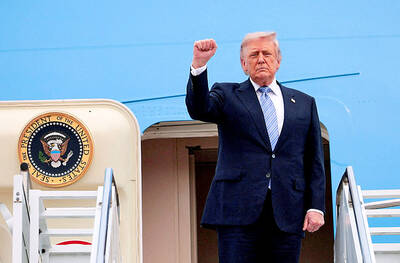
US-CHINA SUMMIT: MOFA welcomed US reassurance of no change in its Taiwan policy; Trump said he did not comment when Xi talked of opposing independence US President Donald Trump yesterday said he has not made a decision on whether to move forward with a major arms package for Taiwan after hearing concerns about it from Chinese President Xi Jinping (習近平). Trump’s comments on Taiwan came as he flew back to Washington after wrapping up critical talks in which both leaders said important progress was made in stabilizing US-China relations even as deep differences persist between the world’s two biggest powers on Iran and Taiwan. “I will make a determination,” Trump said, adding: “I’ll be making decisions. But, you know, I think the last thing we need right

TAIWAN ISSUE: US treasury secretary Scott Bessent said on the first day of meetings that ‘it wouldn’t be a US-China summit without the Taiwan issue coming up’ There were no surprises on the first day of the summit between US President Donald Trump and Chinese President Xi Jinping (習近平), the Mainland Affairs Council (MAC) said yesterday, as the government reiterated that cross-strait stability is crucial to the Asia-Pacific region, as well as the world. As the two presidents met for a highly anticipated summit yesterday, Chinese state media reported that Xi warned Trump that missteps regarding Taiwan could push their two countries into “conflict.” Trump arrived in China with accolades for his host, calling Xi a “great leader” and “friend,” and extending an invitation to visit the White House


 RSS
RSS