


While Indonesia's tourism and export sectors have suffered from the nationwide anti-US protests sweeping the country this month, at least one industry is experiencing a mini-boom, office and home security providers, industry sources said.
"If an investor wants to look into a security company right now, I'd say he wouldn't lose his money," said Glen Gardiner, a systems consultant at Sentinel Security Group.
In fact, security services have been a growth industry for the past three to four years, as Indonesia experienced first a financial crisis in late 1997 followed by the deep recession of 1998, leading to the fall of former president Suharto the same year after 33 years of authoritarian, if somewhat secure, rule.
With Suharto's fall there was a wave of rising political insecurity and violence, including attacks on Indonesian-Chinese communities, religious strife between Christian and Muslim communities and secessionist struggles in Aceh and elsewhere. The rising political and social unrest has already taken its toll on the resident foreign business community.
Then came the Sept. 11 terrorist attacks on the World Trade Center in New York and the Pentagon building in Washington, far away from Indonesia but close enough to spark dangerous repercussions for US civilians in the world's most populous Muslim country -- at lease 180 million of Indonesia's 220 million people are followers of Islam.
While the Indonesian government was quick to extend its condolences to the US victims of the terrorist attacks, a few militant Muslim groups were just as quick to warn the US of a serious backlash should it attack Afghanistan.
One particularly vocal group -- the Front of Islamic Defense (FPI), promised to carry out "sweeps" against US residents in Indonesia, and even sent gangs to search hotels in Solo, central Java, for US tourists. None were found.
Not surprisingly, the US and British embassies in Jakarta have issued travel warnings to their nationals since last month. The warnings seemed prudent after Oct.r 7, the launch day for US and British air and missile strikes on Afghanistan, which sparked off a wave of nationwide anti-US protests in Indonesia and more threats of "sweeps" against foreign residents. The US embassy had sent home its non-essential staff in the country the previous week. Some large US multinationals, such as Mattel and Nike, have also removed their expatriate staff. It's all been good news for local suppliers of security services.
"We've seen a growth in the number of companies dusting off their evacuation plans, and calling us up for consultancy input," said Gardiner. With the threat of "sweeps," nearly all Jakarta-based securities services have reported a significant increase in business.
"There has been an increase in demand for guards, mainly from expatriates but also from office buildings and housing estates," said Larus, a marketing manager for the Jaga Griya Jaguards Company.
Nearly all well-to-do households in Jakarta, a city already somewhat notorious for its high crime rate, employ a "jaga," or "night watchman," but extreme times call for extreme measures.
"People want to make sure they are paying for a guard who stays awake at night," said Gardiner, whose company claims to draw their guards "from the finest mold of clay."
And the finer clay, obviously, costs more money than your normal household "jaga" who gets paid an average of 50,000 rupiah (US$50) a month.
While it's all good news for Indonesia's security firms, the rising wave of expatriate jitters, has certainly not been good for the economy as a whole.
An estimated 1.3 million foreign tourists have cancelled planned trips to Indonesia in the wake of nationwide anti-US protests this month, losing the country about US$1.1 billion in unrealized income, and exports orders to the US market for Indonesian textiles and other products have dropped off this month.
Heightened security concerns, also adversely affect local investments and consumption, said James Castle, who heads the consultancy firm Castle Group and is the current chairman of the US Chamber of Commerce.
"Companies and individuals spend more money making their houses and places of work safe and less money on improving their business and consuming products that can be the lifeblood of local demand," Castle wrote in a recent article published in Business Times newspaper of Singapore.

SILENCING CRITICS: In addition to blocking Taiwan, China aimed to prevent rights activists from speaking out against authoritarian states, a Cabinet department said The Ministry of Foreign Affairs (MOFA) yesterday condemned transnational repression by Beijing after RightsCon, a major digital human rights conference scheduled to be held in Zambia this week, was abruptly canceled due to Chinese pressure over Taiwanese participation. This year’s RightsCon, the world’s largest conference discussing issues “at the intersection of human rights and technology,” was scheduled to take place from tomorrow to Friday in Lusaka, and expected to draw 2,600 in-person attendees from 150 countries, along with 1,100 online participants. However, organizers were forced to cancel the event due to behind-the-scenes pressure from China, the ministry said, expressing its “strongest condemnation”
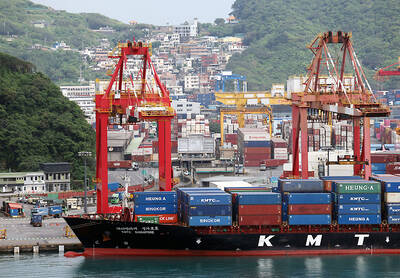
Taiwan’s economy grew far faster than expected in the first quarter, as booming demand for artificial intelligence (AI) applications drove a surge in exports, spilling over into investment and consumption, the Directorate-General of Budget, Accounting and Statistics (DGBAS) said yesterday. GDP growth was 13.69 percent year-on-year during the January-to-March period, beating the DGBAS’ February forecast by 2.23 percentage points and marking the most robust growth in nearly four decades, DGBAS senior official Chiang Hsin-yi (江心怡) told a news conference in Taipei. The result was powered by exports, which remain the backbone of Taiwan’s economy, Chiang said. Outbound shipments jumped 51.12 percent year-on-year to
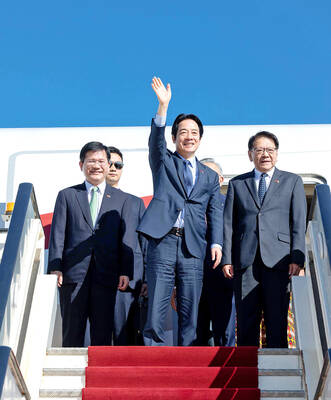
DELAYED BUT DETERMINED: The president’s visit highlights Taiwan’s right to international engagement amid regional pressure from China President Willaim Lai (賴清德) yesterday arrived in Eswatini, more than a week after his planned visit to Taiwan’s sole African ally was suspended because of revoked overflight permits. “The visit, originally scheduled for April 22, was postponed due to unforeseen external factors,” Lai wrote on social media. “After several days of careful arrangements by our diplomatic and national security teams, we successfully arrived today.” Lai said he looked forward to further deepening Taiwan-Eswatini relations through closer cooperation in the economy, agriculture, culture and education, as well as advancing the nation’s international partnerships. The president was initially scheduled to arrive in time to celebrate
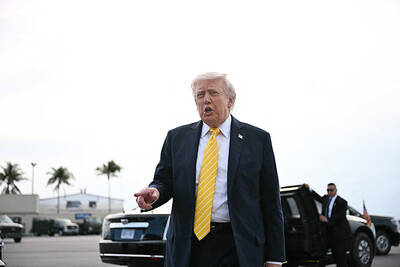
Iran’s Islamic Revolutionary Guard Corp (IRGC) yesterday said the US faced a choice between an “impossible” military operation or a “bad deal” with Tehran, after US President Donald Trump disparaged Iran’s latest peace proposal. Negotiations between the two countries have been deadlocked since a ceasefire came into effect on April 8, with only one round of direct peace talks held so far. Iran’s Tasnim and Fars news agencies reported that Tehran had submitted a 14-point proposal to mediator Pakistan, but Trump was quick to cast doubt on it. “I will soon be reviewing the plan that Iran has just sent to us, but


 RSS
RSS