


With a burst of flame, followed by a thunderclap boom that broke the serenity of the training area in the foothills of Japan’s Mount Fuji, the first rocket fired by the US Marines from their mobile launcher screamed toward its target, the orange burn of its engine painting a streak across the blue sky.
Another five rockets followed in rapid succession, before a second High Mobility Artillery Rocket System (HIMARS) truck drove out of concealment in a copse of evergreens, fired its salvo of six rockets, then retreated back to cover.
The live-fire exercise this week at the US military’s Camp Fuji maneuver area lasted only a few minutes, but was a significant demonstration to Pacific allies of US capabilities as Washington seeks to deter possible Chinese aggression against Taiwan.
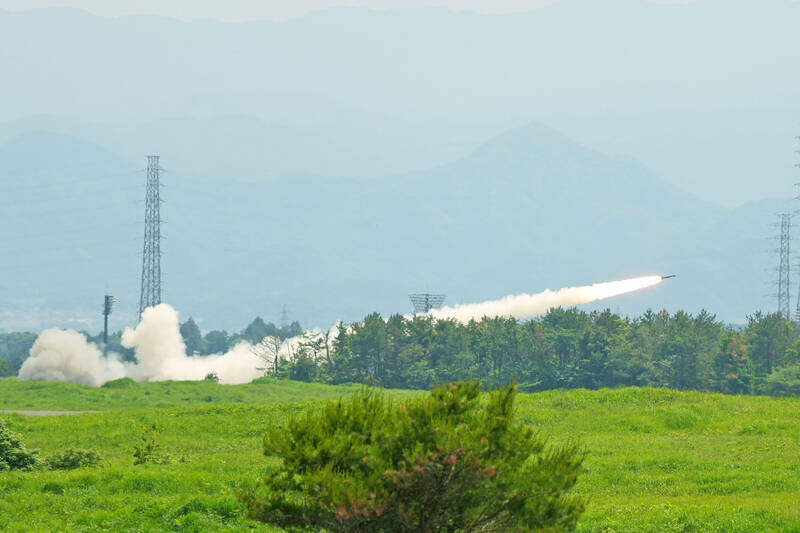
Photo: AP
STRENGTH TO DETER
It was also a demonstration of how the US is shifting tactics in the Pacific, as China’s People’s Liberation Army rapidly modernizes.
“The US does not want China to invade Taiwan, but it would not be relying on the traditional aircraft carrier-based attack wings of the past,” said Euan Graham, senior defense analyst with the Australian Strategic Policy Institute.
“In Iran, with the US conflict there, there were over 40 US aircraft, manned and unmanned, either destroyed or damaged against a much less capable adversary, so in the case of conflict with China that vulnerability would be much greater,” he said. “That’s why we’re seeing the US emphasizing ... these smaller units.”
According to the Pentagon’s latest annual report to Congress, the goal is to “deny the ability of any country in the Indo-Pacific to dominate us or our allies.” It said the priority was on bolstering deterrence “through strength, not confrontation.”
MOBILITY IS LIFE
HIMARS is a truck-mounted pod of rockets that can be hidden from drone or satellite surveillance, driven out to fire its GPS-guided missiles, then quickly back to a new hidden position using what the military commonly calls “shoot-and-scoot” tactics.
“It depends on the crew, but it can get as fast as four minutes, (even) two minutes sometimes,” said Sgt. Kevin Alvarez, section chief of one of the two Fox Battery, 3rd Battalion, 12th Marines, 3rd Marine Division HIMARS launchers involved in the Camp Fuji exercise.
Introduced about 20 years ago, the HIMARS was used in Iraq and Afghanistan, but was largely unknown to the general public until Ukraine used it with great success in its fight against Russia.
Those conflicts, especially with the use of drones on the battlefield that can quickly identify dug-in artillery positions, have underscored the value of mobility, said Lieutenant Colonel Ryan Anness, commander of the 3rd Battalion.
“They’re much quicker, much faster and much easier to hide than, say, traditional cannon artillery, and obviously having the precision fire weapons and having the ability to hide easier is why so many countries, and why it’s important for us, to have the HIMARS,” he said.
LONG-RANGE GUNNERY
The HIMARS can fire a variety of ordnance. Initially, only shorter-range munitions were provided to Ukraine, until the US decided to allow Kyiv to have the Army Tactical Missile System (ATACMS), which can hit targets at about 300km away.
In the first days of the war against Iran after the US and Israel attacked on Feb. 28, the HIMARS was used to fire ATACMS and, for the first time in combat, the even longer-range Precision Strike Missiles (PrSM), sinking “multiple” Iranian surface ships and a submarine in port, Air Force General Dan Caine, chairman of the Joint Chiefs of Staff, has said.
The PrSM can reach targets at ranges greater than 500km, according to manufacturer Lockheed Martin.
Together with the Army’s Typhon — another truck-based launcher that shoots longer-range Tomahawk cruise missiles and other munitions, but is less maneuverable than the HIMARS — the two systems could easily cover the Taiwan Strait, and the strategically important Luzon Strait, between the Philippines and Taiwan, if deployed on Taiwan and the Philippine and Japanese islands nearby, Graham said.
Both sea lanes would be critical to any sort of Chinese invasion or blockade plan.
“In advance of a conflict around Taiwan, there would likely be a large-scale outflux of US assets within the envelope of China’s missile capabilities,” Graham said. “All that would be left is submarines, which are more survivable, and small units based on rugged survivability — mobile systems like the HIMARS.”
PARTNERSHIP
The maneuvers carried out at Camp Fuji used dummy rockets — concrete-filled tubes with no explosives — and were carried out under strict safety guidelines and observed by Japanese military officials, who shut down a local road during the exercise just in case one of the projectiles fell short.
Although safety rules meant running the live-fire exercise slower than the HIMARS would be used in combat, Anness stressed the value of it both for his Marines and for ties with US allies.
“Being able to have long-range precision-fire weapons provides deterrence here in the Pacific and we train with our Japanese partners as much as we can to make sure we’re ready,” he said.
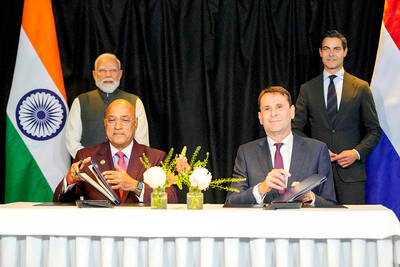
NEW MARKET: The partnership opens up India to the Dutch company, which already has a strong hold in the semiconductor market of South Korea, Taiwan and China ASML Holding NV entered into a partnership agreement with Tata Electronics Pvt Ltd aimed at ramping up India’s goal to develop domestic chip-manufacturing capabilities. The Dutch company’s technology would help power Tata Electronics’ planned 300 millimeter (mm) semiconductor foundry in Gujarat, according to a joint statement from the two companies on Saturday. The signing of a memorandum of understanding coincides with a visit by Indian Prime Minister Narendra Modi to the Netherlands, which is looking to deepen bilateral relations with New Delhi. ASML, whose top customers include Taiwan Semiconductor Manufacturing Co (台積電) and Samsung Electronics Co, makes lithography machines that can print
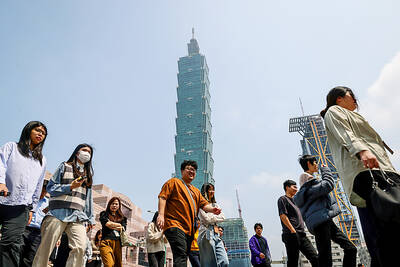
TECH RELIANCE: Growth is increasingly reflecting an unequal K-shaped distribution, where technology sectors outperform and other industries struggle, an expert said Standard Chartered Bank has significantly raised its forecast for Taiwan’s economic growth to 9.5 percent this year, up from 7.6 percent previously, citing surging artificial intelligence (AI) demand driving exports, semiconductor production and investment. The upgrade reflects a sustained AI supercycle that continues to fuel demand for advanced chips and technology infrastructure, which form the backbone of Taiwan’s exports, the bank said in a report this week. “We raise our 2026 growth forecast to reflect a much stronger-than-expected first-quarter GDP figure,” Standard Chartered senior economist for greater China and Asia Tommy Wu (胡東安) said in the report. Driven largely by a 35.3 percent
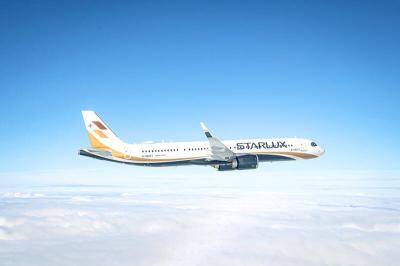
Two of Taiwan’s international carriers, Starlux Airlines Co (星宇航空) and EVA Airways Corp (長榮航空), have retained the five-star airline rating awarded by international airline review organization Skytrax. Starlux was awarded the distinction for a second consecutive year, while EVA Air received it for the 11th straight year, Skytrax said in statements released yesterday and on Thursday last week, respectively. The five-star rating is considered one of the airline industry's highest honors and is awarded following professional audits of airline product and frontline service standards, Skytrax said. The ratings are based on in-depth assessments using unified global quality standards rather than customer review scores
Tokyo Electron's Taiwan unit today said in a written response that it respects the judicial process, takes the court ruling seriously and would not appeal in the Taiwan Semiconductor Manufacturing Co (TSMC, 台積電) trade secrets case. Last month, a court fined the Taiwan unit of Japan's Tokyo Electron NT$150 million (US$4.74 million) in a case involving trade secrets related to TSMC's sensitive chip technology.


 RSS
RSS