


Samsung Electronics Co and its largest labor union are to resume negotiations on Monday to avert a strike that the nation’s prime minister warned could wreak havoc on the economy.
Management and the union representatives at the world’s biggest memory chipmaker are to meet for the talks on wages and compensation, with Samsung having reported operating profit that soared on artificial intelligence (AI)-driven demand for its semiconductors.
“Along with the entire public, we earnestly request Samsung’s management and union to achieve results during the mediation tomorrow, which is virtually the last chance,” South Korean Prime Minister Kim Min-seok said in an address to the nation on Sunday. “If the strike becomes a reality, the economic damage that we have to face would be unimaginable,” he added.
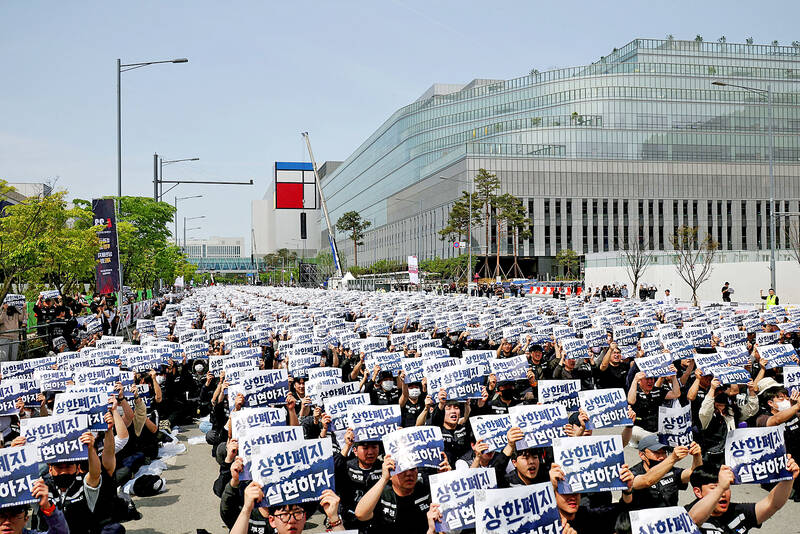
Photo: Reuters
The negotiations, in which the head of the government’s labor relations commission would take part, come three days ahead of the union’s May 21 deadline for an agreement, before it stages an 18-day walkout.
Kim estimated the labor action would cost up to 1 trillion won (US$668 million) for every day the Samsung chip factory is shut.
“What is more concerning is that a temporary pause on semiconductor manufacturing lines leads to months of inactivity,” he said, adding that there were worries about economic damage ballooning to as much as 100 trillion won if materials had to be disposed of due to a strike.
The prime minister signaled for the first time that the government could resort to emergency powers to prevent a strike if the parties fail to reach an agreement, while the National Labor Relations Commission conducts mediation and arbitration.
Kim said the government would pursue “all measures including emergency powers” in order to protect the national economy if the labor action threatened the economy.
Samsung accounts for 22.8 percent of South Korea’s exports and 26 percent of the domestic stock market, employing more than 120,000 people and working with 1,700 suppliers, he said.
Samsung Electronics chair Jay Y. Lee issued a rare apology at the weekend for the company’s “internal issues” causing concern.
“Now is the time to wisely gather our strengths and move in one direction,” Lee said on Saturday at Seoul’s Gimpo International Airport as he returned from an overseas trip, according a Yonhap News report. “Union members, Samsung family members, we are one body, one family,” he added.
Government-mediated talks broke down earlier this month, with management and the union unable to bridge a gap between the workers’ demands and executives’ offers.
The workers’ group is calling on Samsung to expand performance-based compensation as earnings rebound on AI infrastructure demand. Labor leaders want Samsung to scrap an existing cap on bonuses, allocate 15 percent of operating profit to worker bonuses, and to formalize the terms in employment contracts.
Samsung proposed allocating 10 percent of operating profit to bonuses, along with a one-time special compensation package that exceeds industry standards. Company executives have argued that the union’s demands would be difficult to sustain over the long term.
Additional reporting by Reuters
Shares of contract chipmaker Taiwan Semiconductor Manufacturing Co (TSMC, 台積電) came under pressure yesterday after a report that Apple Inc is looking to shift some orders from the Taiwanese company to Intel Corp. TSMC shares fell NT$55, or 2.4 percent, to close at NT$2,235 on the local main board, Taiwan Stock Exchange data showed. Despite the losses, TSMC is expected to continue to benefit from sound fundamentals, as it maintains a lead over its peers in high-end process development, analysts said. “The selling was a knee-jerk reaction to an Intel-Apple report over the weekend,” Mega International Investment Services Corp (兆豐國際投顧) analyst Alex Huang
TRANSITION: With the closure, the company would reorganize its Taiwanese unit to a sales and service-focused model, Bridgestone said Bridgestone Corp yesterday announced it would cease manufacturing operations at its tire plant in Hsinchu County’s Hukou Township (湖口), affecting more than 500 workers. Bridgestone Taiwan Co (台灣普利司通) said in a statement that the decision was based on the Tokyo-based tire maker’s adjustments to its global operational strategy and long-term market development considerations. The Taiwanese unit would be reorganized as part of the closure, effective yesterday, and all related production activities would be concluded, the statement said. Under the plan, Bridgestone would continue to deepen its presence in the Taiwanese market, while transitioning to a sales and service-focused business model, it added. The Hsinchu
Taiwan Semiconductor Manufacturing Co (TSMC, 台積電) has approved a capital budget of US$31.28 billion for production expansion to meet long-term development needs during the artificial intelligence (AI) boom. The company’s board meeting yesterday approved the capital appropriation plan for purposes such as the installation of advanced technology capacity and fab construction, the world’s largest contract chipmaker said in a statement. At an earnings conference last month, TSMC forecast that its capital expenditure for this year would be at the higher end of the US$52 billion to US$56 billion range it forecast in January in response to robust demand for 5G, AI and
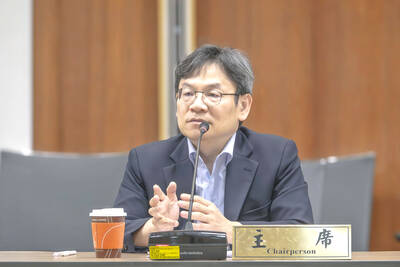
Taiwan Semiconductor Manufacturing Co’s (TSMC, 台積電) investment project in Arizona has progressed better than expected, but it still faces challenges such as water and labor shortages, National Development Council (NDC) Minister Yeh Chun-hsien (葉俊顯) said yesterday. Speaking with reporters after visiting TSMC’s Arizona hub and attending the SelectUSA Investment Summit in Maryland last week, Yeh said TSMC’s Arizona site turned a profit of NT$16.14 billion (US$514 million) last year in its first full year of mass production. “TSMC told me it was surprised by the smooth trial run of the first fab, which has left the company optimistic about the project’s outlook,”


 RSS
RSS