


While the central bank has kept interest rates unchanged, minutes of the meeting last month reveal that policymakers are increasingly alert to the risk that external shocks could destabilize inflationary expectations even as current price pressures remain contained.
All board members agreed to maintain the benchmark rate, citing stable domestic inflation and resilient economic growth. However, the tone of the discussion pointed to a more forward-looking concern — not where inflation is now, but where people think it is headed.
The minutes highlighted close attention to oil prices, foreign exchange movements and the psychological transmission of inflation.

Photo: CNA
While geopolitical tensions in the Middle East have lifted global crude prices, policymakers said that Taiwan’s inflation remains under control, supported in part by government measures to stabilize energy costs and cushion imported price pressures.
That backdrop justifies keeping monetary policy on hold for now, they said.
However, several members said that inflation dynamics are increasingly driven by expectations rather than immediate price changes.
Even if headline consumer price growth continues to moderate, they said that persistent perceptions of rising prices could encourage firms to raise prices more aggressively, particularly in areas where costs are difficult to reverse once adjusted.
The central bank reiterated that oil shocks typically unfold in two stages: an initial supply-driven phase that does not require policy action and a second phase in which inflationary expectations become unanchored and might prompt monetary tightening.
Officials said Taiwan is currently in the first phase, helped by energy price stabilization policies.
Still, the minutes revealed unease about how quickly that balance could shift. Some policymakers warned that prolonged geopolitical tensions could keep oil prices elevated long enough to spill into broader inflation, while others flagged the risk that entrenched expectations could eventually dampen consumption and weigh on economic growth.
Foreign exchange trends also featured prominently, with a stronger US dollar and weaker New Taiwan dollar seen as additional sources of imported inflation.
On the domestic side, policymakers acknowledged that Taiwan’s expansion remains uneven, with growth heavily concentrated in artificial intelligence-related industries while other sectors lag.
Lower-income households are also facing higher inflation pressures than headline figures suggest, raising concerns over distributional impacts, they said.
While the policy stance remains unchanged, the minutes underscore a subtle shift in focus — stability today, but heightened sensitivity to how quickly external shocks could reshape inflationary expectations.

SECOND-RATE: Models distilled from US products do not perform the same as the original and undo measures that ensure the systems are neutral, the US’ cable said The US Department of State has ordered a global push to bring attention to what it said are widespread efforts by Chinese companies, including artificial intelligence (AI) start-up DeepSeek (深度求索), to steal intellectual property from US AI labs, according to a diplomatic cable. The cable, dated Friday and sent to diplomatic and consular posts around the world, instructs diplomatic staff to speak to their foreign counterparts about “concerns over adversaries’ extraction and distillation of US AI models.” Distillation is the process of training smaller AI models using output from larger, more expensive ones to lower the costs of training a powerful new
Shares of Taiwan Semiconductor Manufacturing Co (TSMC, 台積電) have repeatedly hit new highs, but an equity analyst said the stock’s valuation remains within a reasonable range and any pullback would likely be technical. The contract chipmaker’s historical price-to-earnings (P/E) ratio has ranged between 20 and 30, Cathay Futures Consultant Co (國泰證期) analyst Tsai Ming-han (蔡明翰) told Central News Agency. With market consensus projecting that TSMC would post earnings per share of about NT$100 (US$3.17) this year, supported by strong global demand for artificial intelligence (AI) applications, and the stock currently trading at a P/E ratio of below 25, Tsai said the valuation
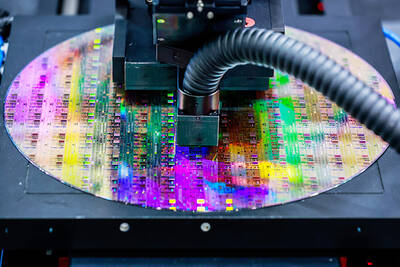
The artificial intelligence (AI) boom has triggered a seismic reshuffling of global equity markets, with Taiwan and South Korea muscling past European nations one by one. With its stock market now valued at nearly US$4.3 trillion, Taiwan surpassed the UK, Europe’s biggest market, earlier this month, data compiled by Bloomberg showed. South Korea is about US$140 billion away from doing the same. The tech-heavy Asian markets have shot past Germany and France in the past seven months. The shift is largely down to massive gains in shares of three companies that provide essential hardware for AI: Taiwan Semiconductor Manufacturing Co (TSMC, 台積電),

NEXT-GENERATION: The company announced plans to roll out platforms with 100 TOPS performance and expects AI-capable systems to become the standard Industrial computer maker Advantech Co (研華) is eyeing strong growth potential in edge artificial intelligence (AI), as the technology shifts from cloud-centric computing to edge deployment and real-world applications, Advantech embedded Internet of Things president Miller Chang (張家豪) said on Thursday last week. Amid rising demand for inference as the industry shifts from training, edge AI is emerging as a key field, given the need for low latency, real-time response and data privacy, Chang said in an exclusive interview with the Taipei Times. While consumer devices such as smartphones already feature some AI capabilities, large-scale inference demand would mainly come from applications


 RSS
RSS