


Industrial computer maker Advantech Co (研華) is eyeing strong growth potential in edge artificial intelligence (AI), as the technology shifts from cloud-centric computing to edge deployment and real-world applications, Advantech embedded Internet of Things president Miller Chang (張家豪) said on Thursday last week.
Amid rising demand for inference as the industry shifts from training, edge AI is emerging as a key field, given the need for low latency, real-time response and data privacy, Chang said in an exclusive interview with the Taipei Times.
While consumer devices such as smartphones already feature some AI capabilities, large-scale inference demand would mainly come from applications for industries such as healthcare, manufacturing and semiconductors, where data privacy and real-time requirements drive the adoption of edge AI, he said.
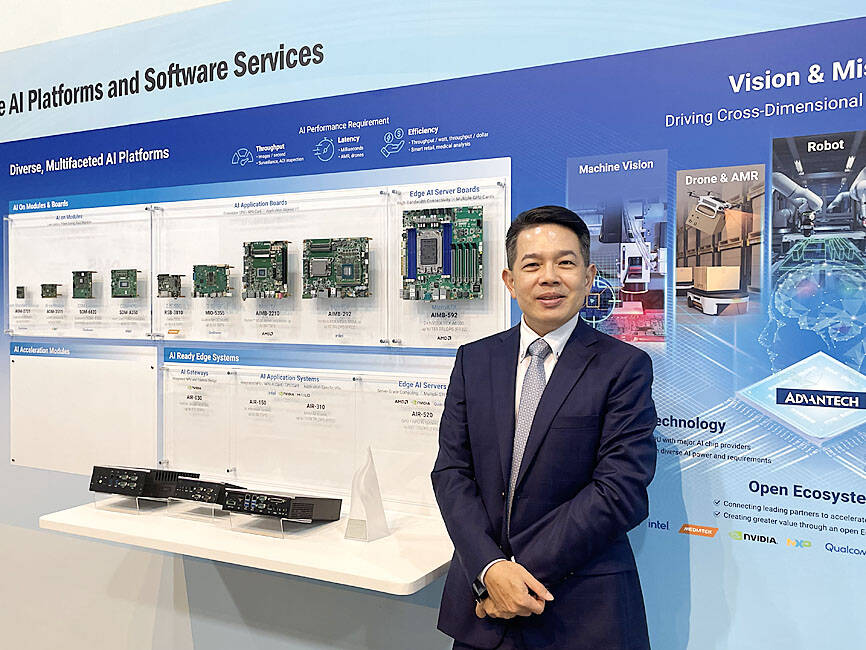
Photo: Meryl Kao, Taipei Times
Since Advantech’s core business has long centered on providing edge computing for industrial applications, it is well-positioned to benefit from growing edge AI deployment, Chang said.
The company is already seeing deployments across industries, from automation, smart manufacturing, healthcare and retail to energy management and robotics, he added.
As the AI technology moves toward integration with physical systems, the development of physical AI, which combines sensing, decisionmaking and action — particularly in robotics and automation — is expected to become a future growth driver for the company, Chang said.
Advantech plans to roll out next-generation integrated edge AI platforms this year, featuring at least 100 trillion operations per second (TOPS) of computing performance, as AI capabilities become a standard configuration rather than an optional add-on, he said.
“In the past, customers asked whether they needed AI; now, systems come with AI capability by default,” he added.
To support diverse industry needs, Advantech has developed a three-tier edge AI hardware architecture, he said.
The first layer, Edge AI Embedded, provides modules that could be integrated into existing systems to upgrade their AI capabilities, Chang said.
The second tier, Edge AI Appliance, offers complete systems tailored for sectors such as healthcare, automation and robotics, he said.
The third layer, Edge AI Server, involves on-site data processing in applications not suited for cloud deployment, Chang said.
On top of the hardware, the company integrates its AI of Things system with development tools to shorten development cycles, he said, adding that through the “three-layer hardware plus one layer of software” approach, Advantech aims to accelerate AI deployment across industries.
Advantech is to present its latest edge AI and AI application solutions across industries at this year’s Computex Taipei trade show in June, Chang said.
During the show, the company would collaborate with major chipmakers, including Intel Corp, Nvidia Corp and Qualcomm Inc, to demonstrate how its platforms support different AI architectures, he said.
Advantech also plans to showcase an integrated AI solution based on Nvidia’s NemoClaw — an open-source platform for deploying autonomous AI agents with built-in security and privacy controls — that aims to help customers accelerate AI adoption, Chang said.
That solution has been applied in areas such as factory operations and energy management, and would be expanded to more scenarios, he added.
“AI will inevitably be deployed in real-world scenarios — and it is already happening,” Chang said.

Cairo’s new monorail slices across the city skyline, running above the familiar chaos of blaring horns and aging buses’ exhaust fumes that mark rush hour below. The US$4.5 billion monorail, opened this month, is among Egypt’s most prominent new transport projects, part of a debt-funded infrastructure drive criticized for sapping state finances while bringing limited benefits to most of the country’s 109 million people. “It feels like you’re in a different country,” said Ramy Sayed, a restaurant manager, aboard a driverless Innovia 300 train. “No noise, no traffic, we’re not used to this.” The eastern line runs 56km from the bustling middle-class

Taiwanese firms have increased investment in the Philippines in recent years as Manila’s ties with Washington deepen and global supply chains continue to shift away from China, an expert at the Chung-Hua Institution for Economic Research (CIER, 中華經濟研究院) said yesterday. The Philippines had not been among Taiwanese investors’ top choices in Southeast Asia, CIER Taiwan ASEAN Studies Center director Kristy Hsu (徐遵慈) said at a seminar in Taipei. However, Taiwan’s investment in the country has grown significantly since the COVID-19 pandemic, reaching US $257 million last year, a high in recent years, she said. Although Taiwan’s total investment in the Philippines still lags
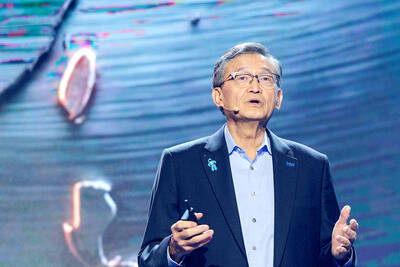
Intel Corp regards Taiwan Semiconductor Manufacturing Co (TSMC, 台積電) as a longstanding partner, as the US chipmaker would continue outsourcing production of advanced chips to TSMC, Intel chief executive officer Lip-Bu Tan (陳立武) said yesterday. “I don’t look at people as competitors. I look at the collaboration... Nvidia is also, you know, a good friend,” Tan told a news conference following his keynote speech at the Computex trade show in Taipei. “It’s a very trusted partnership for us... We are a big, top customer for them, and we’re going to continue doing that,” he said, referring to TSMC, the world’s largest foundry

Artificial intelligence (AI) agents would supplant smartphones as the center of people’s digital lives, fundamentally reshaping personal devices and driving a major computing upgrade cycle, Qualcomm Inc CEO Cristiano Amon said yesterday. In his keynote speech for this year’s Computex trade show in Taipei, Amon said that the rise of "agentic AI" — AI systems capable of reasoning, planning and carrying out tasks autonomously — would transform how people interact with technology across phones, PCs, vehicles and wearable devices. Describing the technology as the next major evolution in computing, Amon said that "2026 is the year of agents.” For decades, smartphones have sat


 RSS
RSS