


Taiwan is playing a “central role” in Google’s transition toward artificial intelligence (AI)-based computing, as well as in the broader industry shift, Google senior vice president of devices and services Rick Osterloh said in an interview with CNA.
Osterloh praised the company’s Taiwanese team for its “amazing R&D capabilities” and highlighted key partners such as MediaTek Inc (聯發科) and Taiwan Semiconductor Manufacturing Co (台積電).
“Our team in the region is so crucial for what we’re doing with our global innovation strategy and central to the shift in the AI computing landscape,” he said at Google’s hardware engineering center in New Taipei City, the company’s largest hardware R&D center outside the US.
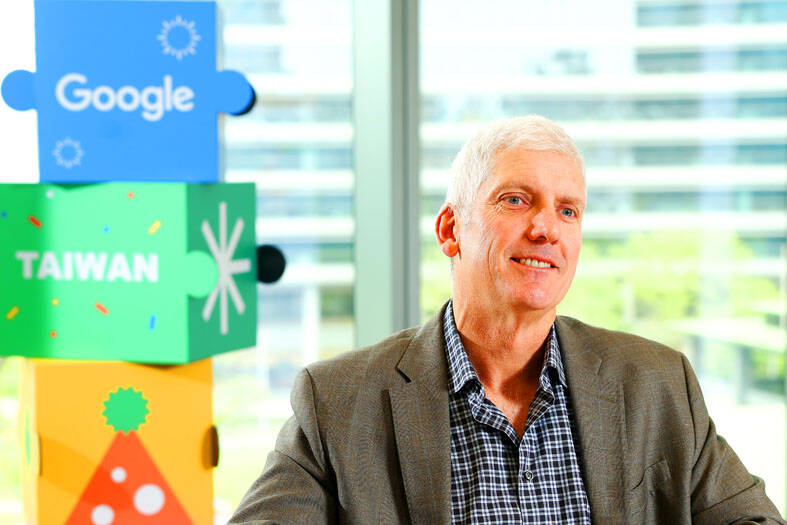
Photo: CNA
Google vice president of hardware Elmer Peng (彭昱鈞) praised Taiwan’s strong ecosystem, citing its deep talent pool in silicon design, devices and Android development, as well as the company’s data center in Changhua County.
He said that ecosystem was perfectly aligned with Google’s “full-stack” strategy, which focuses on offering a comprehensive group of solutions that address every layer of a technology stack.
Osterloh said the company’s full-stack approach to AI spans applications, AI models and underlying technology, including data centers and chips.
At the same time, by centering its ecosystem on the Gemini family, Google enables the same core technology to be used across enterprise services in Google Cloud, automotive systems in Android Auto and consumer devices such as Android smartphones, he said.
For users, this integration enables shared context and memory across platforms, he added, saying that Google is “the only real full-stack provider of AI that can support enterprises and consumers.”
Osterloh introduced a new capability called “Personal Intelligence,” launched in Taiwan on April 15. The feature builds on a user’s interaction history across services such as Gmail and Google Photos to deliver more personalized responses and actions.
Looking ahead, the first generation of “AI-native” devices would need to enhance functions such as calling, photography and web browsing while incorporating new AI-driven capabilities, he said.
Osterloh pointed to developments such as “Gemini Task Automation,” which enables “agentic workflows” such as automatically completing tasks such as booking a ride, as well as the integration of Gemini into the Chrome browser to assist users in real time.
However, he cautioned that creating fully AI-native devices would require rethinking user interfaces and underlying technologies to move from an application-driven to an AI-driven computing model.

Elon Musk’s lieutenants have reached out to chip industry suppliers, including Applied Materials Inc, Tokyo Electron Ltd and Lam Research Corp, for his envisioned Terafab, early steps in an audacious and likely arduous attempt to break into the production of cutting-edge chips. Staff working for the joint venture between Tesla Inc and Space Exploration Technologies Corp (SpaceX) have sought price quotes and delivery times for an array of chipmaking gear, people familiar with the matter said. In past weeks, they’ve contacted makers of photomasks, substrates, etchers, depositors, cleaning devices, testers and other tools, according to the people, who asked not to
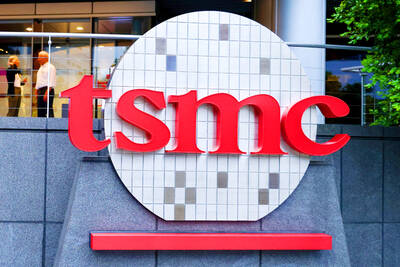
NO SHORTCUTS: Asked about Elon Musk’s Terafab initiative, TSMC CEO C.C. Wei said it takes two to three years to build a fab and another one to two to ramp it up Taiwan Semiconductor Manufacturing Co (TSMC, 台積電) yesterday raised its revenue growth forecast for this year to above 30 percent, up from the 25 percent it estimated three months earlier, citing extremely robust artificial intelligence (AI)-related chip demand. “Our customers and customers’ customers, who are mainly cloud service providers, continue to send us very positive signals and outlook,” TSMC chairman and CEO C.C. Wei (魏哲家) said at an earnings conference. The company also hiked its capital expenditure for this year toward the higher end of its forecast, or US$56 billion, as it aims to step up advanced chip capacity expansions, such as
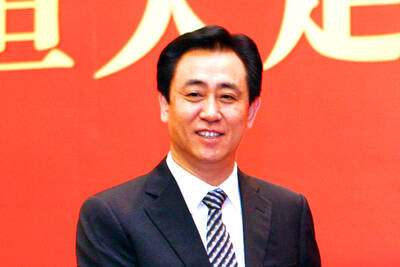
The founder of Chinese property giant Evergrande Group (恆大集團) has pleaded guilty to charges of fraud and bribery, a court said yesterday, the latest blow for what was once the country’s leading developer. Evergrande’s rise was propelled by decades of rapid urbanization and rising living standards, but in 2020, its access to credit dramatically narrowed when the government introduced curbs on excessive borrowing and speculation. The company defaulted in 2021 after struggling to repay creditors. Founder Xu Jiayin (許家印), 67, known as Hui Ka Yan in Cantonese, was reportedly held by police in 2023, with Evergrande saying he had been subjected to
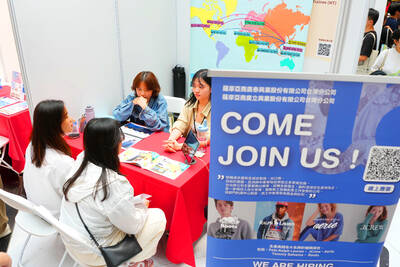
Taiwan is attracting a growing number of foreign jobseekers as companies increasingly recruit overseas talent to ease labor shortages and expand global reach, recruitment platform 104 Job Bank (104人力銀行) said yesterday. More than 40,000 foreign nationals searched for jobs in Taiwan through the platform last year, a 28 percent increase from a year earlier, the company said. Malaysians accounted for the largest share of overseas jobseekers at 12.2 percent, followed by Indonesians at 11.9 percent and Vietnamese at 10.8 percent. Indonesian applicants surged more than 50 percent year-on-year, while Vietnamese jobseekers rose by more than 30 percent. Applicants from the


 RSS
RSS