


Artificial intelligence (AI) lab Anthropic is exploring the possibility of designing its own chips, three sources said, as the company and its rivals respond to a shortage of AI chips needed to power and develop more advanced AI systems.
The plans are in early stages and the company might still decide to only buy AI chips and not design any, said two people with knowledge of the matter and one person briefed on Anthropic’s plans.
The company has yet to commit to a specific design or put together a dedicated team to work on the project, one of the sources said.
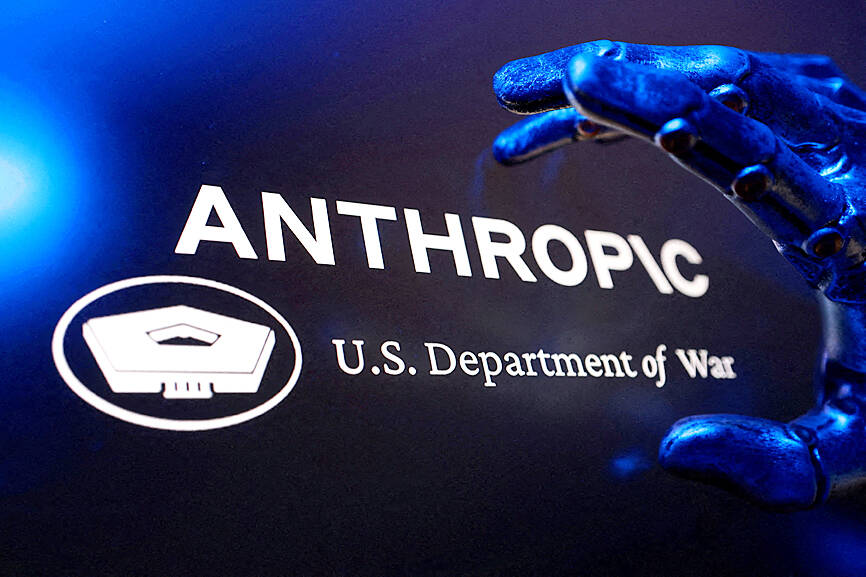
Photo: Reuters
Demand for its AI model Claude has accelerated this year, with the start-up’s run-rate revenue now surpassing US$30 billion, up from about US$9 billion at the end of last year, Anthropic said.
Anthropic uses a range of chips, including tensor processing units (TPUs) designed by Alphabet’s Google and Amazon’s chips to develop and run its AI software and chatbot Claude.
Earlier this week, Anthropic signed a long-term deal with Google and Broadcom, which helps design the TPUs. That deal builds on the company’s commitment to invest US$50 billion in bolstering US computing infrastructure.
Anthropic’s discussions mirror similar efforts underway at large tech companies that are seeking to design their own AI chips, including Meta and OpenAI.
Designing an advanced AI chip could cost roughly half a billion dollars, as companies need to employ skilled engineers and spend to make sure the manufacturing process has no defects, industry sources said.
Separately, US Secretary of the Treasury Scott Bessent and Federal Reserve Chair Jerome Powell convened an urgent meeting with bank CEOs this week to warn of cyber risks posed by Anthropic’s latest AI model, two sources familiar with the matter said.
Anthropic launched the powerful Mythos model earlier this week, but stopped short of a broad release, citing concerns it could expose previously unknown cybersecurity vulnerabilities.
The company has said the model is capable of identifying and exploiting weaknesses across “every major operating system and every major web browser.”
Anthropic said it was in ongoing discussions with US government officials about the model’s “offensive and defensive cyber capabilities.”
A third source close to the matter reiterated Anthropic’s outreach, saying the company briefed senior US government officials and key industry stakeholders on Mythos’ capabilities ahead of its release.
The US Treasury-hosted meeting in Washington on Tuesday was aimed at ensuring banks are aware of the risks posed by Mythos and similar models, and are taking steps to defend their systems, one of the sources said.
Access to Mythos would be limited to about 40 technology companies, including Microsoft and Google, the start-up has said.


Taiwan’s foreign exchange reserves fell below the US$600 billion mark at the end of last month, with the central bank reporting a total of US$596.89 billion — a decline of US$8.6 billion from February — ending a three-month streak of increases. The central bank attributed the drop to a combination of factors such as outflows by foreign institutional investors, currency fluctuations and its own market interventions. “The large-scale outflows disrupted the balance of supply and demand in the foreign exchange market, prompting the central bank to intervene repeatedly by selling US dollars to stabilize the local currency,” Department of Foreign

Intel Corp is joining Elon Musk’s long-shot effort to develop semiconductors for Tesla Inc, Space Exploration Technologies Corp and xAI, marking a surprising twist in the chipmaker’s comeback bid. Intel would help the Terafab project “refactor” the technology in a chip factory, the company said on Tuesday in a post on X, Musk’s social media platform. That is a stage in the development process that typically helps make chips more powerful or reliable. The chipmaker’s shares jumped 4.2 percent to US$52.91 in New York trading on Tuesday. The Terafab project is a grand plan by Musk to eventually manufacture his own chips for

Taiwan Power Co (Taipower, 台電) yesterday said it plans to resume operations at two coal-fired power generators for three months to boost security of electricity supply as liquefied natural gas (LNG) supply risks are running high due to the Middle East conflict. The two coal-fired power generators are at Mailiao Power Plant in Yunlin County’s Mailiao Township (麥寮). The plant, operated by Formosa Plastics Group (台塑集團), supplied electricity to Taipower’s power grid until the end of last year. Taipower’s decision came about one month after Minister of Economic Affairs Kung Ming-hsin (龔明鑫) on March 10 said that the nation had no imminent

Some robotaxi passengers were left stranded in the middle of fast-moving traffic in a major Chinese city after their driverless vehicles stopped running, according to police and media reports on Wednesday. A preliminary investigation indicates more than 100 robotaxis came to a halt because of a “system malfunction,” police in the city of Wuhan said in a statement, without elaborating. No injuries were reported. One passenger told Chinese media that their robotaxi stopped after turning a corner. An instruction on a screen read: “Driving system malfunction. Staff are expected to arrive in 5 minutes.” After no one showed up, the passenger pushed


 RSS
RSS