


Taiwan Semiconductor Manufacturing Co (TSMC, 台積電) yesterday reported a 35 percent increase in quarterly revenue, suggesting that global artificial intelligence (AI) chip demand remained intact during the first weeks of war in the Middle East.
Revenue for the first three months of the year rose to NT$1.13 trillion (US$35.62 billion), TSMC said.
Analysts estimated NT$1.12 trillion on average.
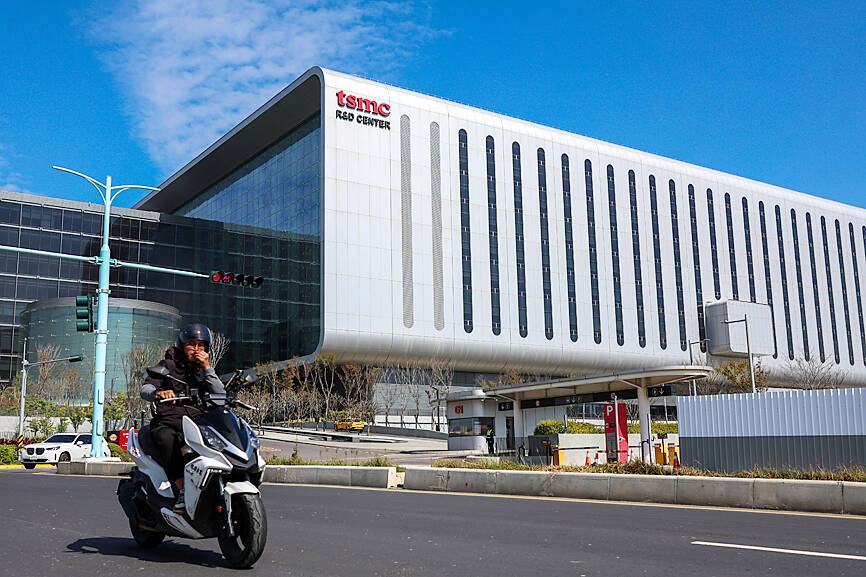
Photo: Daniel Ceng, AP
Sales last month rose 45 percent.
The report might help quell concerns that a prolonged crisis in the Middle East would dampen demand for power-hungry AI data centers and gadgets such as the iPhone. The war has put pressure on global shipping routes and energy prices, and investors are looking for clues as to whether its impact would spread to tech giants’ spending plans.
TSMC and AI customers such as Nvidia also face increasing skepticism that they could keep growing at current rates. After explosive sales turned Nvidia into the world’s most valuable company and TSMC the most valuable company in Asia, investors are seeking assurances that booming AI spending can be maintained.
TSMC’s results in the first quarter are likely to beat the guidance midpoint — and consensus — given sustained strong demand for 3 and 5-nanometer nodes used in AI accelerators and networking-chip production.
Favorable appreciation of the US dollar against New Taiwan dollar provides a further tailwind.
It is calculated that the gross margin could reach a record high of 65 percent at least.
The earnings call would focus on management’s view on Android smartphone and PC demand (especially whether higher memory costs might prompt another inventory correction); and if fab operations and the 2H margin could be pressured by any disruption to chemicals or energy supply, or higher related costs.
Another item to watch would be if sustained, multiyear AI chip demand and strength in leading-edge nodes supports raising the long-term gross margin target above 58 percent, Bloomberg analyst Charles Shum said.
TSMC is to report full first quarter results on Thursday next week.


Taiwan’s foreign exchange reserves fell below the US$600 billion mark at the end of last month, with the central bank reporting a total of US$596.89 billion — a decline of US$8.6 billion from February — ending a three-month streak of increases. The central bank attributed the drop to a combination of factors such as outflows by foreign institutional investors, currency fluctuations and its own market interventions. “The large-scale outflows disrupted the balance of supply and demand in the foreign exchange market, prompting the central bank to intervene repeatedly by selling US dollars to stabilize the local currency,” Department of Foreign

Intel Corp is joining Elon Musk’s long-shot effort to develop semiconductors for Tesla Inc, Space Exploration Technologies Corp and xAI, marking a surprising twist in the chipmaker’s comeback bid. Intel would help the Terafab project “refactor” the technology in a chip factory, the company said on Tuesday in a post on X, Musk’s social media platform. That is a stage in the development process that typically helps make chips more powerful or reliable. The chipmaker’s shares jumped 4.2 percent to US$52.91 in New York trading on Tuesday. The Terafab project is a grand plan by Musk to eventually manufacture his own chips for
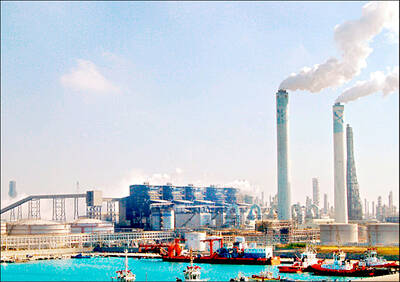
Taiwan Power Co (Taipower, 台電) yesterday said it plans to resume operations at two coal-fired power generators for three months to boost security of electricity supply as liquefied natural gas (LNG) supply risks are running high due to the Middle East conflict. The two coal-fired power generators are at Mailiao Power Plant in Yunlin County’s Mailiao Township (麥寮). The plant, operated by Formosa Plastics Group (台塑集團), supplied electricity to Taipower’s power grid until the end of last year. Taipower’s decision came about one month after Minister of Economic Affairs Kung Ming-hsin (龔明鑫) on March 10 said that the nation had no imminent

Some robotaxi passengers were left stranded in the middle of fast-moving traffic in a major Chinese city after their driverless vehicles stopped running, according to police and media reports on Wednesday. A preliminary investigation indicates more than 100 robotaxis came to a halt because of a “system malfunction,” police in the city of Wuhan said in a statement, without elaborating. No injuries were reported. One passenger told Chinese media that their robotaxi stopped after turning a corner. An instruction on a screen read: “Driving system malfunction. Staff are expected to arrive in 5 minutes.” After no one showed up, the passenger pushed


 RSS
RSS