


Delta Electronics Inc (台達電) yesterday reported revenue of NT$159.35 billion (US$5.02 billion) for the first quarter of this year, up 34 percent from a year earlier and marking the highest for the January-to-March period in the firm’s history.
The results underscored the company’s still-strong shipments of power electronics — such as power supplies, thermal management products and passive components — and infrastructure-related products for data centers and power networking in the quarter, despite it usually being a low season.
Owing to fewer working days than a quarter earlier and lower contributions from its automation and mobility businesses, first-quarter revenue fell 1.42 percent from the previous quarter, company data showed.
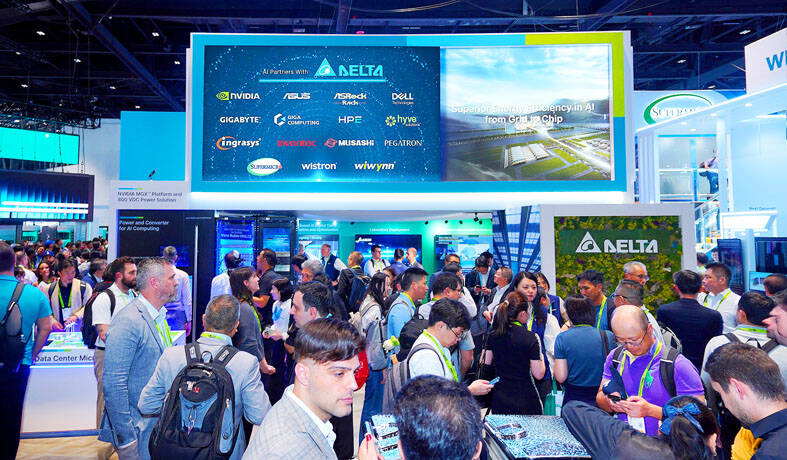
Photo courtesy of Delta Electronics Inc
However, Delta Electronics expect second-quarter revenue to be larger than the first-quarter figure, chairman Ping Cheng (鄭平) told investors on Feb. 26, citing robust demand for the company’s artificial intelligence (AI) server power and liquid cooling products.
Delta Electronics — the largest vendor of power supply components in the world, as well as a key supplier of servo motors, inverters and programmable logic controllers in China — also reported that sales last month hit a record NT$59.78 billion.
Power electronics accounted for 53 percent of sales last month, while infrastructure-related products contributed 33 percent, it said in a statement.
Automation devices, such as controllers, robotic arms and building management systems, made up 9 percent of its sales last month, while mobility applications, including those for electric vehicle charging, made up 4 percent, it added.
Analysts at Goldman Sachs Group Inc and Daiwa Securities Group Inc in separate notes said Delta Electronics would continue to see a solid revenue and profitability uptrend this year, given increasing contributions from its AI-related power products, as well as the production ramp-up of its high-voltage direct current energy systems for AI servers and data centers later this year.


Taiwan’s foreign exchange reserves fell below the US$600 billion mark at the end of last month, with the central bank reporting a total of US$596.89 billion — a decline of US$8.6 billion from February — ending a three-month streak of increases. The central bank attributed the drop to a combination of factors such as outflows by foreign institutional investors, currency fluctuations and its own market interventions. “The large-scale outflows disrupted the balance of supply and demand in the foreign exchange market, prompting the central bank to intervene repeatedly by selling US dollars to stabilize the local currency,” Department of Foreign

Intel Corp is joining Elon Musk’s long-shot effort to develop semiconductors for Tesla Inc, Space Exploration Technologies Corp and xAI, marking a surprising twist in the chipmaker’s comeback bid. Intel would help the Terafab project “refactor” the technology in a chip factory, the company said on Tuesday in a post on X, Musk’s social media platform. That is a stage in the development process that typically helps make chips more powerful or reliable. The chipmaker’s shares jumped 4.2 percent to US$52.91 in New York trading on Tuesday. The Terafab project is a grand plan by Musk to eventually manufacture his own chips for

Some robotaxi passengers were left stranded in the middle of fast-moving traffic in a major Chinese city after their driverless vehicles stopped running, according to police and media reports on Wednesday. A preliminary investigation indicates more than 100 robotaxis came to a halt because of a “system malfunction,” police in the city of Wuhan said in a statement, without elaborating. No injuries were reported. One passenger told Chinese media that their robotaxi stopped after turning a corner. An instruction on a screen read: “Driving system malfunction. Staff are expected to arrive in 5 minutes.” After no one showed up, the passenger pushed
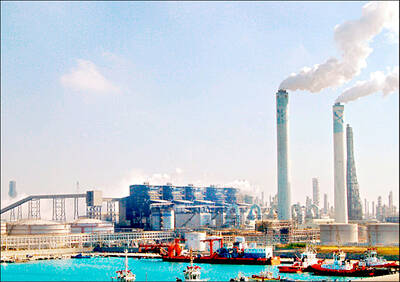
Taiwan Power Co (Taipower, 台電) yesterday said it plans to resume operations at two coal-fired power generators for three months to boost security of electricity supply as liquefied natural gas (LNG) supply risks are running high due to the Middle East conflict. The two coal-fired power generators are at Mailiao Power Plant in Yunlin County’s Mailiao Township (麥寮). The plant, operated by Formosa Plastics Group (台塑集團), supplied electricity to Taipower’s power grid until the end of last year. Taipower’s decision came about one month after Minister of Economic Affairs Kung Ming-hsin (龔明鑫) on March 10 said that the nation had no imminent


 RSS
RSS