


Taiwan plans to launch a US$250 billion credit guarantee program to support domestic companies investing in the US, part of a broader effort to deepen supply chain cooperation with Washington following conclusion of tariff negotiations earlier this year, National Development Council Minister Yeh Chun-hsien (葉俊顯) said yesterday.
The government would provide guarantees covering up to 50 percent of loans extended by participating financial institutions, with the program designed to encourage investment in sectors including semiconductors, and information and communications technology, Yeh said.
The initiative follows a memorandum of understanding between the two nations in which Taiwan committed to US$250 billion in direct investment in the US, alongside the credit guarantee program intended to mobilize additional private-sector funding.
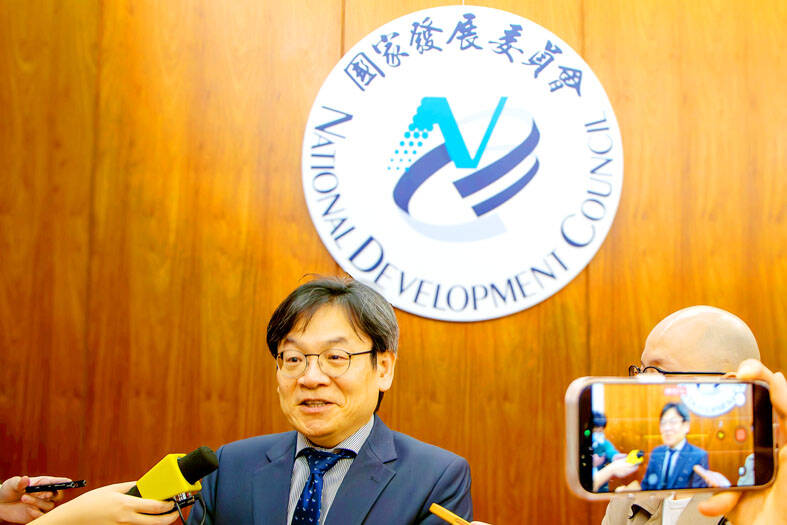
Photo courtesy of the National Development Council
The NDC briefed representatives from 38 public and private financial institutions on the proposed financing mechanism.
Under the plan, the government would guarantee loans with a leverage ratio of up to 20 times, with the dedicated funding required for the program estimated at about US$6.25 billion.
The program would be rolled out in five phases. In the first phase, the government aims to raise more than US$1.2 billion, with the National Development Fund contributing about US$800 million to take a leading role in launching the initiative. Over time, the government’s share would gradually decline, with the long-term goal of achieving a one-to-one funding ratio with private financial institutions.
Companies would use the funds primarily for productive investments such as building manufacturing facilities, purchasing machinery and equipment, supporting operating capital and establishing industrial clusters in the US, Yeh said, adding that a cap would be set on borrowing by a single company to prevent crowding out other firms.
As participating financial institutions vary in asset size and lending capacity, the program would offer three participation tiers — US$25 million, US$50 million and US$75 million — allowing lenders to choose commitments aligned with their financial capacity, he said.
To ease pressure on banks’ capital adequacy ratios, institutions would initially contribute only one-fifth of their pledged funds, similar to a deposit, with the remaining four-fifths provided gradually as loan projects are approved, Yeh said.
Following the briefing, the NDC plans to gather feedback from financial institutions and submit the proposal to the Executive Yuan by the end of next month.
Companies could start applying for financing and signing loan agreements before the end of June if the boards of participating financial institutions approve the initiative, Yeh said.
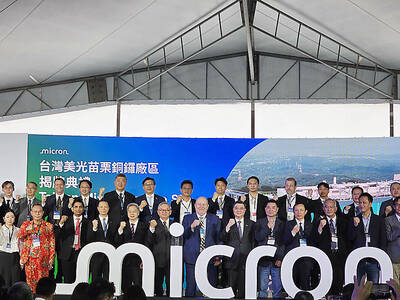
UNPRECEDENTED PACE: Micron Technology has announced plans to expand manufacturing capabilities with the acquisition of a new chip plant in Miaoli Micron Technology Inc unveiled a newly acquired chip plant in Miaoli County yesterday, as the company expands capacity to meet growing demand for advanced DRAM chips, including high-bandwidth memory chips amid the artificial intelligence boom. The plant in Miaoli County’s Tongluo Township (銅鑼), which Micron acquired from Powerchip Semiconductor Manufacturing Corp (力積電) for US$1.8 billion, is expected to make a sizeable capacity contribution to the company from fiscal 2028, the company said in a statement. It would be an extended production site of Micron’s large-scale manufacturing hub in Taichung, the company said. As the global semiconductor industry is racing to reach US$1 trillion
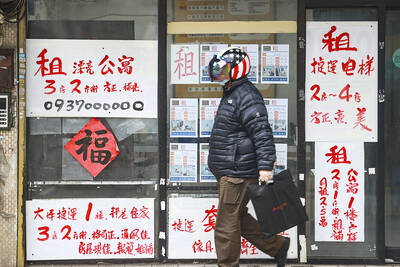
A man walks past real-estate advertisements outside a house in Taipei yesterday. The central bank yesterday said it plans to establish an “Inflation-at-Risk” gauge as a supplementary tool for observing inflation, as policymakers express wish to communicate more effectively with the public when making inflation forecasts.
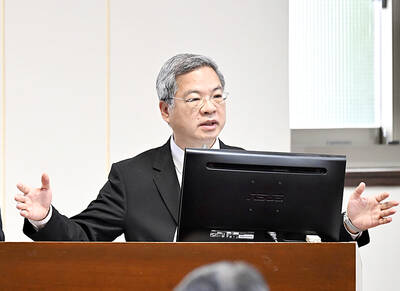
ABOVE LEGAL REQUIREMENT: The Ministry of Economic Affairs is prepared if LNG supply is disrupted, with more than the legal requirement of 11 days of inventory Taiwan has largely secured liquefied natural gas (LNG) supplies through May and arranged about half of June’s supply, Minister of Economic Affairs Kung Ming-hsin (龔明鑫) said yesterday. Since the Middle East conflict began on Feb. 28, Taiwan’s LNG inventories have remained more than 12 days, exceeding the legal requirement of 11 days, indicating no major supply concerns for domestic gas and electricity, Kung said at a meeting of the legislature’s Economics Committee in Taipei. The ministry aims to increase the figure to 14 days by the end of next year, he said. While one or two LNG or crude oil shipments for May

Memory chip stocks extended their losses yesterday after Alphabet Inc’s Google publicized research that could allow more efficient use of the storage needed for artificial intelligence (AI) development. SK Hynix Inc and Samsung Electronics Co, South Korean leaders in the market, fell more than 6 percent and about 5 percent respectively in Seoul. In the US, Micron Technology Inc, Western Digital Corp and Sandisk Corp slid more than 2 percent in pre-market trading, after they all closed lower on Wednesday. Memory companies have been on a tear in recent months as the rapid development of AI infrastructure triggered a spike in chip


 RSS
RSS