


Taiwan’s consumer price index (CPI) could rise about 1.9 percent this year, if crude oil prices average US$100 a barrel, central bank Governor Yang Chin-long (楊金龍) said yesterday, signaling that price pressures remain broadly contained for the time being.
The central bank on March 19 raised its inflation forecast to 1.8 percent, assuming oil prices average US$85 per barrel and incorporating government measures to stabilize prices.
Speaking to the Legislative Yuan’s Finance Committee, Yang said the bank’s latest estimate aligns with the median forecast from major international institutions, even as Brent crude climbed above US$110 per barrel yesterday after Iran-backed Houthis fired missiles at Israel from Yemen.
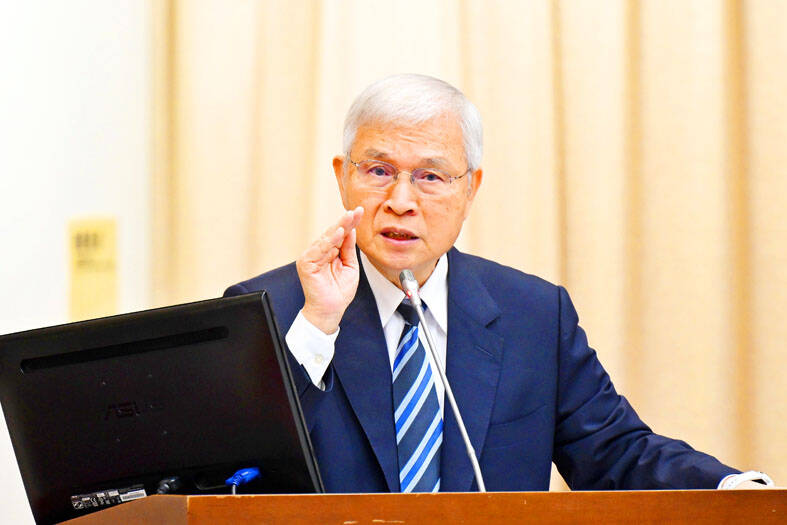
Photo: Chen Yi-kuan, Taipei Times
Crude oil prices remain highly volatile and could fall to about US$70 per barrel if hostilities in the Middle East end quickly, the central bank governor said.
“Interest rates mainly address demand-driven inflation, whereas higher oil prices are a supply-side shock best managed through supply-side measures,” Yang said, adding that the central bank might tighten policy if it deems it necessary to tame inflation.
The government has mechanisms to cushion the impact of rising energy costs, including fuel and commodity price stabilization programs, he said.
The central bank would seek to maintain New Taiwan dollar’s exchange-rate stability to prevent imported inflation from adding to price pressures, but it does not set a specific defense line for the local currency, Yang said.
He said Taiwan could still expand more than 7 percent this year if the Middle East conflict proves short-lived and does not disrupt investment by US cloud service providers, a key driver of the nation’s export momentum.
Capital outflows triggered by the geopolitical tensions are normal after the local stock market recently hit record highs, he said.
Yang also commented on the government’s preferential housing loan program for first-home buyers, set to expire on July 31, saying that long loan grace periods can encourage lax financial planning.
“A slightly shorter grace period could foster more disciplined personal finance, benefiting borrowers and banks,” he said.
Currently, the program allows a five-year grace period, with 75 percent of borrowers using three-year terms, data from the Ministry of Finance showed.
Yang said the central bank would continue to update its projections for key economic indicators and policy stance as new data and geopolitical developments emerge, signaling a cautious, but measured approach to inflation and growth amid global uncertainties.

UNPRECEDENTED PACE: Micron Technology has announced plans to expand manufacturing capabilities with the acquisition of a new chip plant in Miaoli Micron Technology Inc unveiled a newly acquired chip plant in Miaoli County yesterday, as the company expands capacity to meet growing demand for advanced DRAM chips, including high-bandwidth memory chips amid the artificial intelligence boom. The plant in Miaoli County’s Tongluo Township (銅鑼), which Micron acquired from Powerchip Semiconductor Manufacturing Corp (力積電) for US$1.8 billion, is expected to make a sizeable capacity contribution to the company from fiscal 2028, the company said in a statement. It would be an extended production site of Micron’s large-scale manufacturing hub in Taichung, the company said. As the global semiconductor industry is racing to reach US$1 trillion
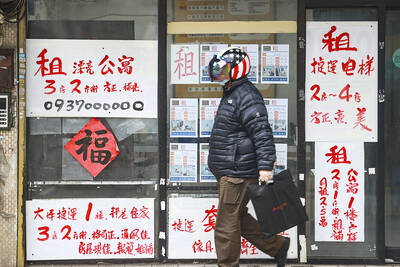
A man walks past real-estate advertisements outside a house in Taipei yesterday. The central bank yesterday said it plans to establish an “Inflation-at-Risk” gauge as a supplementary tool for observing inflation, as policymakers express wish to communicate more effectively with the public when making inflation forecasts.
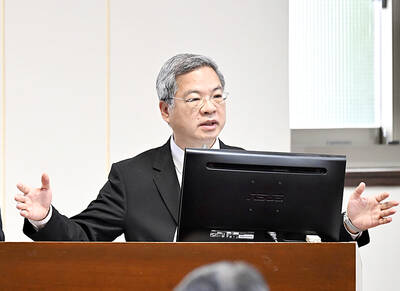
ABOVE LEGAL REQUIREMENT: The Ministry of Economic Affairs is prepared if LNG supply is disrupted, with more than the legal requirement of 11 days of inventory Taiwan has largely secured liquefied natural gas (LNG) supplies through May and arranged about half of June’s supply, Minister of Economic Affairs Kung Ming-hsin (龔明鑫) said yesterday. Since the Middle East conflict began on Feb. 28, Taiwan’s LNG inventories have remained more than 12 days, exceeding the legal requirement of 11 days, indicating no major supply concerns for domestic gas and electricity, Kung said at a meeting of the legislature’s Economics Committee in Taipei. The ministry aims to increase the figure to 14 days by the end of next year, he said. While one or two LNG or crude oil shipments for May

Memory chip stocks extended their losses yesterday after Alphabet Inc’s Google publicized research that could allow more efficient use of the storage needed for artificial intelligence (AI) development. SK Hynix Inc and Samsung Electronics Co, South Korean leaders in the market, fell more than 6 percent and about 5 percent respectively in Seoul. In the US, Micron Technology Inc, Western Digital Corp and Sandisk Corp slid more than 2 percent in pre-market trading, after they all closed lower on Wednesday. Memory companies have been on a tear in recent months as the rapid development of AI infrastructure triggered a spike in chip


 RSS
RSS