


Cathay Financial Holding Co (國泰金控) said yesterday its exposure to the Middle East remains limited and manageable despite heightened geopolitical tensions and rising inflationary pressure.
Internal stress tests under multiple scenarios show the group’s capital position would remain within regulatory requirements even under a prolonged inflation environment triggered by regional conflicts, president Lee Chang-ken (李長庚) told an investors’ conference in Taipei.
Neither the group’s banking unit nor its insurance arm holds Iranian sovereign debt, Lee said, adding that its life insurance subsidiary has no exposure to overseas private credit and the bank does not invest in such products.
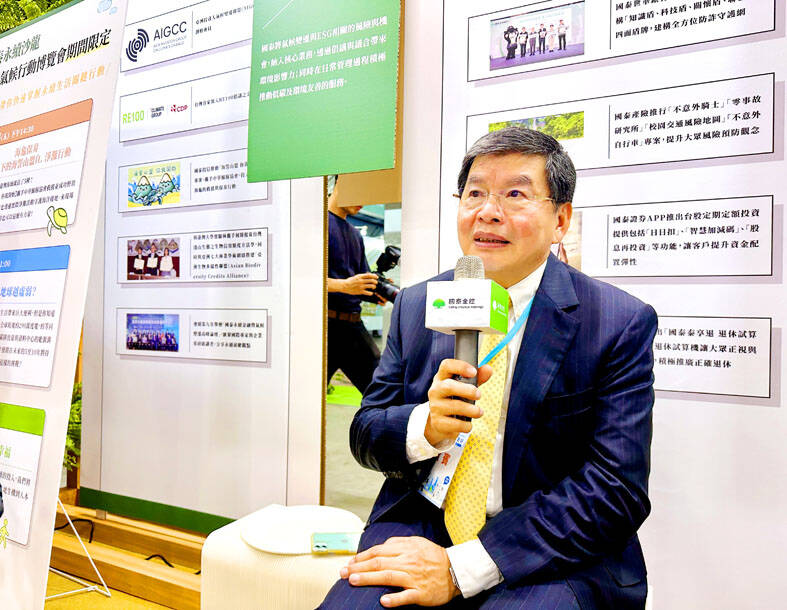
Photo: CNA
Four investment funds offered through the group hold related assets with net exposure of about US$100 million, Lee said.
Cathay United Bank Co (國泰世華銀行), the conglomerate’s main lending arm, holds about NT$2.8 billion (US$87.83 million) in Middle Eastern sovereign bonds, he said.
Concerns over private credit products have largely centered on whether large-scale withdrawals could trigger a chain reaction of redemptions. However, Lee said the current market structure is stronger than during the global financial crisis in 2008.
He said he has not observed signs of large-scale redemption pressure, and product structures and subscription and redemption rules are now more robust and tightly regulated.
Most investors remain in profit despite market volatility, Lee said, adding that the company would continue to monitor financial markets and geopolitical developments.
Lee said the worst-case scenario would involve the complete closure of the strategic Strait of Hormuz, which would disrupt shipments of crude oil and natural gas.
For now, the waterway remains partially open, as Iran has allowed oil tankers to pass under certain conditions, reportedly charging about US$2 million per large tanker.
The fee translates to roughly US$1 per ton, meaning oil prices could remain manageable even if crude rises to US$120 per barrel, provided traffic through the strait continues, Lee said.
Cathay Financial reported a net income of NT$107.6 billion for last year, down 3 percent from a year earlier, largely due to a one-off foreign exchange reserve provision booked in December by its main subsidiary, Cathay Life Insurance Co (國泰人壽). Earnings per share were NT$7.06.
Despite the decline, the group said its core operations remained strong, with its banking, property insurance and securities units all posting record profits.
Cathay Life acting president Lin Chao-ting (林昭廷) said the insurer plans to gradually increase its exposure to Taiwanese equities over the long term, focusing on stocks with stable dividend payouts, while expanding investments in infrastructure projects and other Taiwan dollar-denominated assets.
Cathay Life realized NT$114.8 billion in gains from equity investments last year, representing a return of 16.4 percent.
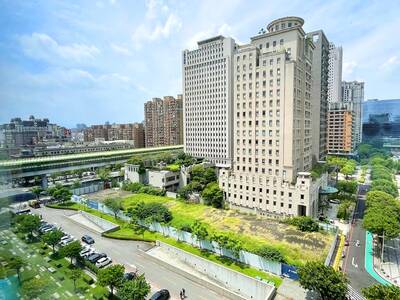
Taichung reported the steepest fall in completed home prices among the six special municipalities in the first quarter of this year, data compiled by Taiwan Realty Co (台灣房屋) showed yesterday. From January through last month, the average transaction price for completed homes in Taichung fell 8 percent from a year earlier to NT$299,000 (US$9,483) per ping (3.3m²), said Taiwan Realty, which compiled the data based on the government’s price registration platform. The decline could be attributed to many home buyers choosing relatively affordable used homes to live in themselves, instead of newly built homes in the city’s prime property market, Taiwan Realty
The government yesterday approved applications by Alphabet Inc’s Google to invest NT$27.08 billion (US$859.98 million) in Taiwan, the Ministry of Economic Affairs said in a statement. The Department of Investment Review approved two investments proposed by Google, with much of the funds to be used for data processing and electronic information supply services, as well as inventory procurement businesses in the semiconductor field, the ministry said. It marks the second consecutive year that Google has applied to increase its investment in Taiwan. Google plans to infuse NT$25.34 billion into Charter Investments Ltd (特許投資顧問) through its Singapore-based subsidiary Fructan Holdings Singapore Pte Ltd, and

JET JUICE: The war on Iran’s secondary effects have seen fuel prices skyrocket, knocking flight schedules down to earth in return as airlines struggle with costs Airline passengers should brace for more irritation in the next few months as carriers worldwide cancel flights and ground planes to cope with stratospheric increases in jet-fuel prices. Dutch flag carrier KLM is the latest company to cut its schedule, saying on Thursday that it would scrap 80 return flights at Amsterdam’s Schiphol Airport in the coming month. That puts it in the same league as United Airlines Holdings Inc, Deutsche Lufthansa AG and Cathay Pacific Airways Ltd, which have all pruned itineraries to mitigate costs. Global capacity for next month has been reduced by about 3 percentage points, with all
Micron Technology Inc is a driving force pushing the US Congress to pass legislation that would put new export restrictions on equipment its Chinese competitors use to make their chips, according to people familiar with the matter. A US House of Representatives panel yesterday was to vote on the “MATCH Act,” a bill designed to close gaps in restrictions on chipmaking equipment. It would also pressure foreign companies that sell equipment to Chinese chipmaking facilities to align with export curbs on US companies like Lam Research Corp and Applied Materials Inc. The bill targets facilities operated by China’s ChangXin Memory Technologies Inc


 RSS
RSS