


Micron Technology Inc is a driving force pushing the US Congress to pass legislation that would put new export restrictions on equipment its Chinese competitors use to make their chips, according to people familiar with the matter.
A US House of Representatives panel yesterday was to vote on the “MATCH Act,” a bill designed to close gaps in restrictions on chipmaking equipment. It would also pressure foreign companies that sell equipment to Chinese chipmaking facilities to align with export curbs on US companies like Lam Research Corp and Applied Materials Inc.
The bill targets facilities operated by China’s ChangXin Memory Technologies Inc (CXMT, 長鑫存儲), Yangtze Memory Technologies Corp (YMTC, 長江存儲) and Semiconductor Manufacturing International Corp (中芯), as well as critical technology nationwide.

Photo: Aly Song, Reuters
Micron has told lawmakers that Washington needs to do more to inhibit Chinese development in the memory market, according to people familiar with the matter.
They said increased US action is necessary to prevent China from dominating memory manufacturing the way it has the solar energy industry and other sectors, and it is a national security issue.
South Korean chipmakers Samsung Electronics Co and SK Hynix Inc now dominate the memory market, with Micron being the third-largest maker and sole major US supplier.
However, YMTC and CXMT are growing fast, despite curbs on exports to them imposed by the US Department of Commerce.
YMTC has been on a restricted trade list since 2022, and CXMT’s advanced facilities have been subject to US export curbs.
The draft bill would restrict more equipment from going to China — including deep ultraviolet immersion machines countrywide, a market dominated by the Netherlands’ ASML Holding NV — and legislate how to impose restrictions if diplomacy fails.
It would also require a license for ASML and other foreign companies to service equipment at covered facilities.
The MATCH Act is only one of many bills tied to export controls to be voted on by the House Foreign Affairs Committee. Others target the commerce department’s licensing, interagency process, entity list, enforcement and penalties.
A House foreign affairs panel staffer touted the slate as the biggest legislative push in the sphere since the Export Control Reform Act of 2018.
If the MATCH Act and other bills advance, it is only one step toward them potentially becoming law. A companion bill has been introduced in the Senate and might eventually be included as an amendment to the National Defense Authorization Act.

Cairo’s new monorail slices across the city skyline, running above the familiar chaos of blaring horns and aging buses’ exhaust fumes that mark rush hour below. The US$4.5 billion monorail, opened this month, is among Egypt’s most prominent new transport projects, part of a debt-funded infrastructure drive criticized for sapping state finances while bringing limited benefits to most of the country’s 109 million people. “It feels like you’re in a different country,” said Ramy Sayed, a restaurant manager, aboard a driverless Innovia 300 train. “No noise, no traffic, we’re not used to this.” The eastern line runs 56km from the bustling middle-class
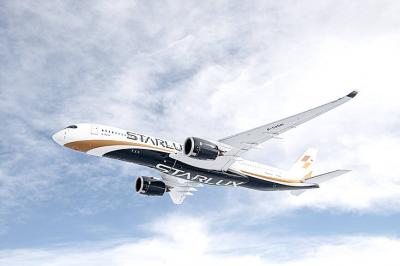
Starlux Airlines Co (星宇航空) today unveiled a long-haul network expansion plan at a shareholders’ meeting in Taipei, including direct flights to Barcelona, Spain, and Zurich, Switzerland, as well as a service connecting Taipei, Sydney and New Zealand. Starlux is to become the first Taiwanese carrier to offer non-stop services to the two European cities, while the inaugural oceanic route is expected to expand transit opportunities within the Australia-New Zealand market, Starlux said. Flight services to Chicago, Dallas, Washington and New York are under evaluation, the airline added. Prior to the shareholders’ meeting, the airline earlier this year announced that it would be

Taiwanese firms have increased investment in the Philippines in recent years as Manila’s ties with Washington deepen and global supply chains continue to shift away from China, an expert at the Chung-Hua Institution for Economic Research (CIER, 中華經濟研究院) said yesterday. The Philippines had not been among Taiwanese investors’ top choices in Southeast Asia, CIER Taiwan ASEAN Studies Center director Kristy Hsu (徐遵慈) said at a seminar in Taipei. However, Taiwan’s investment in the country has grown significantly since the COVID-19 pandemic, reaching US $257 million last year, a high in recent years, she said. Although Taiwan’s total investment in the Philippines still lags
Taiwanese prosecutors suspect that three people successfully smuggled at least one shipment of Nvidia Corp artificial intelligence (AI) chips to China after first exporting them to Japan, people familiar with the matter said. The trio was detained last week by the Keelung District Prosecutors’ Office for allegedly falsifying documents related to exports of Super Micro Computer Inc servers containing advanced Nvidia chips, which the US has barred from sale to China without a license from Washington. The move marked Taiwan’s first public crackdown on AI chip diversion after years of pressure from the US to take a more active role in curtailing


 RSS
RSS