


Carl Zeiss AG plans to increase investment and workforce in Taiwan this year to meet growing demand for advanced chip manufacturing and packaging inspections, the German company said yesterday.
It attributed robust demand for sophisticated packaging, such as 2.5D or 3D packaging, to an artificial intelligence boom and explosive demand for high-performance computing applications.
“We are accelerating our investment in Taiwan as it is a market with huge potential... We are looking mostly at the semiconductor area. Advanced packaging is the main direction we are working on in Taiwan,” Zeiss Taiwan general manager Henry Cai (蔡慧) told a news conference in Taipei. “We hope to increase the R&D workforce by at least 50 percent in Hsinchu.”
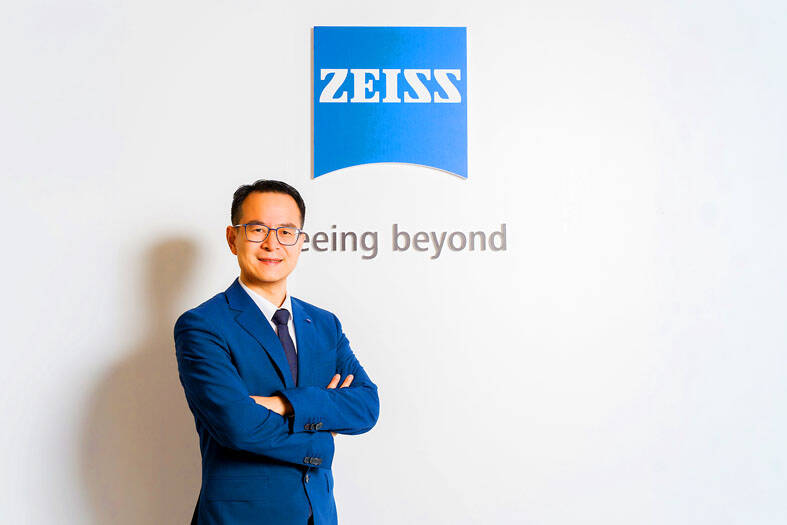
Photo courtesy of Zeiss Taiwan
The company offers nondestructive and high-resolution X-ray inspection to identify defects, which helps customers enhance production efficiency and improve yield rate of advanced packaging technology, such as chip-on-wafer-on-substrate technology, Zeiss said.
It is also seeking potential merger and acquisition (M&A) opportunities in the semiconductor area after last year acquiring local contact lens supplier Brighten Optix Corp (亨泰光學) for NT$5.4 billion (US$168.27 million). The deal would add about 200 employees to Zeiss Taiwan.
Zeiss in 2024 launched a NT$300 million innovation center at the Hsinchu Science Park (新竹科學園區), which is part of the company’s 10-year, NT$10 billion investment commitment through 2028. As of the end of 2024, it had invested NT$6 billion.
To enhance its localization strategy and deepen its cooperation with customers, Zeiss moved its advanced inspection equipment to the center, offering early inspection services for customers when their new chips are in the early stage of development.
The Middle East war is not expected to cause any raw material supply disruptions for the industry as most companies have learned lessons from COVID-19 pandemic lockdowns and adjusted, the company said.
However, spikes in transportation costs due to shipping route changes and higher crude oil prices have prompted the company to boost inventory of some spare parts against supply constraint risks, it said.

The EU and US are nearing an agreement to coordinate on producing and securing critical minerals, part of a push to break reliance on Chinese supplies. The potential deal would create incentives, such as minimum prices, that could advantage non-Chinese suppliers, according to a draft of an “action plan” seen by Bloomberg. The EU and US would also cooperate on standards, investments and joint projects, as well as coordinate on any supply disruptions by countries like China. The two sides are additionally seeking other “like-minded partners” to join a multicountry accord to help create these new critical mineral supply chains, which feed into

For weeks now, the global tech industry has been waiting for a major artificial intelligence (AI) launch from DeepSeek (深度求索), seen as a benchmark for China’s progress in the fast-moving field. More than a year has passed since the start-up put Chinese AI on the map in early last year with a low-cost chatbot that performed at a similar level to US rivals. However, despite reports and rumors about its imminent release, DeepSeek’s next-generation “V4” model is nowhere in sight. Speculation is also swirling over the geopolitical implications of which computer chips were chosen to train and power the new

Elon Musk’s lieutenants have reached out to chip industry suppliers, including Applied Materials Inc, Tokyo Electron Ltd and Lam Research Corp, for his envisioned Terafab, early steps in an audacious and likely arduous attempt to break into the production of cutting-edge chips. Staff working for the joint venture between Tesla Inc and Space Exploration Technologies Corp (SpaceX) have sought price quotes and delivery times for an array of chipmaking gear, people familiar with the matter said. In past weeks, they’ve contacted makers of photomasks, substrates, etchers, depositors, cleaning devices, testers and other tools, according to the people, who asked not to
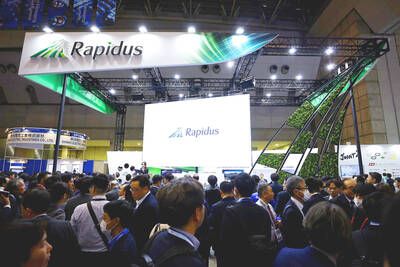
Japan approved ¥631.5 billion (US$3.97 billion) in additional subsidies to hasten Rapidus Corp’s entry into the high-stakes artificial intelligence (AI) chipmaking arena, ramping up support for a project widely regarded as a long shot. The capital is intended to bankroll Rapidus’ work for information technology firm Fujitsu Ltd, one of the initial customers that Tokyo hopes would get the signature endeavor off the ground. The new money raises the fees and investments that the government is injecting into the start-up to ¥2.6 trillion by the end of the current fiscal year to March next year, the Japanese Ministry of Economy, Trade and


 RSS
RSS