


Chinese Premier Li Qiang (李強) pledged to address worries that trade partners have about China’s large surplus, underscoring Beijing’s concern the issue could disrupt relations with more nations during a truce with the US in the tariff dispute.
“We take our trading partners’ concerns seriously and we are ready to work with all parties to promote the sound and balanced development of trade,” Li said in a keynote speech at the China Development Forum in Beijing on Sunday.
“We will also further widen market access for the services sector and increase imports of medical and health care products, digital technologies and low carbon services to provide more business opportunities for foreign companies,” he added.
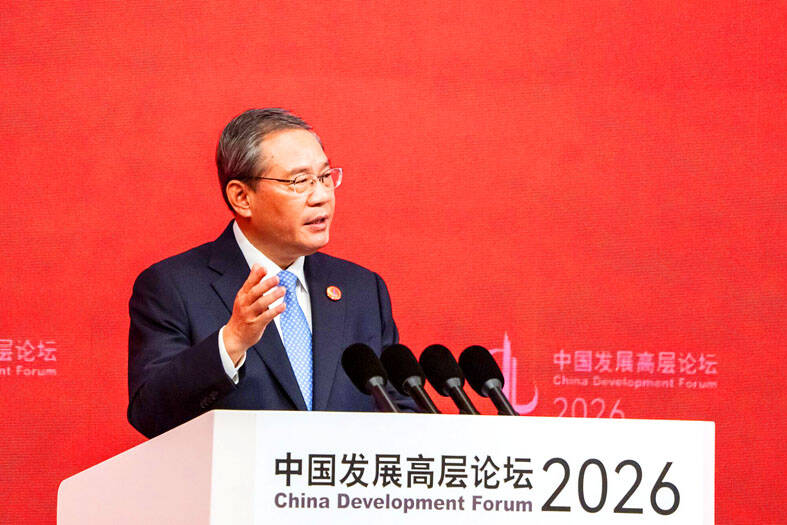
Photo: Bloomberg
China racked up a record trade surplus of US$1.2 trillion last year and exports continued to surge in the first two months of this year, exacerbating worry in many countries around the world about the future of their own industries.
Authorities in China have taken some steps to address the rising trade tensions, including by reducing export tax rebates for hundreds of products such as solar cells and batteries.
The manufacturing strength comes with the economy troubled by weak domestic consumption. Industries including solar are also struggling with overcapacity and intense price competition.
Beijing has made progress in curbing so called involution style competition, Li said.
At the same forum, People’s Bank of China Governor Pan Gongsheng (潘功勝) defended his nation’s current account surplus, saying it “is allocated to different regions and industries worldwide through foreign investment by Chinese enterprises and the banks.”
He added that the surplus “has underpinned global economic growth and financial stability.”
Pan also mentioned a slew of “non-economic factors” that damaged global economic balances, including front-loading of Chinese exports triggered by US tariffs, and export controls that distorted business and household expectations.
IMF first deputy managing director Dan Katz said at the forum that Beijing “can do more to increase consumption and domestic demand — especially for services — by boosting household incomes and reducing incentives for precautionary savings.”
This would entail “shifting resources away from industrial subsidies and infrastructure and toward social safety net programs and stabilizing the property sector to give citizens the confidence to spend more and save less,” he added.
It would also mean moving the tax burden from middle-class households toward better off ones, and cutting exemptions for corporates.
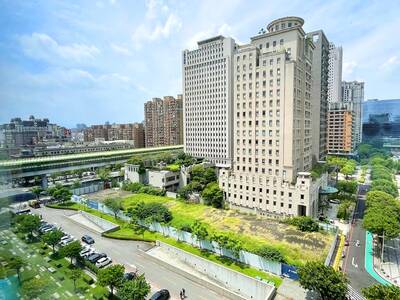
Taichung reported the steepest fall in completed home prices among the six special municipalities in the first quarter of this year, data compiled by Taiwan Realty Co (台灣房屋) showed yesterday. From January through last month, the average transaction price for completed homes in Taichung fell 8 percent from a year earlier to NT$299,000 (US$9,483) per ping (3.3m²), said Taiwan Realty, which compiled the data based on the government’s price registration platform. The decline could be attributed to many home buyers choosing relatively affordable used homes to live in themselves, instead of newly built homes in the city’s prime property market, Taiwan Realty
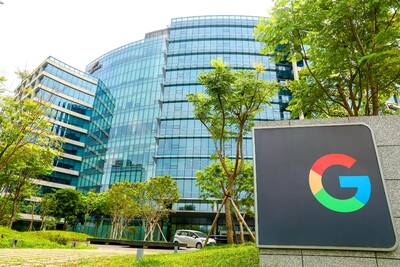
The government yesterday approved applications by Alphabet Inc’s Google to invest NT$27.08 billion (US$859.98 million) in Taiwan, the Ministry of Economic Affairs said in a statement. The Department of Investment Review approved two investments proposed by Google, with much of the funds to be used for data processing and electronic information supply services, as well as inventory procurement businesses in the semiconductor field, the ministry said. It marks the second consecutive year that Google has applied to increase its investment in Taiwan. Google plans to infuse NT$25.34 billion into Charter Investments Ltd (特許投資顧問) through its Singapore-based subsidiary Fructan Holdings Singapore Pte Ltd, and

JET JUICE: The war on Iran’s secondary effects have seen fuel prices skyrocket, knocking flight schedules down to earth in return as airlines struggle with costs Airline passengers should brace for more irritation in the next few months as carriers worldwide cancel flights and ground planes to cope with stratospheric increases in jet-fuel prices. Dutch flag carrier KLM is the latest company to cut its schedule, saying on Thursday that it would scrap 80 return flights at Amsterdam’s Schiphol Airport in the coming month. That puts it in the same league as United Airlines Holdings Inc, Deutsche Lufthansa AG and Cathay Pacific Airways Ltd, which have all pruned itineraries to mitigate costs. Global capacity for next month has been reduced by about 3 percentage points, with all

Micron Technology Inc is a driving force pushing the US Congress to pass legislation that would put new export restrictions on equipment its Chinese competitors use to make their chips, according to people familiar with the matter. A US House of Representatives panel yesterday was to vote on the “MATCH Act,” a bill designed to close gaps in restrictions on chipmaking equipment. It would also pressure foreign companies that sell equipment to Chinese chipmaking facilities to align with export curbs on US companies like Lam Research Corp and Applied Materials Inc. The bill targets facilities operated by China’s ChangXin Memory Technologies Inc


 RSS
RSS