


More than 15 million barrels of Russian oil are floating within easy reach of India, offering the nation a quick fix to Middle East supply shortages after the US issued a temporary license allowing purchases.
The crude is sitting on more than a dozen tankers in the Arabian Sea and the Bay of Bengal, according to ship tracking data compiled by Bloomberg.
These cargoes — which appear to be unsold, or without a specific destination port — could reach India in a week or less.
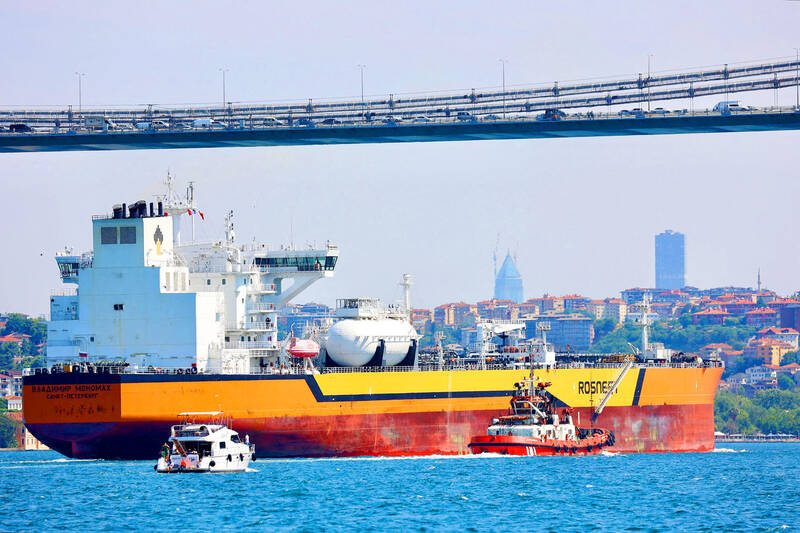
Photo: Reuters
Another eight vessels carrying roughly 7 million barrels of Russian Urals oil are idling off Singapore and could also reach India within a week.
Beyond that, more cargoes are moving east through the Mediterranean Sea and the Suez canal, and could potentially reach India in under a month.
India, which became a major importer of discounted Russian oil following the invasion of Ukraine, had sharply cut back on the purchases under US pressure.
However, the war in the Middle East has cut off its access to replacement supplies from Persian Gulf producers, prompting Washington to give it a one-month waiver to resume buying.
Tankers laden with Russian oil had begun changing their destination to signal Indian ports even before the license was issued late on Thursday in Washington.
About 18 vessels carrying Urals are now indicating they are heading to India, energy market intelligence firm Kpler said.
“Refiners could quickly ramp up purchases again, potentially pushing volumes back above 2 million barrels a day in the near term,” said Sumit Ritolia, an analyst at the data intelligence firm. “The steep discounts previously seen on Russian crude could narrow significantly and may even shift toward premiums.”
Russia’s flagship Urals grade had been trading at deep discounts to ICE Brent, as India pulled back on purchases and China was left to absorb stranded cargoes. The resumption of Indian purchases and the shortages caused by the Middle East crisis would temporarily reverse that trend.
Indian refiners have already bought more than 10 million barrels of Urals in recent days, paying premiums to Brent for cargoes inclusive of freight and delivery costs.
Prices are as much as US$12 a barrel higher than in previous weeks.
Separately, South Korea yesterday struck a deal to ship about 4 million barrels of oil from the United Arab Emirates (UAE), bolstering supplies as the US-Israel war on Iran upends energy markets.
Iran claims it is now in control of the crucial Strait of Hormuz, the Gulf chokepoint through which one-fifth of the world’s crude oil flows.
Heavily reliant on oil shipped through the strait, South Korea said it had dispatched tankers to secure alternative supplies of fuel.
“We plan to immediately berth two South Korean-flagged oil tankers — each with a capacity of 2 million barrels — at alternative ports within the UAE that do not require passage through the Strait of Hormuz,” South Korean Presidential Chief of Staff Kang Hoon-sik said.
Seoul also secured a pledge that “up to 2 million barrels from the jointly held strategic reserves that the UAE stores in South Korea can be made available at any time upon request,” Kang said.
About 70 percent of the crude oil South Korea imports passes through the Strait of Hormuz, Seoul said.
Additional reporting by AFP

MANAGING RISKS: Taiwan has secured LNG sufficient to cover 95 percent of electricity demand for next month, UBS said, describing the government’s approach as proactive UBS Group AG has raised its forecast for Taiwan’s economic growth this year to 8 percent, up from 6.9 percent previously, and said expansion could reach as high as 8.6 percent if external energy shocks are avoided. The upgrade reflects a stronger-than-expected first-quarter performance and sustained momentum in artificial intelligence (AI)-driven exports, which UBS said are providing a firm foundation for growth despite geopolitical and energy risks. Taiwan’s GDP expanded 13.69 percent year-on-year in the first quarter, the fastest growth since the second quarter of 1987, the Directorate-General of Budget, Accounting and Statistics (DGBAS) reported on Thursday. On a seasonally
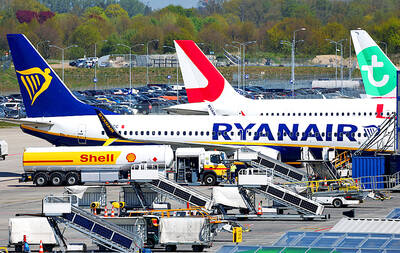
Ryanair, Transavia, Volotea and other low-cost airlines are feeling the financial pain from high jet fuel prices as a result of the Middle East war and are cutting flights. The closure of the Strait of Hormuz has taken a huge chunk of oil supplies off the market, sending the price of jet fuel soaring and triggering fears of shortages that could force airlines to cancel flights. Airlines are not waiting for a lack of supplies to react. “Travel alert: Airlines are cutting thousands of flights right now,” Travel Therapy host Karen Schaler said in an Instagram reel this past weekend.

Shares of Taiwan Semiconductor Manufacturing Co (TSMC, 台積電) have repeatedly hit new highs, but an equity analyst said the stock’s valuation remains within a reasonable range and any pullback would likely be technical. The contract chipmaker’s historical price-to-earnings (P/E) ratio has ranged between 20 and 30, Cathay Futures Consultant Co (國泰證期) analyst Tsai Ming-han (蔡明翰) told Central News Agency. With market consensus projecting that TSMC would post earnings per share of about NT$100 (US$3.17) this year, supported by strong global demand for artificial intelligence (AI) applications, and the stock currently trading at a P/E ratio of below 25, Tsai said the valuation

The list of Asian stocks that benefit from business partnership with Nvidia Corp is getting longer, as the region further integrates into the artificial intelligence (AI) chip giant’s business ecosystem. Just in the past week, South Korea’s LG Electronics Inc, Taiwan’s Nanya Technology Corp (南亞科技), as well as China’s Huizhou Desay SV Automotive Co (德賽西威) and Pateo Connect Technology Shanghai Corp (博泰車聯) have become the latest to rally on news of tie-ups, supply-chain participation or product collaboration with the US chip designer. Asian suppliers account for about 90 percent of Nvidia’s production costs, up from about 65 percent last year, data compiled


 RSS
RSS