

China yesterday imposed export restrictions on dozens of Japanese firms that it said were involved in building up Tokyo’s military, escalating a months-long row.
The spat between Asia’s top two economies was sparked by comments by Japanese Prime Minister Sanae Takaichi in November last year that Japan could intervene militarily in any attack on Taiwan.
The measures announced yesterday cover exports of “dual-use” items — which can have civilian and military uses — to 20 Japanese entities, including subsidiaries of Mitsubishi Heavy Industries Ltd and Japan’s space agency.
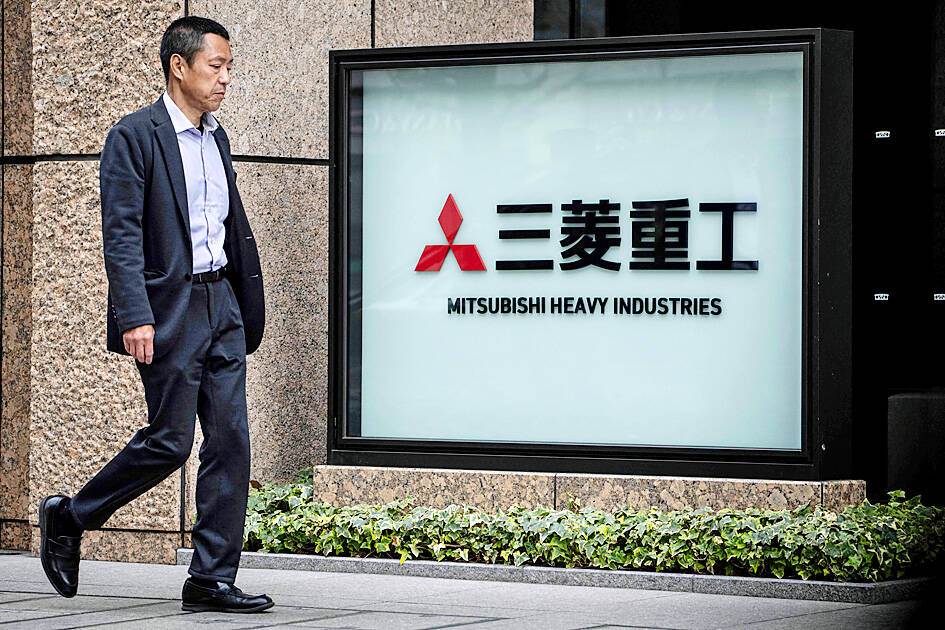
Photo: AFP
The Chinese Ministry of Commerce added a further 20 Japanese organizations, including car manufacturer Subaru Corp, to a “watch list” requiring stricter reviews of exported items that could be used for military purposes.
“The above measures are aimed at curbing Japan’s ‘remilitarization’ and nuclear ambitions and are completely legitimate, reasonable and lawful,” the Chinese ministry said in a statement.
“Honest and law-abiding Japanese entities have nothing to worry about,” it added.
A Japanese Ministry of Economy, Trade and Industry official told Agence France-Presse that Tokyo would “take appropriate measures” after analyzing the impact of the new curbs.
Tokyo had strongly protested the measures and demanded they be overturned, said Japanese Deputy Chief Cabinet Secretary Kei Sato who called Beijing’s move “absolutely intolerable and extremely regrettable.”
China last month announced tightened controls on exports to Japan for items with potential military uses.
This fueled worries that Beijing might choke supplies of vital rare-earth minerals, some of which are included in China’s list of “dual-use” goods.
The latest move singles out Japanese industrial heavyweights, including shipbuilding and aerospace firms.
Shares in Kawasaki Heavy Industries Ltd sank almost 5 percent in Tokyo, while Mitsubishi Heavy Industries shed close to 4 percent and IHI Corp tumbled nearly 7 percent.
Several of the firms listed are active in the defense industry, manufacturing kits including ships, fighter jets and missiles for the Japanese military.
Takaichi’s government in December last year approved a record defense budget worth ¥9 trillion (US$57.78 billion) for the coming fiscal year to expand its military capabilities.
Takaichi told the Japanese parliament on Friday last week that China was intensifying attempts to change the “status quo” “by force or coercion” in the East China and the South China seas.
“Strengthening our defense capabilities is essential to protect the lives and peaceful livelihoods of our citizens, as we face the most severe and complex security environment since the end of [World War II],” Takaichi said on Monday.
Japanese firms dealing with China were already struggling with delays in getting approvals, Nagoya University of Foreign Studies professor emeritus of Japan-China relations Noriyuki Kawamura said.
“With today’s announcement, we can expect the process will be made even more stringent. I believe this will be a huge blow to companies involved,” Kawamura said.
University of Tokyo international security professor Heng Yee-kuang (衡奕匡) said that Japanese firms are major buyers of critical minerals gallium and germanium from China, with gallium nitride used in radar sensors on Japanese warships.
“Short-term impact may be limited with a stockpile to cushion the disruptions, but if the controls drag on, some damage is possible,” Heng said.
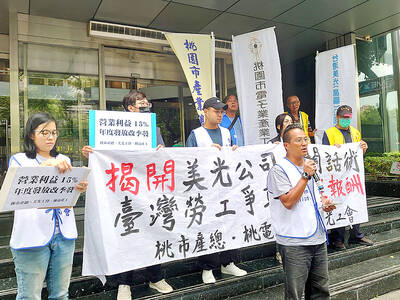
UNION DETERMINATION: Rejecting an offer for a one-time payout as an attempt to influence opinion, the union said a strike at the memory chip manufacturer is possible The Micron Taiwan workers’ union yesterday rejected a one-time payout unveiled by US-based Micron Technology Inc last week, saying it wants a long-term mechanism under which employees would share 15 percent of the company’s operating profits. While the union and the company are still in talks over the dispute, the reward package was proposed unilaterally by the employer without reaching an agreement with the union, union head Jerry Lin (林哲瑞) told reporters. Lin said he suspected the company was seeking to influence public opinion with the move. On Friday last week, Micron announced a reward package under which employees in Taiwan would receive
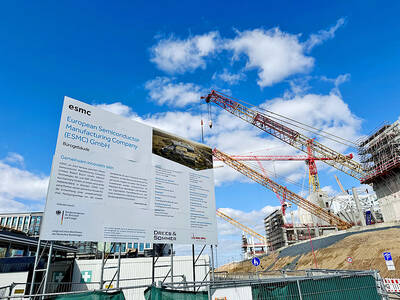
BUILDER’s RITES: The topping out ceremony is held when a project being built has its highest point laid out, a sure sign that TSMC’s European project is making solid progress A “topping out” ceremony was held on Monday at a plant under construction in Germany by Taiwan Semiconductor Manufacturing Co (TSMC, 台積電), indicating that the fab is progressing as planned and within budget, the head of a joint-venture company in charge of the project said. A topping out ceremony is the construction milestone of laying the final beam or structural piece at the highest point of a building, and it honors the construction crew, architects and engineers. European Semiconductor Manufacturing Co (ESMC) president Christian Koitzsch said that about 2,000 workers from 106 countries are working around the clock at the site in
SOME CUSHION: Taiwan’s GDP is forecast to grow more than 11 percent this year, so the economy should be able to absorb the impact of a rate hike, an expert said With domestic inflation topping the 2 percent alert level for a fourth consecutive month last month and several major central banks around the world raising their key interest rates, Taiwan’s central bank is facing growing pressure to raise rates at its quarterly policymaking meeting on Thursday, economists said. At its June meeting, the central bank left interest rates unchanged for the ninth consecutive quarter, with the discount rate at 2 percent. Central Bank Governor Yang Chin-long (楊金龍) had said that the bank maintained a somewhat hawkish stance, with two board directors voicing support for a rate hike at the meeting. Cathay United
APPEAL: Any agreement to produce advanced memory such as HBM or DRAM could run into opposition from Seoul as those technologies are sensitive, sources said South Korea’s SK Hynix Inc is in talks with Intel Corp about a deal that would see it manufacture memory chips on US soil for the first time, three people familiar with the discussions said. Under one potential scenario, SK Hynix would lease part of Intel’s long-planned chipmaking facility in Ohio, they said. Under another scenario, it could form a venture with Intel and major cloud firms that are keen to lock in memory supplies, two of the people said. A deal would relieve pressure on Intel, which has been struggling, and mark a big win for US President Donald


 RSS
RSS