


French President Emmanuel Macron told a global artificial intelligence (AI) summit in India yesterday he was determined to ensure safe oversight of the fast-evolving technology.
The EU has led the way for global regulation with its Artificial Intelligence Act, which was adopted in 2024 and is coming into force in phases.
“We are determined to continue to shape the rules of the game... with our allies such as India,” Macron said in New Delhi. “Europe is not blindly focused on regulation — Europe is a space for innovation and investment, but it is a safe space.”
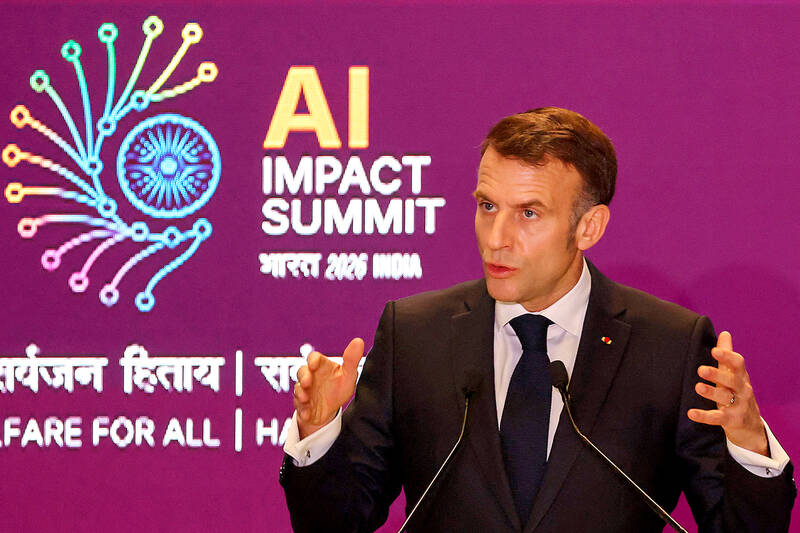
Photo: AFP
The AI Impact Summit is the fourth annual international gathering focused on the rapidly advancing field.
At last year’s summit in Paris, US Vice President J.D. Vance warned against “excessive regulation” that “could kill a transformative sector.”
Under EU laws, regulators can ban AI systems deemed to pose “unacceptable risks” to society, such as identifying people in real time using cameras in public spaces.
Macron, speaking at the AI Impact Summit in New Delhi, said France was “doubling the number of AI scientists and engineers trained,” with new startups in the sector creating “dozens of thousands” of jobs.
In his address at the summit, Indian Prime Minister Narendra Modi said AI has to be open to all.
“AI has to be democratized so that humans don’t just become a data point for AI or remain a raw material for AI,” Modi said yesterday, speaking in Hindi.
“We must democratize AI. It must become a medium for inclusion and empowerment, particularly for the Global South,” he said.
Modi also highlighted recent launches of AI models by Indian companies, saying that “the AI model which succeeds in India can be deployed all over the world.”
“India believes that AI technology will only be beneficial when it is shared and its core systems are open; only then will our millions of young minds be able to make it better and safer,” he added. “We must resolve that AI is used for the global common good.”
Modi, breaking into English, added: “We are entering an era where humans and intelligence systems co-create, co-work and co-evolve.”
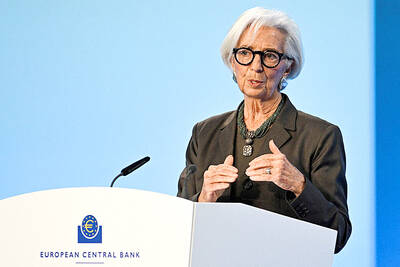
European Central Bank (ECB) President Christine Lagarde is expected to step down from her role before her eight-year term ends in October next year, the Financial Times reported. Lagarde wants to leave before the French presidential election in April next year, which would allow French President Emmanuel Macron and German Chancellor Friedrich Merz to find her replacement together, the report said, citing an unidentified person familiar with her thoughts on the matter. It is not clear yet when she might exit, the report said. “President Lagarde is totally focused on her mission and has not taken any decision regarding the end of
OpenAI has warned US lawmakers that its Chinese rival DeepSeek (深度求索) is using unfair and increasingly sophisticated methods to extract results from leading US artificial intelligence (AI) models to train the next generation of its breakthrough R1 chatbot, a memo reviewed by Bloomberg News showed. In the memo, sent on Thursday to the US House of Representatives Select Committee on China, OpenAI said that DeepSeek had used so-called distillation techniques as part of “ongoing efforts to free-ride on the capabilities developed by OpenAI and other US frontier labs.” The company said it had detected “new, obfuscated methods” designed to evade OpenAI’s defenses
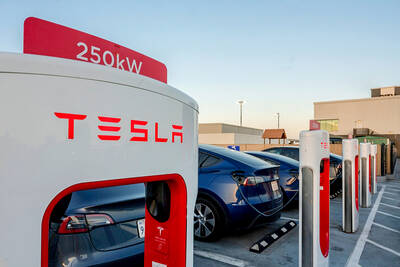
NEW IMPORTS: Car dealer PG Union Corp said it would consider introducing US-made models such as the Jeep Grand Cherokee and Stellantis’ RAM 1500 to Taiwan Tesla Taiwan yesterday said that it does not plan to cut its car prices in the wake of Washington and Taipei signing the Agreement on Reciprocal Trade on Thursday to eliminate tariffs on US-made cars. On the other hand, Mercedes-Benz Taiwan said it is planning to lower the price of its five models imported from the US after the zero tariff comes into effect. Tesla in a statement said it has no plan to adjust the prices of the US-made Model 3, Model S and Model X as tariffs are not the only factor the automaker uses to determine pricing policies. Tesla said

Australian singer Kylie Minogue says “nothing compares” to performing live, but becoming an international wine magnate in under six years has been quite a thrill for the Spinning Around star. Minogue launched her first own-label wine in 2020 in partnership with celebrity drinks expert Paul Schaafsma, starting with a basic rose but quickly expanding to include sparkling, no-alcohol and premium rose offerings. The actress and singer has since wracked up sales of around 25 million bottles, with her carefully branded products pitched at low-to mid-range prices in dozens of countries. Britain, Australia and the United States are the biggest markets. “Nothing compares to performing


 RSS
RSS