


US trading partners in Asia started weighing fresh uncertainties yesterday after President Donald Trump vowed to impose a new tariff on imports, hours after the Supreme Court struck down many of the sweeping levies he used to launch a global trade war.
The court’s ruling invalidated a number of tariffs that the Trump administration had imposed on Asian export powerhouses from China and South Korea to Japan and Taiwan, the world’s largest chip maker and a key player in tech supply chains.
Within hours, Trump said he would impose a new 10 percent duty on US imports from all countries starting on Tuesday for an initial 150 days under a different law, prompting analysts to warn that more measures could follow, threatening more confusion for businesses and investors.
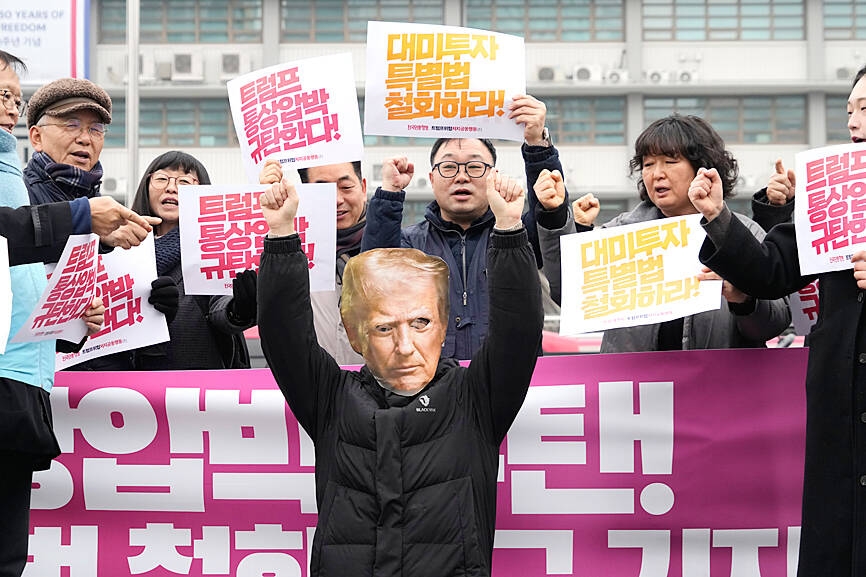
Photo: AP
In Japan, a government spokesman said Tokyo “will carefully examine the content of this ruling and the Trump administration’s response to it, and respond appropriately.”
China, which is preparing to host Trump late next month, has yet to formally comment or launch any counter moves with the country on an extended holiday. But a senior financial official in China-ruled Hong Kong described the US situation as a “fiasco.”
Hong Kong Secretary for Financial Services and the Treasury Christopher Hui (許正宇) said Trump’s new levy served to underscore Hong Kong’s “unique trade advantages.”
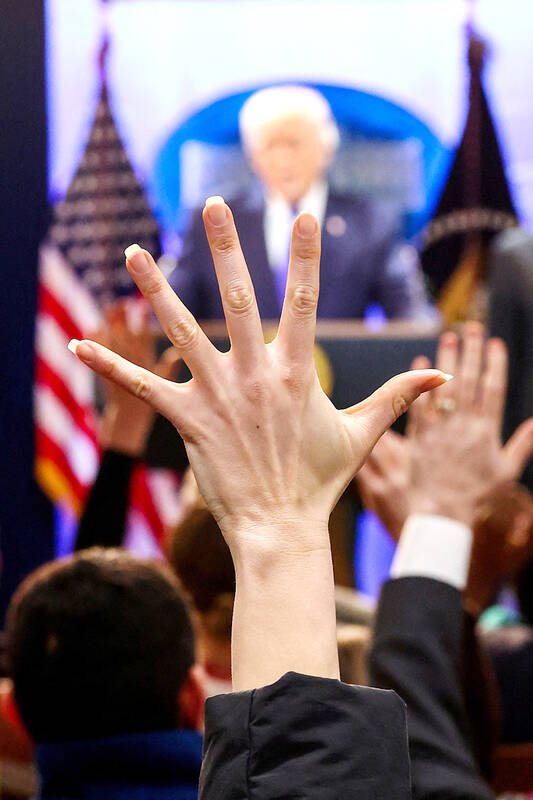
Photo: Reuters
“This shows the stability of Hong Kong’s policies and our certainty ... it shows global investors the importance of predictability,” Hui said at a media briefing yesterday when asked how the new US tariff’s would affect the city’s economy.
Hong Kong operates as a separate customs territory from mainland China, a status that has shielded it from direct exposure to US tariffs targeting Chinese goods.
While Washington has imposed duties on mainland exports, Hong Kong-made products have generally faced lower tariff rates, allowing the city to maintain trade flows even as Sino-US tensions have escalated.
Before the Supreme Court’s ruling, Trump’s tariff push had strained Washington’s diplomatic relations across Asia, particularly for export-reliant economies integrated into US-bound supply chains.
Friday’s ruling concerns only the tariffs launched by Trump on the basis of the International Emergency Economic Powers Act, or IEEPA, intended for national emergencies.
Trade policy monitor Global Trade Alert estimated that by itself, the ruling cuts the trade-weighted average US tariff almost in half from 15.4 percent to 8.3 percent.
For those countries on higher US tariff levels, the change is more dramatic. For China, Brazil and India, it will mean double-digit percentage point cuts, albeit to still-high levels.
In Taiwan, the government said it was monitoring the situation closely, noting that the US government had yet to determine how to fully implement its trade deals with many countries.
“While the initial impact on Taiwan appears limited, the government will closely monitor developments and maintain close communication with the US to understand specific implementation details and respond appropriately,” a Cabinet statement said.
Taiwan has signed two recent deals with the US — one was a Memorandum of Understanding last month that committed Taiwan to invest US$250 billion and the second was signed this month to lowering reciprocal tariffs.
Analysts said that the Supreme Court’s ruling against Trump’s more aggressive tariff measures might offer little relief for the global economy. They warned of looming confusion as trading nations brace for moves by Trump to find other means of using levies to circumvent the ruling.
Thailand’s Trade Policy and Strategy Office head Nantapong Chiralerspong said the ruling might even benefit its exports as uncertainty drove a fresh round of “front loading,” where shippers race to move goods to the US, fearing even higher tariffs.
In corporate disclosures tracked by Reuters, firms across the Asia-Pacific region reported financial hits, supply shifts and withdrawals as levies escalated through last year and early this year.
South Korea said the US Supreme Court ruling would not derail its broader trade agreement with Washington.
South Korean Industry Minister Kim Jung-kwan held an emergency meeting yesterrday to assess the decision. The ruling renders void the 15 percent reciprocal tariff currently applied to South Korean goods, the Ministry of Trade, Industry and Resources said in a statement.
“Although the ruling has heightened uncertainty over exports to the US, the overall framework of export conditions secured under the Korea-US tariff agreement will remain intact,” Kim said, pledging a full-scale response to protect national interests and Korean companies.
Sectoral tariffs on automobiles and steel, imposed under separate laws, remain in place, and are unaffected by the court’s decision, the ministry said.
Seoul said it would closely monitor Washington’s follow-up measures, while continuing talks on the implementation of last year’s trade agreement.
The ruling comes against an already fragile tariff backdrop between Seoul and Washington. The US imposed a 15 percent tariff on South Korean imports, including autos, under a deal that features a US$350 billion investment commitment. Trump last month also warned of a possible tariff increase, citing delays in South Korean legislation needed to implement the pledge.
The presidential Blue House said it would comprehensively review the court ruling and the US government’s position, and would proceed in a direction that best serves the national interest.
Seoul said it would monitor US developments on potential refunds of the now-voided reciprocal tariffs and work with business groups to support affected companies.

The domestic unit of the Chinese-owned, Dutch-headquartered chipmaker Nexperia BV will soon be able to produce semiconductors locally within China, according to two company sources. Nexperia is at the center of a global tug-of-war over critical semiconductor technology, with a Dutch court in February ordering a probe into alleged mismanagement at the company. The geopolitical tussle has disrupted supply chains, with some carmakers reportedly forced to cut production due to chip shortages. Local production would allow Nexperia’s domestic arm, Nexperia Semiconductors (China) Ltd (安世半導體中國), to bypass restrictions in place since October on the supply of silicon wafers — etched with tiny components to

Singapore-based ride-hailing and delivery giant Grab Holdings Ltd has applied for regulatory approval to acquire the Taiwan operations of Germany-based Delivery Hero SE's Foodpanda in a deal valued at about US$600 million. Grab submitted the filing to the Fair Trade Commission on Friday last week, with the transaction subject to regulatory review and approval, the company said in a statement yesterday. Its independent governance structure would help foster a healthy and competitive market in Taiwan if the deal is approved, Grab said. Grab, which is listed on the NASDAQ, said in the filing that US-based Uber Technologies Inc holds about 13 percent of

Taiwan Semiconductor Manufacturing Co (TSMC, 台積電) yesterday received government approval to deploy its advanced 3-nanometer (3nm) process at its second fab currently under construction in Japan, the Ministry of Economic Affairs said in a news release. The ministry green-lit the plan for the facility in Kumamoto, which is scheduled to start installing equipment and come online in 2028 with a monthly production capacity of 15,000 12-inch wafers, the ministry said. The Department of Investment Review in June 2024 authorized a US$5.26 billion investment for the facility, slated to manufacture 6- to 12nm chips, significantly less advanced than 3nm process. At a meeting with

Taiwan’s food delivery market could undergo a major shift if Singapore-based Grab Holdings Ltd completes its planned acquisition of Delivery Hero SE’s Foodpanda business in Taiwan, industry experts said. Grab on Monday last week announced it would acquire Foodpanda’s Taiwan operations for US$600 million. The deal is expected to be finalized in the second half of this year, with Grab aiming to complete user migration to its platform by the first half of next year. A duopoly between Uber Eats and Foodpanda dominates Taiwan’s delivery market, a structure that has remained intact since the Fair Trade Commission (FTC) blocked Uber Technologies Inc’s


 RSS
RSS