


Three Vietnamese airlines announced nearly US$37 billion in purchases on Wednesday, in a series of contracts signed with US aerospace companies.
The agreements come as Hanoi and Washington continue trade negotiations on US tariffs on Vietnamese products, currently set at 20 percent.
The Southeast Asian nation posted 8 percent growth last year despite the new US tariffs, defying expectations when many feared the collapse of its export-driven growth model.
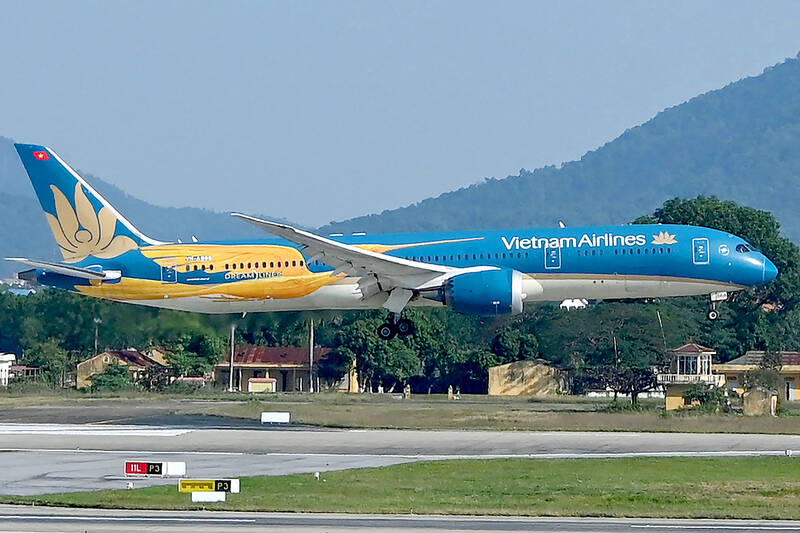
Photo: AFP
Fledgling airline Sun PhuQuoc Airways said on Wednesday it placed an order for 40 of Boeing Co’s 787 Dreamliners, a long-haul aircraft, with an estimated total value of US$22.5 billion.
Founded just a year ago, the airline said in a statement that the purchase “reflects Sun PhuQuoc Airways’ strategic ambition to build a truly intercontinental network.”
National carrier Vietnam Airlines placed an US$8.1 billion order for around 50 Boeing 737-8 aircraft, and opened discussions for an additional order for around 30 wide-body aircraft in the future, the airline said in a statement.
The agreement creates “a solid foundation for our ambition to become a leading airline by 2030,” Vietnam Airlines chairman Dang Ngoc Hoa said in the statement.
Low-cost carrier Vietjet Air also announced two contracts, totalling US$6.3 billion.
Of that, about US$5.4 billion will go toward supplies and maintenance of engines for 44 Airbus SE A320 series aircraft by US manufacturer Pratt & Whitney.
Around US$960 million remaining will go towards leasing six Boeing 737 series aircraft from Griffin Global Asset Management LLC.
The signing took place on the sidelines of Vietnamese leader To Lam’s visit to Washington, where he is expected to join the inaugural meeting of US President Donald Trump’s “Board of Peace.”
The two countries held a sixth round of trade talks this month, but have not reached a final agreement.
Last year, Vietnam, a manufacturing hub in the region, saw a 28 percent surge in exports to the US — its largest export market — while its trade surplus swelled to US$134 billion, according to official figures.
When Trump announced his “Liberation Day” tariffs in April last year, Vietnam had the third-largest trade surplus with the US of any country after China and Mexico, and was targeted with one of the highest rates in Trump’s tariff blitz.
However, by July, Hanoi secured a minimum 20 percent tariff with Washington, down from more than 40 percent, in return for opening its market to US products, including cars.

SECOND-RATE: Models distilled from US products do not perform the same as the original and undo measures that ensure the systems are neutral, the US’ cable said The US Department of State has ordered a global push to bring attention to what it said are widespread efforts by Chinese companies, including artificial intelligence (AI) start-up DeepSeek (深度求索), to steal intellectual property from US AI labs, according to a diplomatic cable. The cable, dated Friday and sent to diplomatic and consular posts around the world, instructs diplomatic staff to speak to their foreign counterparts about “concerns over adversaries’ extraction and distillation of US AI models.” Distillation is the process of training smaller AI models using output from larger, more expensive ones to lower the costs of training a powerful new
Micron Technology Inc is a driving force pushing the US Congress to pass legislation that would put new export restrictions on equipment its Chinese competitors use to make their chips, according to people familiar with the matter. A US House of Representatives panel yesterday was to vote on the “MATCH Act,” a bill designed to close gaps in restrictions on chipmaking equipment. It would also pressure foreign companies that sell equipment to Chinese chipmaking facilities to align with export curbs on US companies like Lam Research Corp and Applied Materials Inc. The bill targets facilities operated by China’s ChangXin Memory Technologies Inc

Singapore-based ride-hailing and delivery giant Grab Holdings’ planned acquisition of Foodpanda’s Taiwan operations has yet to enter the formal review stage, as regulators await supplementary documents, the Fair Trade Commission (FTC) said yesterday. Acting FTC Chairman Chen Chih-min (陳志民) told the legislature’s Economics Committee that although Grab submitted its application on March 27, the case has not been officially accepted because required materials remain incomplete. Once the filing is finalized, the FTC would launch a formal probe into the deal, focusing on issues such as cross-shareholding and potential restrictions on market competition, Chen told lawmakers. Grab last month announced that it would acquire
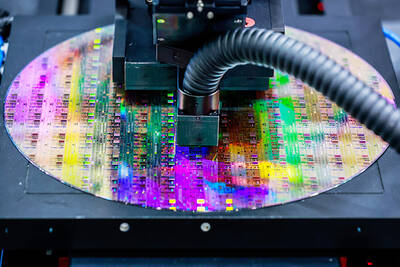
The artificial intelligence (AI) boom has triggered a seismic reshuffling of global equity markets, with Taiwan and South Korea muscling past European nations one by one. With its stock market now valued at nearly US$4.3 trillion, Taiwan surpassed the UK, Europe’s biggest market, earlier this month, data compiled by Bloomberg showed. South Korea is about US$140 billion away from doing the same. The tech-heavy Asian markets have shot past Germany and France in the past seven months. The shift is largely down to massive gains in shares of three companies that provide essential hardware for AI: Taiwan Semiconductor Manufacturing Co (TSMC, 台積電),


 RSS
RSS