


The union at TaiDoc Technology Corp (泰博科技) said yesterday that it will launch a strike campaign to press the medical device maker to meet its demands, including reinstating dismissed union officials.
Union members and labor groups chanted slogans during a protest outside the Ministry of Labor in Taipei yesterday morning.
It was the union’s fourth protest at the ministry, following three demonstrations over what it described as overly strict management rules for migrant workers and alleged union-busting.
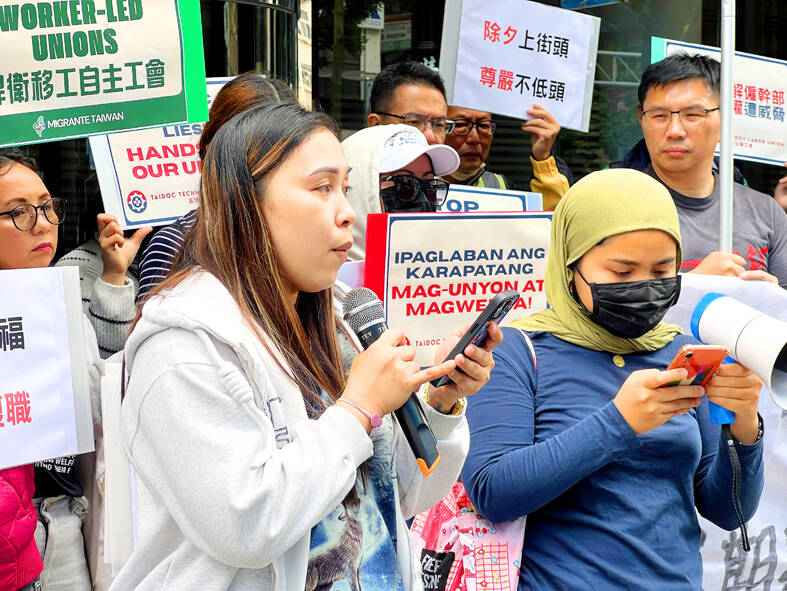
Photo: CNA
Fang Chang (張仲方), a labor rights advocate who hosted the protest, said the New Taipei City-based company dismissed all union officials the day after the union’s third protest on Monday last week over the firing of its chair.
Afterward, Chang said, TaiDoc chairman Chen Chao-wang (陳朝旺) offered to reinstate the six officials during a videoconference on the condition that they quit the union, an offer they rejected. They were then forced out of their dormitories the following day.
Union chair Elizabeth Basas said the strike campaign was announced outside the Ministry of Labor on Lunar New Year’s Eve to underscore the union’s determination to continue its actions until the dispute is resolved.
“This is not only a fight for money, but also a fight to defend our dignity, rights and freedom,” she said.
Basas and the six dismissed officials are staying at a shelter run by the labor rights NGO Serve the People Association.
Lennon Wang (汪英達), the group’s director of migrant worker policy and the union’s secretary-general, said the union has close to 30 members, all Filipino workers, adding that reinstating the dismissed officials is a prerequisite for negotiations.
He said the timing of an actual walkout has yet to be decided, adding the company would “definitely fire everyone who goes on strike.”
In response, the Ministry of Labor said the Labor Union Act (工會法) protects the right to organize for both local and migrant workers, and warned TaiDoc could face fines of up to NT$500,000 (US$15,943) if its actions are found to constitute malicious union-busting.
TaiDoc later said it would not respond to the union’s protest or demands.

The EU and US are nearing an agreement to coordinate on producing and securing critical minerals, part of a push to break reliance on Chinese supplies. The potential deal would create incentives, such as minimum prices, that could advantage non-Chinese suppliers, according to a draft of an “action plan” seen by Bloomberg. The EU and US would also cooperate on standards, investments and joint projects, as well as coordinate on any supply disruptions by countries like China. The two sides are additionally seeking other “like-minded partners” to join a multicountry accord to help create these new critical mineral supply chains, which feed into

Elon Musk’s lieutenants have reached out to chip industry suppliers, including Applied Materials Inc, Tokyo Electron Ltd and Lam Research Corp, for his envisioned Terafab, early steps in an audacious and likely arduous attempt to break into the production of cutting-edge chips. Staff working for the joint venture between Tesla Inc and Space Exploration Technologies Corp (SpaceX) have sought price quotes and delivery times for an array of chipmaking gear, people familiar with the matter said. In past weeks, they’ve contacted makers of photomasks, substrates, etchers, depositors, cleaning devices, testers and other tools, according to the people, who asked not to

For weeks now, the global tech industry has been waiting for a major artificial intelligence (AI) launch from DeepSeek (深度求索), seen as a benchmark for China’s progress in the fast-moving field. More than a year has passed since the start-up put Chinese AI on the map in early last year with a low-cost chatbot that performed at a similar level to US rivals. However, despite reports and rumors about its imminent release, DeepSeek’s next-generation “V4” model is nowhere in sight. Speculation is also swirling over the geopolitical implications of which computer chips were chosen to train and power the new

Japan approved ¥631.5 billion (US$3.97 billion) in additional subsidies to hasten Rapidus Corp’s entry into the high-stakes artificial intelligence (AI) chipmaking arena, ramping up support for a project widely regarded as a long shot. The capital is intended to bankroll Rapidus’ work for information technology firm Fujitsu Ltd, one of the initial customers that Tokyo hopes would get the signature endeavor off the ground. The new money raises the fees and investments that the government is injecting into the start-up to ¥2.6 trillion by the end of the current fiscal year to March next year, the Japanese Ministry of Economy, Trade and


 RSS
RSS