


Four of the biggest US technology companies together have forecast capital expenditures that would reach about US$650 billion this year — a flood of cash earmarked for new data centers and all the gear within them.
The spending planned by Alphabet Inc, Amazon.com Inc, Meta Platforms Inc and Microsoft Corp, all in pursuit of dominance in the still-nascent market for artificial intelligence (AI) tools, is a boom without a parallel this century.
Each of the companies’ estimates for this year is expected either near or surpass their budgets for the past three years combined. They would set a high-watermark for capital spending by any single corporation in any one of the past 10 years, Bloomberg data showed.
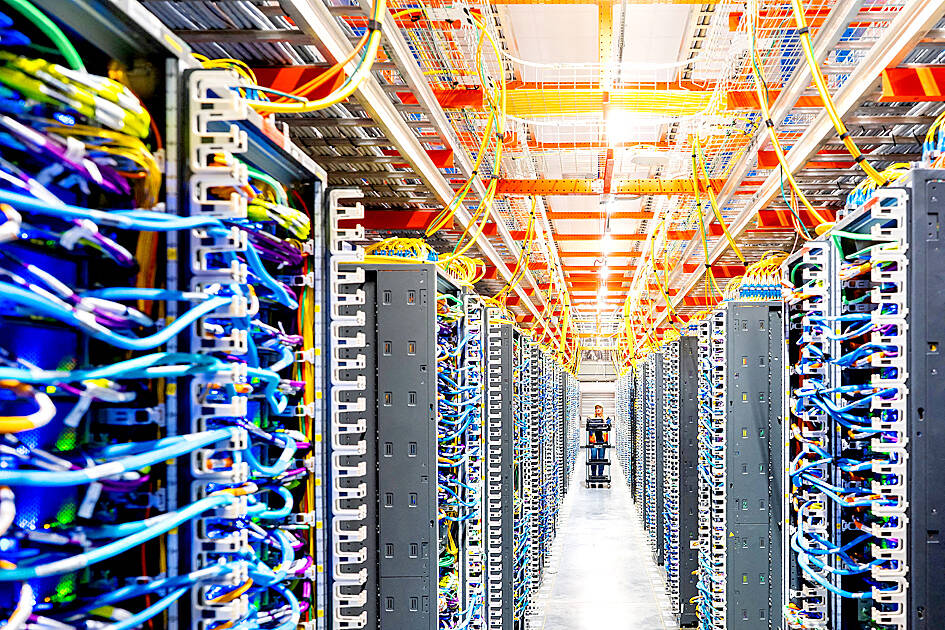
Photo: Reuters
The ever-larger numbers — in total, an estimated 60 percent increase from a year earlier — means yet another acceleration in the wave of data center construction taking place around the world and in the financing boom required to pay for all of it.
The sprint to build the sprawling facilities, which hold racks of humming servers powered by expensive processors, has touched off an unprecedented level of borrowing, pinched energy supplies, and brought developers into conflict with communities worried about rising power and water costs.
It also raises the risk that expenditures by a narrow set of affluent companies, already accounting for a rising share of economic activity in the US, could distort big-picture data such as construction spending, GDP, durable goods and employment reports, potentially making the overall economy look healthier than it is.
The four companies “see the race to provide AI compute as the next winner-take-all or winner-takes-most market,” DA Davidson & Co analyst Gil Luria said. “And none of them is willing to lose.”
Meta on Jan. 28 said full-year capex would rise to as much as US$135 billion — a potential jump of about 87 percent.
Microsoft the same day reported a 66 percent increase in second-quarter capital spending, topping estimates, and analysts project it would shell out almost US$105 billion in capex for the fiscal year ending in June. The news triggered the second-biggest single-day decline in market value for any stock.
Alphabet on Wednesday last week rattled investors when it revealed a capital spending forecast that exceeded not just analyst estimates, but the spending of a vast swath of US industry — it plans to spend as much as US$185 billion.
Amazon on Thursday bested that with a planned US$200 billion in capital expenditures this year, also sending its shares tumbling.
Altogether, the four companies have lost more than US$950 billion in market value since dropping their latest earnings and outlooks. On the other hand, companies that make the gear used in AI computing were gaining, including Nvidia Corp, Advanced Micro Devices Inc and Broadcom Inc.
Each tech giant has laid out a slightly different route to recouping their investments, but their spending is based on the same premise: that OpenAI’s ChatGPT and rival tools capable of generating text and displaying elements of human reasoning would play an increasingly important role for people at work and at home.
Building the cutting-edge software models that makes that shift possible is an extraordinarily expensive process that requires stringing together thousands of chips that sell for tens of thousands of dollars apiece. Hence the big bills. The spending is also predicated on the notion that the end products would result in exponentially higher future revenue.
As the numbers rise, what is still unclear is whether the companies would all be able to execute on their lofty ambitions.
As the data center build-out has escalated, they are already competing for finite crews of electricians, cement trucks and Nvidia chips rolling out of Taiwan Semiconductor Manufacturing Co (台積電) factories.
“There are and will be bottlenecks,” Luria said.
There is also the question of how they will afford it. Meta and Google, whose profit mainly comes from digital advertising; Amazon, the largest online retailer and cloud-computing provider; and Microsoft, the biggest seller of business software, are each dominant in their industries and have ample cash cushions. Their willingness to plow huge chunks of that cash into an AI-fueled future means those reserves, and investors’ patience, would be tested.
Theory Ventures LLC founder Tomasz Tunguz, who earlier in his career worked at Google and who published a blog last year comparing the AI boom to past investment frenzies, said they do not always end well.
However, on the way up “they are all huge catalysts for the economy,” he said.


Taiwanese firms have increased investment in the Philippines in recent years as Manila’s ties with Washington deepen and global supply chains continue to shift away from China, an expert at the Chung-Hua Institution for Economic Research (CIER, 中華經濟研究院) said yesterday. The Philippines had not been among Taiwanese investors’ top choices in Southeast Asia, CIER Taiwan ASEAN Studies Center director Kristy Hsu (徐遵慈) said at a seminar in Taipei. However, Taiwan’s investment in the country has grown significantly since the COVID-19 pandemic, reaching US $257 million last year, a high in recent years, she said. Although Taiwan’s total investment in the Philippines still lags

Intel Corp regards Taiwan Semiconductor Manufacturing Co (TSMC, 台積電) as a longstanding partner, as the US chipmaker would continue outsourcing production of advanced chips to TSMC, Intel chief executive officer Lip-Bu Tan (陳立武) said yesterday. “I don’t look at people as competitors. I look at the collaboration... Nvidia is also, you know, a good friend,” Tan told a news conference following his keynote speech at the Computex trade show in Taipei. “It’s a very trusted partnership for us... We are a big, top customer for them, and we’re going to continue doing that,” he said, referring to TSMC, the world’s largest foundry

Hon Hai Precision Industry Co (鴻海精密) yesterday said it would work with US chipmaker Intel Corp to jointly develop and deploy next-generation artificial intelligence (AI) infrastructure and intelligent computing platforms in a move to capture booming demand for AI computing systems. Hon Hai, also known as Foxconn Technology Group (富士康), said in a statement that the partnership would combine its global manufacturing scale, system integration expertise and AI data center deployment capabilities with Intel’s strengths in processor architecture, silicon technologies and software ecosystem. The companies said they plan to work on equipment used in AI data centers, including server racks powered by

Artificial intelligence (AI) agents would supplant smartphones as the center of people’s digital lives, fundamentally reshaping personal devices and driving a major computing upgrade cycle, Qualcomm Inc CEO Cristiano Amon said yesterday. In his keynote speech for this year’s Computex trade show in Taipei, Amon said that the rise of "agentic AI" — AI systems capable of reasoning, planning and carrying out tasks autonomously — would transform how people interact with technology across phones, PCs, vehicles and wearable devices. Describing the technology as the next major evolution in computing, Amon said that "2026 is the year of agents.” For decades, smartphones have sat


 RSS
RSS