


Taiwan’s economy last year soared on skyrocketing exports of artificial intelligence (AI) hardware and semiconductors, but companies in more traditional manufacturing sectors could only look on with envy as they were clobbered by US tariffs and a strong local currency.
The nation’s growth has for decades been based on overseas shipments of a range of goods including machinery, metals and chemicals, mostly small and medium-sized manufacturers employing thousands of workers.
However, the past 12 months saw companies in those sectors dealt a body blow as their goods sold into the US were loaded with 20 percent levies as part of US President Donald Trump’s global trade war, threatening people’s jobs.
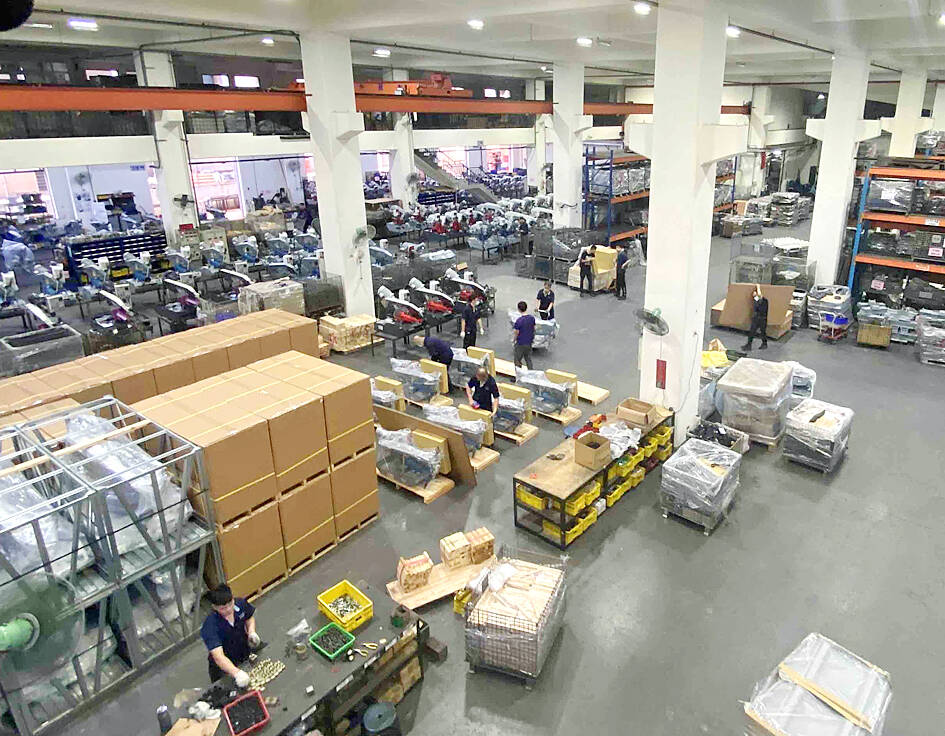
Photo: Huang Shu-lei, Taipei Times
One area that was exempted was semiconductor chips — a critical sector dominated by Taiwanese tech giant Taiwan Semiconductor Manufacturing Co (台積電).
That meant economic growth likely ballooned 7.4 percent last year, according to government estimates, which would be the fastest in 15 years.
“We don’t really feel that growth,” machine toolmaker Litz Hitech Corp (麗馳科技) sales director Chris Wu (吳青龍) said. “Overall, the data looks strong, but for traditional industries, and for our company in particular, exports have declined — we’re down 30 percent.”
Trump initially announced a 32 percent tariff on Taiwanese exports, which was later lowered to 20 percent, as part of his sweep of measures against dozens of trade partners in April last year. A trade deal announced earlier this month cut that again to 15 percent, in line with key manufacturing rivals South Korea and Japan.
While it was good news for traditional manufacturers, Wu said it was not a panacea.
Overseas demand for Litz Hitech’s precision tools and processing machines has not recovered, and a 15 percent tariff is still nearly three times the company’s profit margin.
On top of that, the New Taiwan dollar was stronger than the won, yen and euro, meaning Taiwanese exports are more expensive, Wu said.
“I don’t think there is a single Taiwanese machine toolmaker that can negotiate to absorb [the tariff] in full — maybe 2 to 3 percent, but absorbing everything is impossible,” he said. “Our company cannot absorb even 1 percent.”
Taiwan’s information and communications technology (ICT) sector, which includes semiconductor chips, has become by far the biggest driver of the nation’s export-dependent economy.
Data for last year laid bare the stark difference in fortunes for tech and more traditional industries, with ICT exports soaring, while metals, plastics and metal-cutting machine tools were all lower.
“Last year’s situation was miserable, very miserable,” Taichung Importers and Exporters Chamber of Commerce chairman Jerry Liu (劉宏洲) said.
Taiwan’s reliance on AI has left some experts worried about the economic impact if the bubble of excitement around the technology were to burst.
“That’s dangerous,” Academia Sinica Institute of Economics research fellow Chen Been-lon (陳明郎) said. “But what can you do? You cannot force people not to invest in semiconductors.”
Taiwan hopes its semiconductor industry remains protected from Trump’s tariffs after the trade deal with Washington committed Taiwanese chip and tech businesses to invest US$250 billion in the US, while the government would provide credit guarantees of up to US$250 billion to support Taiwanese firms’ investment on US soil. However, a potential US Supreme Court ruling against Trump’s power to apply levies could upend the agreement.
“If it’s unconstitutional... the current negotiated result may need to be redone,” raising the risk of tariffs on the ICT sector, Taiwan Institute of Economic Research economist Wu Meng-tao (吳孟道) said.
Many in the traditional manufacturing sector, including Litz Hitech, have put employees on unpaid leave or reduced their working hours.
Conditions for small and medium-sized manufacturers could get tougher this year if the US Federal Reserve cuts interest rates. The NT dollar, which has pulled back from its highs last year, could come under renewed upward pressure.
Liu said he was “gritting my teeth and holding on” — and hoping that the government helped to “stabilize the currency.”
However, Taiwan Machine Tools and Accessory Builders’ Association chairman Patrick Chen (陳紳騰) said manufacturers also needed to move with the times by adopting AI and offering customers “comprehensive solutions.”
“Simply selling standalone machines or individual pieces of equipment is a business model of the past,” he added.
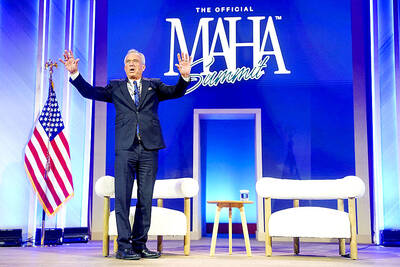
Sweeping policy changes under US Secretary of Health and Human Services Robert F. Kennedy Jr are having a chilling effect on vaccine makers as anti-vaccine rhetoric has turned into concrete changes in inoculation schedules and recommendations, investors and executives said. The administration of US President Donald Trump has in the past year upended vaccine recommendations, with the country last month ending its longstanding guidance that all children receive inoculations against flu, hepatitis A and other diseases. The unprecedented changes have led to diminished vaccine usage, hurt the investment case for some biotechs, and created a drag that would likely dent revenues and
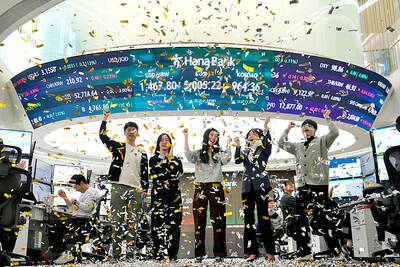
Global semiconductor stocks advanced yesterday, as comments by Nvidia Corp chief executive officer Jensen Huang (黃仁勳) at Davos, Switzerland, helped reinforce investor enthusiasm for artificial intelligence (AI). Samsung Electronics Co gained as much as 5 percent to an all-time high, helping drive South Korea’s benchmark KOSPI above 5,000 for the first time. That came after the Philadelphia Semiconductor Index rose more than 3 percent to a fresh record on Wednesday, with a boost from Nvidia. The gains came amid broad risk-on trade after US President Donald Trump withdrew his threat of tariffs on some European nations over backing for Greenland. Huang further
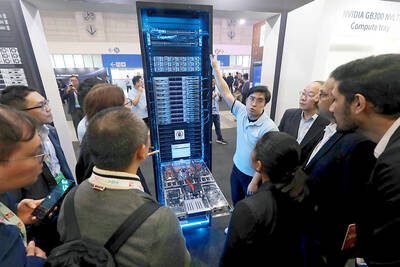
Nvidia Corp’s GB300 platform is expected to account for 70 to 80 percent of global artificial intelligence (AI) server rack shipments this year, while adoption of its next-generation Vera Rubin 200 platform is to gradually gain momentum after the third quarter of the year, TrendForce Corp (集邦科技) said. Servers based on Nvidia’s GB300 chips entered mass production last quarter and they are expected to become the mainstay models for Taiwanese server manufacturers this year, Trendforce analyst Frank Kung (龔明德) said in an interview. This year is expected to be a breakout year for AI servers based on a variety of chips, as
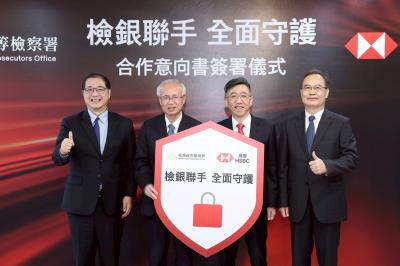
HSBC Bank Taiwan Ltd (匯豐台灣商銀) and the Taiwan High Prosecutors Office recently signed a memorandum of understanding (MOU) to enhance cooperation on the suspicious transaction analysis mechanism. This landmark agreement makes HSBC the first foreign bank in Taiwan to establish such a partnership with the High Prosecutors Office, underscoring its commitment to active anti-fraud initiatives, financial inclusion, and the “Treating Customers Fairly” principle. Through this deep public-private collaboration, both parties aim to co-create a secure financial ecosystem via early warning detection and precise fraud prevention technologies. At the signing ceremony, HSBC Taiwan CEO and head of banking Adam Chen (陳志堅)


 RSS
RSS