


HSBC Bank Taiwan Ltd (匯豐台灣商銀) and the Taiwan High Prosecutors Office recently signed a memorandum of understanding (MOU) to enhance cooperation on the suspicious transaction analysis mechanism. This landmark agreement makes HSBC the first foreign bank in Taiwan to establish such a partnership with the High Prosecutors Office, underscoring its commitment to active anti-fraud initiatives, financial inclusion, and the “Treating Customers Fairly” principle. Through this deep public-private collaboration, both parties aim to co-create a secure financial ecosystem via early warning detection and precise fraud prevention technologies.
At the signing ceremony, HSBC Taiwan CEO and head of banking Adam Chen (陳志堅) emphasized, "Protecting the general public’s assets and financial security is our mission. HSBC highly values customers’ rights and continues to invest global resources to strengthen our anti-fraud defenses. Following the successful launch of our 'Global Intelligent Fraud Prevention Network’ late last year, the partnership with the High Prosecutors Office marks another significant milestone. By combining prosecutorial expertise with HSBC Group’s advanced AI detection systems, we can defend against suspicious capital flows with greater precision, building an invincible financial safety net for Taiwan."
Witnessed by Minister of Justice Cheng Ming-chien (鄭銘謙), the MOU was signed by Chen and Taiwan High Prosecutors Office Chief Prosecutor Chang Tou-hui (張斗輝). The collaboration focuses on three key areas to prevent clients’ bank accounts from being exploited as tools for fraud or money laundering.
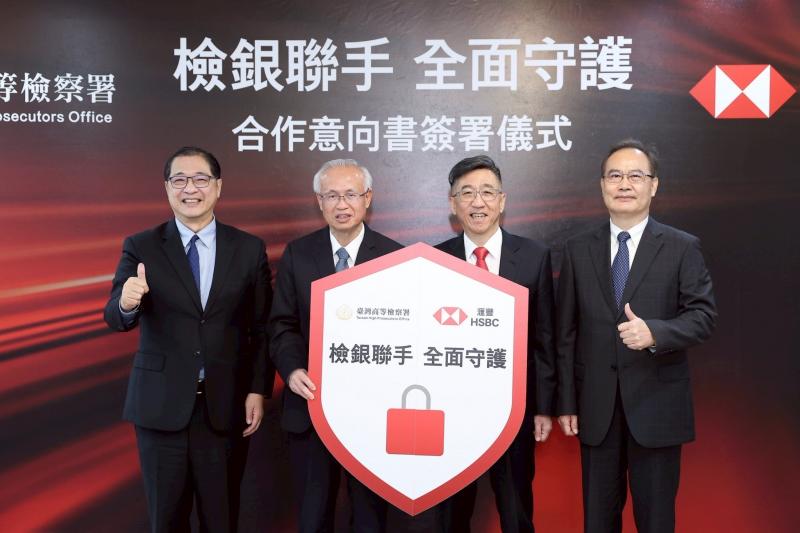
Photo courtesy of HSBC Bank Taiwan Ltd
Firstly, Optimization of Early Warning Detection: HSBC will analyze de-identified fraud data provided by the High Prosecutors Office to identify predictive patterns. By optimizing detection models, the bank can uncover other potentially suspicious accounts involved in fraud or money laundering. These de-identified analytical results will be shared back with the High Prosecutors Office to co-develop more accurate early warning mechanisms.
Second, Sharing of Risk Parameters: Based on investigative needs, the High Prosecutors Office and prosecutors’ offices nationwide will periodically provide "high-risk factors, parameters, and patterns of bank accounts" to serve as vital references for HSBC’s risk management.
Lastly, Joint Public-Private Efforts on Fraud: During its internal risk control processes, HSBC will maintain close cooperation with the High Prosecutors Office for the purpose of preventing financial fraud and money laundering, ensuring the maximum effectiveness of anti-fraud efforts.
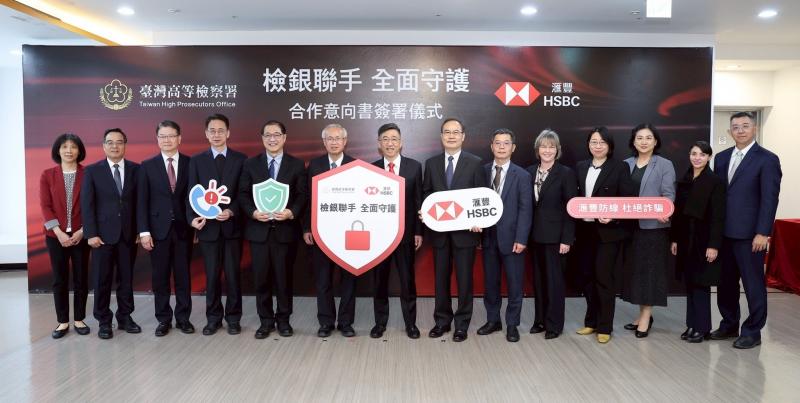
Photo courtesy of HSBC Bank Taiwan Ltd
In recent years, HSBC has integrated innovative technology with cross-border resources to enhance transaction monitoring and build a meticulous anti-fraud system, while raising customer awareness. Data shows that in 2025, HSBC Taiwan’s success rate in blocking fraud at the bank counters doubled compared to the previous year, demonstrating remarkable results.
Furthermore, late last year, Alex Levin, Head of Financial Crime, Asia and Middle East, HSBC, was invited by the Executive Yuan’s Anti-Money Laundering Office to speak at an international seminar. He delivered a keynote on “Leveraging Technology to Manage Financial Crime," sharing HSBC’s global experience and observations in the field.
Beyond asset protection, HSBC remains dedicated to financial accessibility for the elderly and people with disabilities. Since 2024, the bank has partnered with the Eden Social Welfare Foundation to host anti-fraud seminars and financial planning workshops for seniors. Last year, HSBC also became the first foreign bank in Taiwan to launch sign language videos on its official website, ensuring that the hearing-impaired have equal access to information on financial products and services, further contributing to a safe and inclusive financial environment.
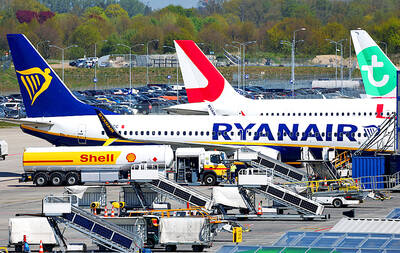
Ryanair, Transavia, Volotea and other low-cost airlines are feeling the financial pain from high jet fuel prices as a result of the Middle East war and are cutting flights. The closure of the Strait of Hormuz has taken a huge chunk of oil supplies off the market, sending the price of jet fuel soaring and triggering fears of shortages that could force airlines to cancel flights. Airlines are not waiting for a lack of supplies to react. “Travel alert: Airlines are cutting thousands of flights right now,” Travel Therapy host Karen Schaler said in an Instagram reel this past weekend.

MANAGING RISKS: Taiwan has secured LNG sufficient to cover 95 percent of electricity demand for next month, UBS said, describing the government’s approach as proactive UBS Group AG has raised its forecast for Taiwan’s economic growth this year to 8 percent, up from 6.9 percent previously, and said expansion could reach as high as 8.6 percent if external energy shocks are avoided. The upgrade reflects a stronger-than-expected first-quarter performance and sustained momentum in artificial intelligence (AI)-driven exports, which UBS said are providing a firm foundation for growth despite geopolitical and energy risks. Taiwan’s GDP expanded 13.69 percent year-on-year in the first quarter, the fastest growth since the second quarter of 1987, the Directorate-General of Budget, Accounting and Statistics (DGBAS) reported on Thursday. On a seasonally

The list of Asian stocks that benefit from business partnership with Nvidia Corp is getting longer, as the region further integrates into the artificial intelligence (AI) chip giant’s business ecosystem. Just in the past week, South Korea’s LG Electronics Inc, Taiwan’s Nanya Technology Corp (南亞科技), as well as China’s Huizhou Desay SV Automotive Co (德賽西威) and Pateo Connect Technology Shanghai Corp (博泰車聯) have become the latest to rally on news of tie-ups, supply-chain participation or product collaboration with the US chip designer. Asian suppliers account for about 90 percent of Nvidia’s production costs, up from about 65 percent last year, data compiled
The Fair Trade Commission’s (FTC) ongoing review of Grab Holdings Ltd’s US$600 million acquisition of Foodpanda Taiwan’s operations, announced on March 23, has taken on fresh urgency as industry experts warn that the transaction could embed significant Chinese cybersecurity vulnerabilities into Taiwan’s digital infrastructure through Grab’s deep ties to autonomous-driving firm WeRide (文遠知行). Less than 16 months after the FTC blocked Uber Eats’ direct attempt to acquire Foodpanda Taiwan — citing potential combined market shares of 80 to 90 percent — the emergence of Grab as the buyer has prompted questions about whether the same competitive harm is simply being rerouted


 RSS
RSS