


Men’s fashion is embracing embroidery and handcrafted textiles that were once viewed as old-fashioned or feminine, with a clutch of modern Indian brands poised to benefit from the catwalk and celebrity-driven trend.
Embroidery is a historic mainstay of traditional clothing in Asia or the Middle East, as well as Western haute couture, but it is increasingly present in Paris, Milan or New York on modern men’s shirts, bomber jackets or blazers. Designers at Dior, Dolce & Gabbana, Kenzo or Gucci have adopted it in recent runway shows, while Louis Vuitton’s celebrity rapper-designer Pharell Williams dedicated his entire June collection to India after visiting the country.
At Men’s Fashion Week in Paris on Thursday, New Delhi-based Kartik Research put on its second show, having joined the world’s most prestigious style calendar for the first time last year with its modern take on traditional fabrics and crafts.

Photo: AFP
“It’s cool that we’re building something that has this momentum and is being appreciated in the way that it is,” founder Kartik Kumra said during a pre-show interview.
The 26-year-old, who opened a flagship store in New York last year and counts actor Paul Mescal and rapper Kendrick Lamar as past clients, likens showing in Paris to being a footballer in the European Champions League.
“Just to get there, it means you’re doing something right. And then once you’re there, you want to do well in it, and so it pushes you,” he said.
Kardo founder Rikki Kher said the taste for handwoven fabrics or intricate embroidery among men reflected societal change and the industry’s desire for novelty.
“Fashion is driven through music and young people, and young people are becoming more gender fluid,” said Kher, who has championed hand-crafted artisanal textiles since 2013.
Embroidery appears to be on the same route as handbags and jewellery, which have entered men’s fashion over the past few years and blurred the industry’s traditional gender lines.
The enthusiasm also reflects a loss of interest in “workwear” or “quiet luxury,” trends that have dominated menswear for years with their simple and often monochrome fabrics.
“Guys are looking for something different,” said Kher, who was showcasing his Fall/Winter collection in Paris during Fashion Week. “They’re able to express themselves a bit more.”
He said he recently spotted mass-market retailers Zara and Marks & Spencer selling embroidered shirts — a sign that the trend has trickled down from catwalks to the high street. Other Indian brands helping modernize their country’s craft traditions include 11.11/Eleven Eleven, Pero, Mii or Rkive City.
Western buyers have also noted the changes.
“We’re coming out of a few seasons that were more on the neutral side ... Now we want to revamp everything with patterns and colors,” said Franck Nauerz, head of menswear at Paris fashion stores Le Bon Marche and La Samaritaine. “There’s a real trend for embroidery, particularly of Indian origin.”
Carlan Pickings, who runs the PPHH fashion store in Melbourne, Australia, said she had seen demand and men’s styles change radically over the past few years.
“Ten years ago, we’d never have believed that we’d now be buying things that were embroidered, colorful, floral,” she said, adding that her clients want “something interesting, but that also has a story behind it.”
“The changes we’ve seen in the last five years, particularly coming out of the Indian market, but also Japan, are really interesting,” Pickings said.

Netherlands-based semiconductor equipment supplier ASML Holding NV yesterday said that it is planning to hire an additional 1,000 people in Taiwan this year in response to growing demand from clients. ASML had previously planned to recruit 600 people this year, but that the plan has been adjusted upward, ASML vice president and ASML Taiwan general manager Grace Wang (汪佳慧) told reporters. ASML has a workforce of more than 4,500 in Taiwan, accounting for about 10 percent of its global total, Wang said. This year’s recruitment campaign would focus on adding people in the customer support, manufacturing and supply chain domains to assist ASML
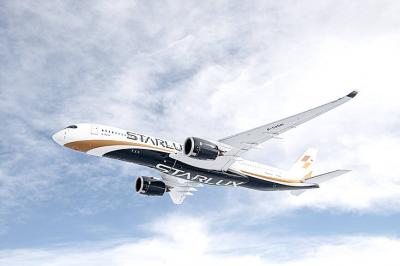
Starlux Airlines Co (星宇航空) today unveiled a long-haul network expansion plan at a shareholders’ meeting in Taipei, including direct flights to Barcelona, Spain, and Zurich, Switzerland, as well as a service connecting Taipei, Sydney and New Zealand. Starlux is to become the first Taiwanese carrier to offer non-stop services to the two European cities, while the inaugural oceanic route is expected to expand transit opportunities within the Australia-New Zealand market, Starlux said. Flight services to Chicago, Dallas, Washington and New York are under evaluation, the airline added. Prior to the shareholders’ meeting, the airline earlier this year announced that it would be

UNDER MICROSCOPE: Taiwan detained three people who allegedly conspired to buy servers in Taiwan and export them using fraudulent documentation, prosecutors said Nvidia Corp chief executive officer Jensen Huang (黃仁勳) on Saturday urged Super Micro Computer Inc to tighten up on compliance after Taiwan detained three people this week for allegedly making fraudulent declarations about artificial intelligence (AI) servers made by its US partner. The development marked the nation’s first crackdown on semiconductor smuggling, which grew after the US slapped restrictions on exports of high-end chips such as Nvidia AI accelerators to China. Nvidia is “rigorous” in explaining regulations to all of its partners, Huang told reporters after arriving in Taipei. “Ultimately Super Micro has to run their own company,” he said in response to
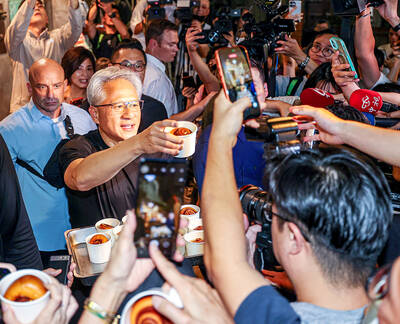
Nvidia Corp yesterday announced that CEO Jensen Huang (黃仁勳) would attend an employee meeting in Taipei tomorrow to celebrate the launch of the company’s Taiwan headquarters project. Huang would attend a gathering at the site of Nvidia’s planned headquarters in Beitou Shilin Technology Park (北投士林科技園區), the company said in a statement. After arriving in Taiwan on Saturday last week, Huang told reporters that he plans to meet with Quanta Computer Inc (廣達) chairman Barry Lam (林百里) and Taiwan Semiconductor Manufacturing Co (TSMC, 台積電) chairman C.C. Wei (魏哲家), and would attend the groundbreaking ceremony for Nvidia’s Taiwan headquarters tomorrow. Nvidia has not yet applied


 RSS
RSS