


“Artificial intelligence” (AI) and “big data” were the most common words used to describe start-ups in Taiwan for the fourth consecutive year, the Taiwan Institute of Economic Research (TIER, 台經院) said in the Taiwan Start-up Ecosystem Survey published yesterday.
The survey, which has been conducted annually since 2018 by TIER in collaboration with PwC Taiwan and Digitimes Research, focused on how start-ups are applying AI in practice, examining the specific technologies they deploy and the business scenarios in which they are used, TIER said in a statement.
The survey also analyzed how investors are assessing Taiwanese start-ups in the AI era, it said.
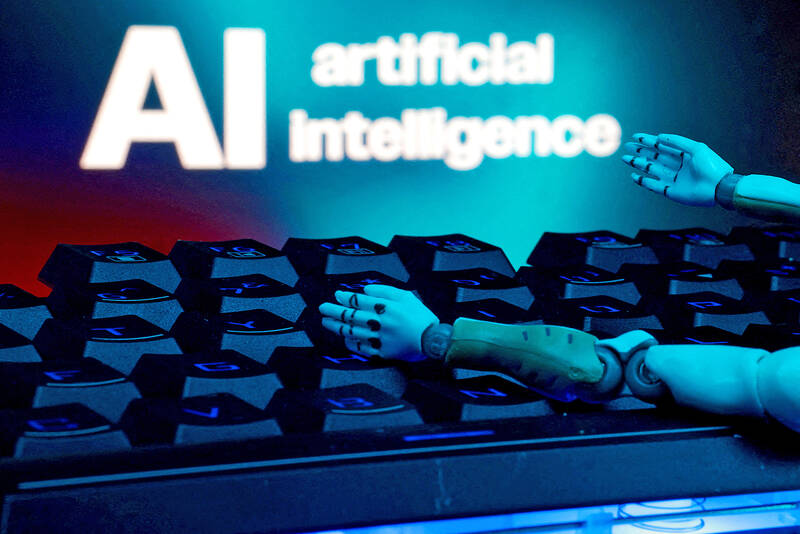
Photo: Reuters
More than 80 percent of start-ups surveyed were involved in AI-related fields, showing that they apply AI as a key tool for operations and product innovation, as they have keen market awareness, the survey said.
The top three overseas market targets for start-ups were Japan (51.2 percent), the US (27.3 percent) and China (23.4 percent), reflecting that nearby and culturally familiar markets remain the preferred choice, it said.
On the investment side, investment institutions were most focused on AI and big data, followed by the biotechnology and medical sectors, it said.
Among AI-focused investments, predictive analytics attracted the most attention at 36.4 percent, followed by visual recognition at 21.8 percent and generative AI at 20 percent, the survey showed.
General venture capital (VC) firms showed greater interest in AI start-ups than corporate venture capital investors over the past two years, with 77.5 percent of general VC firms reporting investments in AI companies, compared with 24.5 percent of corporate venture investors, it said.
AI and big data are increasingly applied across start-up sectors, primarily as tools for product and service design rather than as standalone technologies, TIER said.
Most AI start-ups are focused on practical applications rather than developing general-purpose platforms or foundational technologies, reflecting an emphasis on embedding AI into existing industries, it said.
However, AI alone is not sufficient to address all core challenges facing start-ups, which must still contend with issues such as market acceptance, inter-organizational coordination and external partnerships, it added.
Ultimately, a competitive advantage depends not on the use of AI itself, but on whether products and services effectively meet market needs, TIER said.
The think tank also highlighted a shift in corporate-start-up from simple capital investment toward innovation-driven strategic partnerships, saying that such a change could help improve corporate resilience and expand market reach as global markets evolve rapidly.

KEEPING UP: The acquisition of a cleanroom in Taiwan would enable Micron to increase production in a market where demand continues to outpace supply, a Micron official said Micron Technology Inc has signed a letter of intent to buy a fabrication site in Taiwan from Powerchip Semiconductor Manufacturing Corp (力積電) for US$1.8 billion to expand its production of memory chips. Micron would take control of the P5 site in Miaoli County’s Tongluo Township (銅鑼) and plans to ramp up DRAM production in phases after the transaction closes in the second quarter, the company said in a statement on Saturday. The acquisition includes an existing 12 inch fab cleanroom of 27,871m2 and would further position Micron to address growing global demand for memory solutions, the company said. Micron expects the transaction to
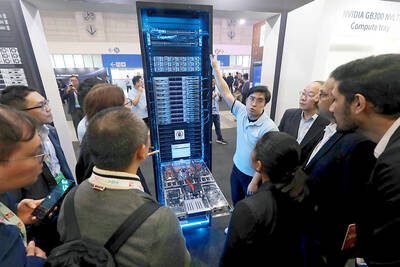
Nvidia Corp’s GB300 platform is expected to account for 70 to 80 percent of global artificial intelligence (AI) server rack shipments this year, while adoption of its next-generation Vera Rubin 200 platform is to gradually gain momentum after the third quarter of the year, TrendForce Corp (集邦科技) said. Servers based on Nvidia’s GB300 chips entered mass production last quarter and they are expected to become the mainstay models for Taiwanese server manufacturers this year, Trendforce analyst Frank Kung (龔明德) said in an interview. This year is expected to be a breakout year for AI servers based on a variety of chips, as
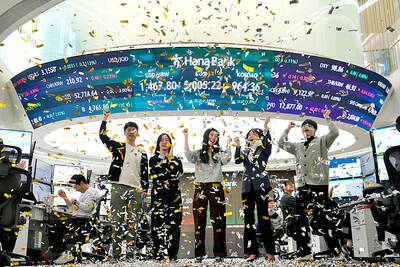
Global semiconductor stocks advanced yesterday, as comments by Nvidia Corp chief executive officer Jensen Huang (黃仁勳) at Davos, Switzerland, helped reinforce investor enthusiasm for artificial intelligence (AI). Samsung Electronics Co gained as much as 5 percent to an all-time high, helping drive South Korea’s benchmark KOSPI above 5,000 for the first time. That came after the Philadelphia Semiconductor Index rose more than 3 percent to a fresh record on Wednesday, with a boost from Nvidia. The gains came amid broad risk-on trade after US President Donald Trump withdrew his threat of tariffs on some European nations over backing for Greenland. Huang further
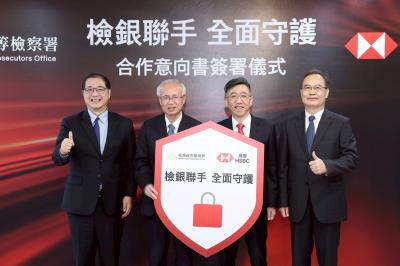
HSBC Bank Taiwan Ltd (匯豐台灣商銀) and the Taiwan High Prosecutors Office recently signed a memorandum of understanding (MOU) to enhance cooperation on the suspicious transaction analysis mechanism. This landmark agreement makes HSBC the first foreign bank in Taiwan to establish such a partnership with the High Prosecutors Office, underscoring its commitment to active anti-fraud initiatives, financial inclusion, and the “Treating Customers Fairly” principle. Through this deep public-private collaboration, both parties aim to co-create a secure financial ecosystem via early warning detection and precise fraud prevention technologies. At the signing ceremony, HSBC Taiwan CEO and head of banking Adam Chen (陳志堅)


 RSS
RSS