


Quanta Computer Inc’s (廣達) artificial intelligence (AI)-related business is expected to grow by at least a triple-digit percentage this year, prompting the company to consider hiking its capital expenditure, mostly in the US and Thailand, company executive vice president Mike Yang (楊麒令) said on Thursday.
Quanta’s order visibility extends into next year on the back of strong AI demand, said Yang, who is also the president of the firm’s server manufacturing arm Quanta Cloud Technology Inc (雲達).
‘NO AI BUBBLE’
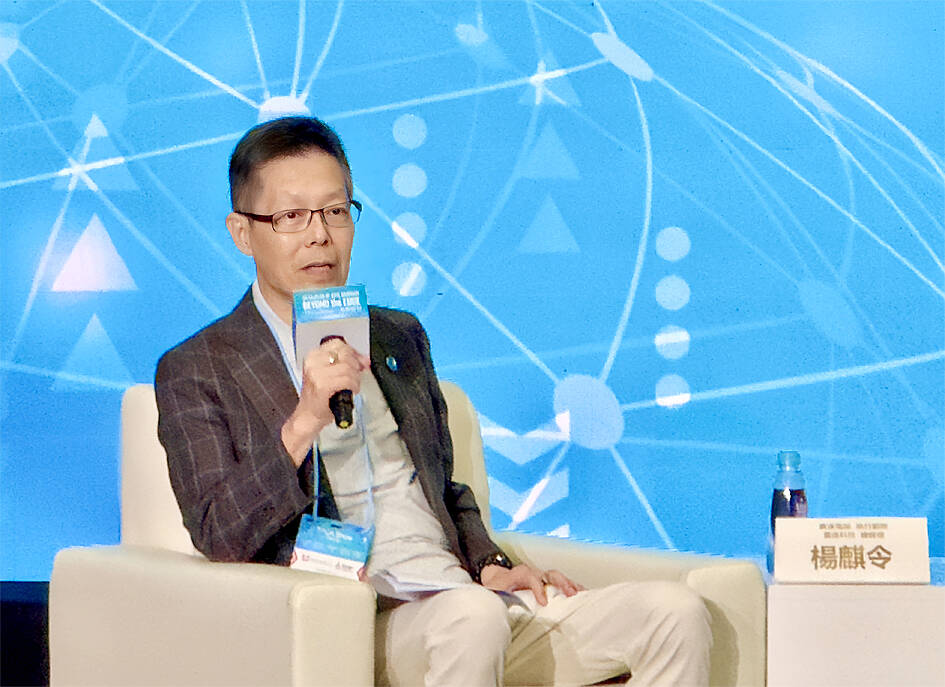
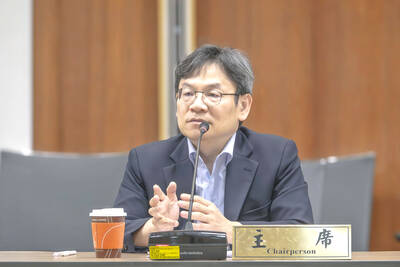
Photo: Fang Wei-chieh, Taipei Times
“It is clear that there is no such thing as an AI bubble,” Yang said.
The construction of data centers is continuing and server manufacturers are still expanding capacity to meet rising demand, Yang said.
Over the next one to three years, AI would not only continue to grow rapidly, but enter a “blooming era,” Quanta chairman Barry Lam (林百里) said, adding that Quanta has secured a competitive edge by successfully transitioning from air-cooled AI servers to liquid-cooled supercomputers.
Quanta expects to begin shipping servers powered by Nvidia’s latest Rubin platform in August, with revenue contribution this year likely to be limited, as it is still in its early rollout phase, he said.
As the system design is largely carried over from the GB200 and GB300 platforms, overall production schedules and deployment efficiency are expected to improve over time, he added.
Quanta is focusing on Level 11 orders, with some projects extending to Level 12, while only a small portion of general-purpose servers remain in standalone configurations, Yang said.
AI server revenue is on track to post triple-digit growth this year, while general-purpose servers should post a solid performance, he said.
The company aims to double capacity this year, primarily for the production of Level 11 servers after reviewing expansion plans and execution schedules over the past two to three years, he said.
Overall this year, AI servers are expected to account for about 80 percent of the company’s total server revenue, Yang said.
Regarding overseas deployment, Quanta is cautious about expanding capacity in Tennessee due to power supply constraints, he said.
In Mexico, Quanta’s server node factory has entered volume production this quarter, he said.
ASUSTEK
Separately, Asustek Computer Inc (華碩) chairman Jonney Shih (施崇棠) yesterday said that the company would continue providing services to its smartphone users, responding to a reporter’s question about whether the company is halting its money-losing smartphone business.
Asustek must reallocate resources quickly to brace for an important paradigm shift ahead and allocate more resources to develop commercial PCs and a wide range of AI-related devices, Shih said.
With memorychip prices surging, Asustek on Jan. 5 raised distribution prices for some computer models, as chip supply constraints are expected to continue, with semiconductor makers prioritizing high-bandwidth chips for AI servers over PC chips.
Addressing concerns that the AI boom has crowded out resources, such as high-bandwidth memory and other components, for non-AI businesses, Shih said the situation has indeed put pressure on non-AI products, but Asustek has long believed that challenges also present opportunities.
Regarding the newly announced US tariffs on Taiwan, Shih said the overall impact on Asustek’s operations is positive, and the company has a flexible global manufacturing footprint to respond to unexpected changes and shifts in the global supply chain.
Shares of contract chipmaker Taiwan Semiconductor Manufacturing Co (TSMC, 台積電) came under pressure yesterday after a report that Apple Inc is looking to shift some orders from the Taiwanese company to Intel Corp. TSMC shares fell NT$55, or 2.4 percent, to close at NT$2,235 on the local main board, Taiwan Stock Exchange data showed. Despite the losses, TSMC is expected to continue to benefit from sound fundamentals, as it maintains a lead over its peers in high-end process development, analysts said. “The selling was a knee-jerk reaction to an Intel-Apple report over the weekend,” Mega International Investment Services Corp (兆豐國際投顧) analyst Alex Huang
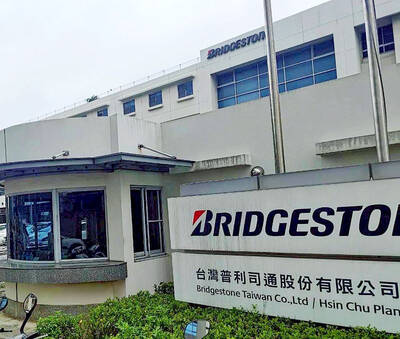
TRANSITION: With the closure, the company would reorganize its Taiwanese unit to a sales and service-focused model, Bridgestone said Bridgestone Corp yesterday announced it would cease manufacturing operations at its tire plant in Hsinchu County’s Hukou Township (湖口), affecting more than 500 workers. Bridgestone Taiwan Co (台灣普利司通) said in a statement that the decision was based on the Tokyo-based tire maker’s adjustments to its global operational strategy and long-term market development considerations. The Taiwanese unit would be reorganized as part of the closure, effective yesterday, and all related production activities would be concluded, the statement said. Under the plan, Bridgestone would continue to deepen its presence in the Taiwanese market, while transitioning to a sales and service-focused business model, it added. The Hsinchu
Taiwan Semiconductor Manufacturing Co (TSMC, 台積電) has approved a capital budget of US$31.28 billion for production expansion to meet long-term development needs during the artificial intelligence (AI) boom. The company’s board meeting yesterday approved the capital appropriation plan for purposes such as the installation of advanced technology capacity and fab construction, the world’s largest contract chipmaker said in a statement. At an earnings conference last month, TSMC forecast that its capital expenditure for this year would be at the higher end of the US$52 billion to US$56 billion range it forecast in January in response to robust demand for 5G, AI and
Taiwan Semiconductor Manufacturing Co’s (TSMC, 台積電) investment project in Arizona has progressed better than expected, but it still faces challenges such as water and labor shortages, National Development Council (NDC) Minister Yeh Chun-hsien (葉俊顯) said yesterday. Speaking with reporters after visiting TSMC’s Arizona hub and attending the SelectUSA Investment Summit in Maryland last week, Yeh said TSMC’s Arizona site turned a profit of NT$16.14 billion (US$514 million) last year in its first full year of mass production. “TSMC told me it was surprised by the smooth trial run of the first fab, which has left the company optimistic about the project’s outlook,”


 RSS
RSS