


Oil prices fell back yesterday while the prices of precious metals surged as markets registered a mild and mixed reaction to the US capture of Venezuelan President Nicolas Maduro in a weekend raid.
“While the capture of Venezuelan President Maduro by American forces has dominated headlines, financial markets seem unperturbed,” Capital Economics Ltd Asia-Pacific markets head Thomas Mathews said in a report. “We agree with the implicit view that the near-term economic and financial implications are minor.”
Shortly after trading began, US benchmark crude oil rose slightly, but it ended US$0.52 lower at US$56.80 per barrel. Brent crude, the international standard, gave up US$0.49 to US$60.26 per barrel.
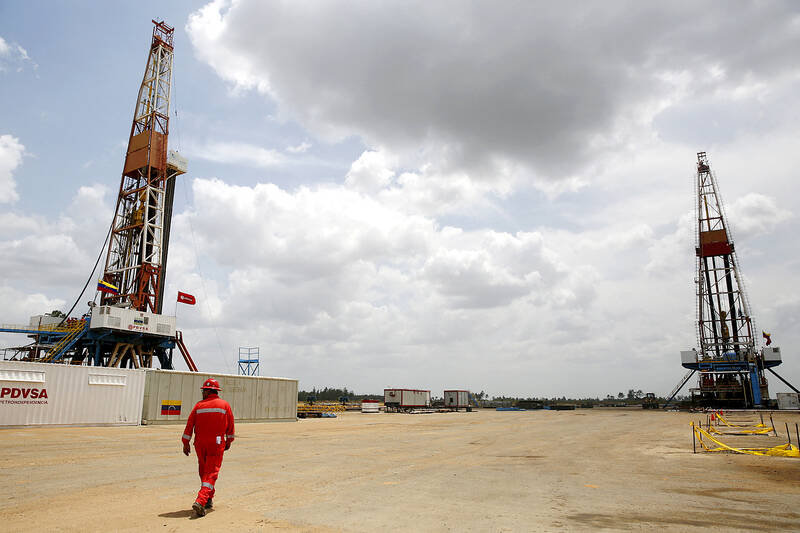
Photo: Reuters
After years of neglect and international sanctions, Venezuela’s oil industry is in disrepair and the country’s output now represents less than 1 percent of global supplies, which is mostly exported to China. It could take years and major investments before production could increase dramatically.
Some analysts expect Venezuela could double or triple its output of about 1.1 million barrels of oil a day to return to historic levels quickly.
With oil levels already plentiful, crude already was trading near its lowest level in about six months. The market is facing a big surplus this year, as OPEC+ and others add more barrels as demand softens.
OPEC+ stuck with plans to pause supply hikes in the first quarter. The group, led by Saudi Arabia and Russia, did not discuss Venezuela during the 10-minute video conference, delegates said adding that it was premature to gauge how to respond to the unfolding situation.
Meanwhile, the price of gold rose 2.4 percent and silver jumped 6 percent. Such assets are often considered safe havens in times of geopolitical turmoil.
The US dollar advanced against all major peers, and the artificial intelligence (AI) trade saw Asian and European stocks gain ground. NASDAQ 100 futures rose 0.7 percent, while those for the S&P 500 were up 0.3 percent.
“The economic impact of what happened in Venezuela is too small to weigh on equity markets,” Pictet Asset Management Ltd senior investment adviser Christopher Dembik said.
The buoyant mood in equities was most prevalent in Asia as a regional gauge rose 1.6 percent to a record. Chipmakers such as Samsung Electronics Co and Taiwan Semiconductor Manufacturing Co (台積電) were among the biggest winners, soaring 7.47 percent and 5.36 percent respectively. Technology stocks led gains in Europe, too.
AI “absolutely stays the most dominant factor in the markets right now,” Saxo Markets chief investment strategist Charu Chanana said. “Tech optimism continues to overpower any of the other narratives in the markets.”
Additional reporting by Bloomberg
Micron Memory Taiwan Co (台灣美光), a subsidiary of US memorychip maker Micron Technology Inc, has been granted a NT$4.7 billion (US$149.5 million) subsidy under the Ministry of Economic Affairs A+ Corporate Innovation and R&D Enhancement program, the ministry said yesterday. The US memorychip maker’s program aims to back the development of high-performance and high-bandwidth memory chips with a total budget of NT$11.75 billion, the ministry said. Aside from the government funding, Micron is to inject the remaining investment of NT$7.06 billion as the company applied to participate the government’s Global Innovation Partnership Program to deepen technology cooperation, a ministry official told the
Taiwan Semiconductor Manufacturing Co (TSMC, 台積電), the world’s leading advanced chipmaker, officially began volume production of its 2-nanometer chips in the fourth quarter of this year, according to a recent update on the company’s Web site. The low-key announcement confirms that TSMC, the go-to chipmaker for artificial intelligence (AI) hardware providers Nvidia Corp and iPhone maker Apple Inc, met its original roadmap for the next-generation technology. Production is currently centered at Fab 22 in Kaohsiung, utilizing the company’s first-generation nanosheet transistor technology. The new architecture achieves “full-node strides in performance and power consumption,” TSMC said. The company described the 2nm process as
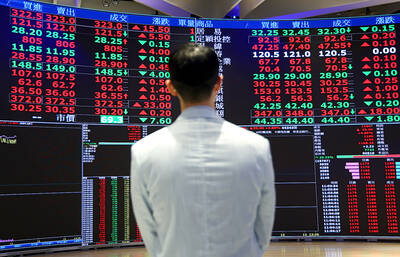
Shares in Taiwan closed at a new high yesterday, the first trading day of the new year, as contract chipmaker Taiwan Semiconductor Manufacturing Co (TSMC, 台積電) continued to break records amid an artificial intelligence (AI) boom, dealers said. The TAIEX closed up 386.21 points, or 1.33 percent, at 29,349.81, with turnover totaling NT$648.844 billion (US$20.65 billion). “Judging from a stronger Taiwan dollar against the US dollar, I think foreign institutional investors returned from the holidays and brought funds into the local market,” Concord Securities Co (康和證券) analyst Kerry Huang (黃志祺) said. “Foreign investors just rebuilt their positions with TSMC as their top target,
H200 CHIPS: A source said that Nvidia has asked the Taiwanese company to begin production of additional chips and work is expected to start in the second quarter Nvidia Corp is scrambling to meet demand for its H200 artificial intelligence (AI) chips from Chinese technology companies and has approached contract manufacturer Taiwan Semiconductor Manufacturing Co (TSMC, 台積電) to ramp up production, sources said. Chinese technology companies have placed orders for more than 2 million H200 chips for this year, while Nvidia holds just 700,000 units in stock, two of the people said. The exact additional volume Nvidia intends to order from TSMC remains unclear, they said. A third source said that Nvidia has asked TSMC to begin production of the additional chips and work is expected to start in the second


 RSS
RSS