


Tariff negotiations with the US have entered their final stage, with progress in sight after both sides reached a consensus on most issues, Minister of Economic Affairs Kung Ming-hsin (龔明鑫) said yesterday.
The government is waiting for a wrap-up meeting to conclude the talks, Kung told reporters before the ministry’s weekly business briefing.
As the US is finalizing agreements with other countries, the outcome of the negotiations with Taiwan might be announced alongside those of other trade partners, he said.
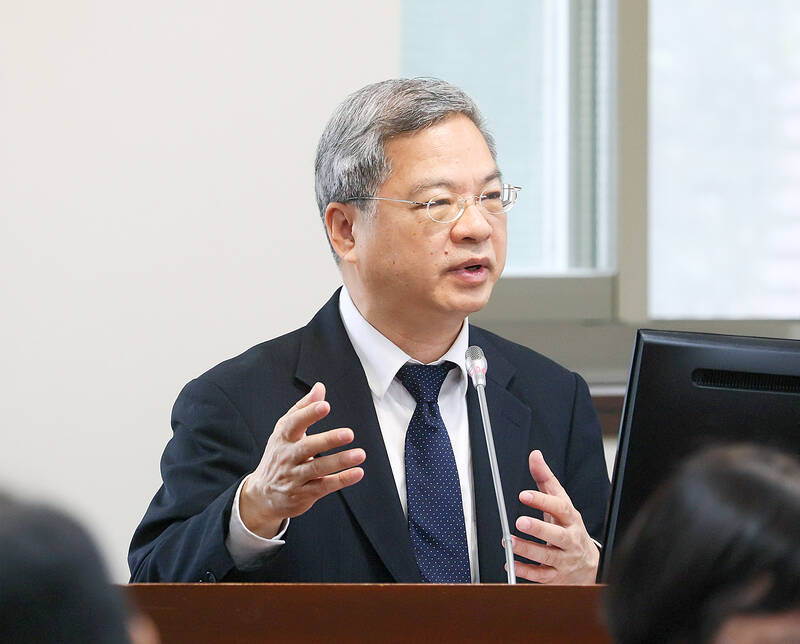
Photo: CNA
Turning to economic growth, Kung said that full-year GDP for last year might surpass the 3.54 percent forecast by the Directorate-General of Budget, Accounting and Statistics (DGBAS) in November.
Robust artificial intelligence (AI) demand supporting semiconductors and AI servers shipments was the top economic driver, while some traditional industries face structural challenges, he said.
The ministry has allocated NT$46 billion (US$1.46 billion) from Special Act for Strengthening Economic, Social and National Security Resilience in Response to International Circumstances (因應國際情勢強化經濟社會及民生國安韌性特別條例) funding of NT$570 billion to help the traditional sector, he said.
Since August, the ministry has received about 2,600 applications for the funds, Kung said, adding that the government aims to support traditional industries through policy tools to improve the overall industrial structure this year.
The main challenge for traditional industries lies in oversupply in China, which has fueled price competition amid persistently weak domestic demand in China, he said.
As it remains unclear when the oversupply situation would ease, Taiwanese companies must shift toward differentiation, including through improving product quality and information security capabilities, and boosting efficiency through digitalization, he said.
Firms should also target niche markets with high certification requirements, where competition is not driven solely by price, to avoid “red ocean” competition, he said.
The government aims to use the special budget to improve the resilience of traditional industries over the next two years, he said.
Kung said that he is “slightly optimistic” about Taiwan’s investment and economic outlook this year, citing sustained export demand and robust industrial investment.
From January to November last year, Taiwan’s overseas investment approved by the ministry totaled US$36.3 billion, down from the same period a year earlier, he said.
DGBAS data showed that total domestic investment grew 10 percent last year after adjusting for price increases, with investments focused on advanced technologies, meaning overseas investment has not crowded out local investment, Kung said.

GROWING OWINGS: While Luxembourg and China swapped the top three spots, the US continued to be the largest exposure for Taiwan for the 41st consecutive quarter The US remained the largest debtor nation to Taiwan’s banking sector for the 41st consecutive quarter at the end of September, after local banks’ exposure to the US market rose more than 2 percent from three months earlier, the central bank said. Exposure to the US increased to US$198.896 billion, up US$4.026 billion, or 2.07 percent, from US$194.87 billion in the previous quarter, data released by the central bank showed on Friday. Of the increase, about US$1.4 billion came from banks’ investments in securitized products and interbank loans in the US, while another US$2.6 billion stemmed from trust assets, including mutual funds,
Micron Memory Taiwan Co (台灣美光), a subsidiary of US memorychip maker Micron Technology Inc, has been granted a NT$4.7 billion (US$149.5 million) subsidy under the Ministry of Economic Affairs A+ Corporate Innovation and R&D Enhancement program, the ministry said yesterday. The US memorychip maker’s program aims to back the development of high-performance and high-bandwidth memory chips with a total budget of NT$11.75 billion, the ministry said. Aside from the government funding, Micron is to inject the remaining investment of NT$7.06 billion as the company applied to participate the government’s Global Innovation Partnership Program to deepen technology cooperation, a ministry official told the
Taiwan Semiconductor Manufacturing Co (TSMC, 台積電), the world’s leading advanced chipmaker, officially began volume production of its 2-nanometer chips in the fourth quarter of this year, according to a recent update on the company’s Web site. The low-key announcement confirms that TSMC, the go-to chipmaker for artificial intelligence (AI) hardware providers Nvidia Corp and iPhone maker Apple Inc, met its original roadmap for the next-generation technology. Production is currently centered at Fab 22 in Kaohsiung, utilizing the company’s first-generation nanosheet transistor technology. The new architecture achieves “full-node strides in performance and power consumption,” TSMC said. The company described the 2nm process as

Even as the US is embarked on a bitter rivalry with China over the deployment of artificial intelligence (AI), Chinese technology is quietly making inroads into the US market. Despite considerable geopolitical tensions, Chinese open-source AI models are winning over a growing number of programmers and companies in the US. These are different from the closed generative AI models that have become household names — ChatGPT-maker OpenAI or Google’s Gemini — whose inner workings are fiercely protected. In contrast, “open” models offered by many Chinese rivals, from Alibaba (阿里巴巴) to DeepSeek (深度求索), allow programmers to customize parts of the software to suit their


 RSS
RSS