


Japan’s chief currency official yesterday sent a warning on recent foreign exchange moves, after the yen weakened against the US dollar following Friday last week’s Bank of Japan (BOJ) decision.
“We’re seeing one-directional, sudden moves especially after last week’s monetary policy meeting, so I’m deeply concerned,” Japanese Vice Finance Minister for International Affairs Atsushi Mimura told reporters. “We’d like to take appropriate responses against excessive moves.”
The central bank on Friday raised its benchmark interest rate to the highest in 30 years, but Bank of Japan Governor Kazuo Ueda chose to keep his options open rather than bolster the yen, delivering a cautious rate hike that left the currency sliding toward levels which have triggered intervention in the past.
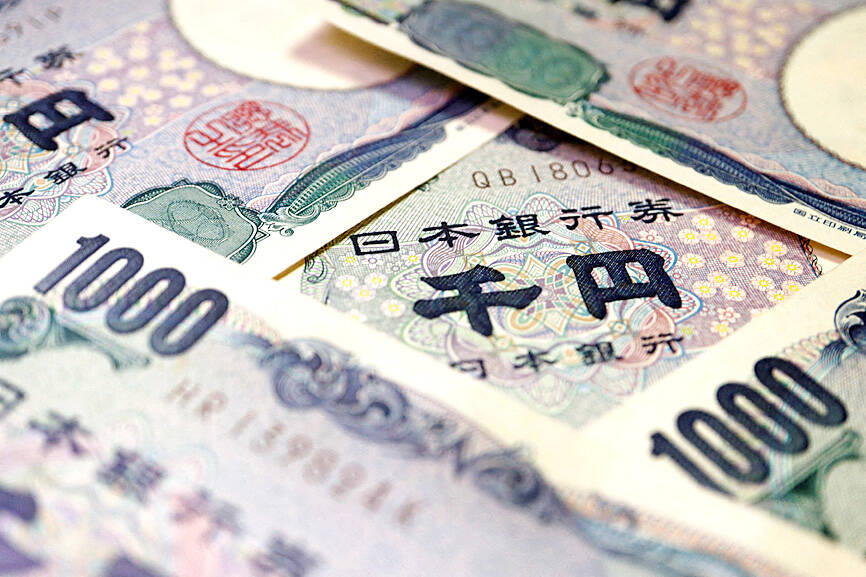
Photo: Reuters
The yen had weakened to as much as 157.78 per US dollar at the weekend, suggesting investors were disappointed that the BOJ did not signal a stronger intention to keep hiking rates.
After Mimura’s comments yesterday, the yen strengthened to as much as 157.51 to the greenback. With analysts broadly expecting the Japanese central bank to hold off on its next hike for another six months or so, the Japanese Ministry of Finance might have to intervene in the currency markets should the yen keep weakening toward the 160 level against the US dollar.
Meanwhile, Japan’s benchmark 10-year yield climbed to a level unseen since February 1999. The two-year yield, which is sensitive to monetary policy expectations, rose to the highest since 1997.
“The sharp yen depreciation is seen as a factor pushing up yields, as it has fueled speculation that the timing of the next rate hike may be brought forward,” Mitsubishi UFJ Morgan Stanley Securities Co senior fixed-income strategist Keisuke Tsuruta said.
He added that yields are expected to remain elevated “given the market conditions after the BOJ meeting and lingering fiscal concerns.”
Elsewhere, precious metals rallied, with their haven appeal boosted by geopolitical tensions and expectations of more US Federal Reserve’s rate cuts. Looser monetary policy typically is a tailwind for gold and silver, which do not pay interest.
Spot gold strengthened more than 1.5 percent to surpass the previous record of US$4,381 an ounce set in October. Silver also climbed to a record and platinum advanced for an eighth straight session.
Copper approached US$12,000 a tonne at the tail end of a momentous year dominated by trade turmoil, tight supply and optimism for long-term demand. The metal is on track for its biggest annual gain since 2009.

HORMUZ ISSUE: The US president said he expected crude prices to drop at the end of the war, which he called a ‘minor excursion’ that could continue ‘for a little while’ The United Arab Emirates (UAE) and Kuwait started reducing oil production, as the near-closure of the crucial Strait of Hormuz ripples through energy markets and affects global supply. Abu Dhabi National Oil Co (ADNOC) is “managing offshore production levels to address storage requirements,” the company said in a statement, without giving details. Kuwait Petroleum Corp said it was lowering production at its oil fields and refineries after “Iranian threats against safe passage of ships through the Strait of Hormuz.” The war in the Middle East has all but closed Hormuz, the narrow waterway linking the Persian Gulf to the open seas,

Taiwan has enough crude oil reserves for more than 100 days and sufficient natural gas reserves for more than 11 days, both above the regulatory safety requirement, Minister of Economic Affairs Kung Ming-hsin (龔明鑫) said yesterday, adding that the government would prioritize domestic price stability as conflicts in the Middle East continue. Overall, energy supply for this month is secure, and the government is continuing efforts to ensure sufficient supply for next month, Kung told reporters after meeting with representatives from business groups at the ministry in Taipei. The ministry has been holding daily cross-ministry meetings at the Executive Yuan to ensure

RATIONING: The proposal would give the Trump administration ample leverage to negotiate investments in the US as it decides how many chips to give each country US officials are debating a new regulatory framework for exporting artificial intelligence (AI) chips and are considering requiring foreign nations to invest in US AI data centers or security guarantees as a condition for granting exports of 200,000 chips or more, according to a document seen by Reuters. The rules are not yet final and could change. They would be the first attempt to regulate the flow of AI chips to US allies and partners since US President Donald Trump’s administration said it rescinded its predecessor’s so-called AI diffusion rules. Those rules sought to keep a significant amount of AI

A new worry has been rippling across the stock market lately: Entire businesses, not just their employees, might be thrown out of work. While most economists say fears of an artificial intelligence (AI) job apocalypse are overblown, seismic shifts have happened in the past after big tech breakthroughs. The IT revolution of the 1990s led to a surge in productivity that sped up the US economy for several years. It also rendered companies or even industries largely redundant — from travel agents and stockbrokers to classified advertising and newspapers, or video rental stores. Economists expect AI would deliver higher productivity,


 RSS
RSS