


Taiwan has enough crude oil reserves for more than 100 days and sufficient natural gas reserves for more than 11 days, both above the regulatory safety requirement, Minister of Economic Affairs Kung Ming-hsin (龔明鑫) said yesterday, adding that the government would prioritize domestic price stability as conflicts in the Middle East continue.
Overall, energy supply for this month is secure, and the government is continuing efforts to ensure sufficient supply for next month, Kung told reporters after meeting with representatives from business groups at the ministry in Taipei.
The ministry has been holding daily cross-ministry meetings at the Executive Yuan to ensure stable supplies of gas and crude oil, Kung added.
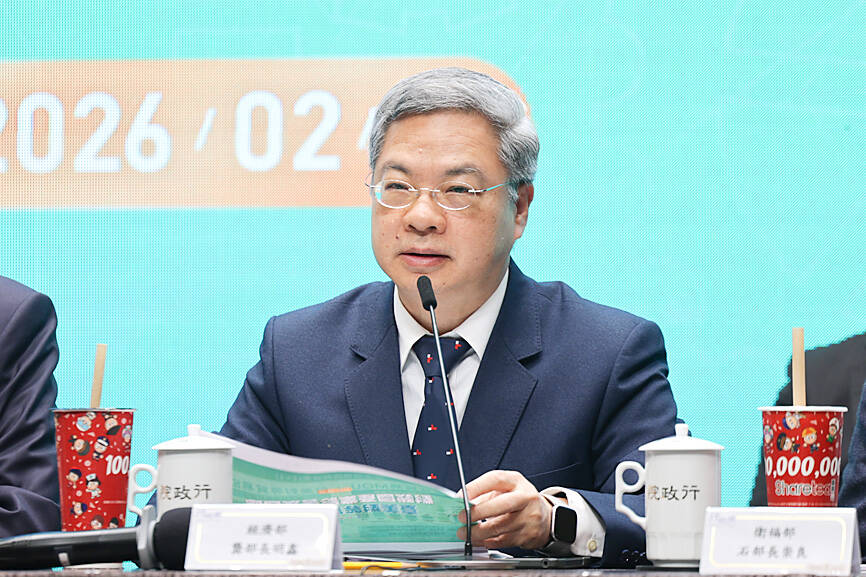
Photo: CNA
Taiwan receives about 30 natural gas shipments each month, of which about 10 come from the Middle East, while the remaining 20 are from other regions, he said.
State-run CPC Corp, Taiwan (中油) has implemented a “dual stabilization mechanism,” including oil price smoothing measures and lowest-price principle among neighboring Asian economies, to keep domestic fuel prices within a controlled range, Kung said.
Electricity prices would ultimately be decided by the electricity rate review committee, but the government’s stance remains to keep prices as stable as possible, he said.
Responding to questions about whether the minister had made commitments regarding electricity pricing policy, General Chamber of Commerce chairman Paul Hsu (許舒博) said after the meeting that Kung had expressed confidence during the meeting that electricity prices could remain relatively stable for now.
As for natural gas prices, whether rates for households and power utilities would be adjusted next month is still under review, Kung said.
Since CPC and Taiwan Power Co (台電) are state-owned enterprises, part of their mandate is to help stabilize prices, meaning they would not always adjust prices immediately in line with market movements, he said.
To secure natural gas supply, the government is pursuing three approaches, Kung said.
First, it is coordinating with major suppliers such as the US and Australia to bring forward cargo deliveries to next month, he said.
Second, the government is exploring possible gas dispatch or exchange arrangements with Asian economies such as Japan and South Korea, although implementation is challenging, as demand remains high across the region, Kung said.
Third, the government might procure gas from the spot market, although such purchases typically come at higher prices and therefore require careful assessments, he said.
Regarding whether coal-fired backup generators might be activated, Kung said it would be a later-stage contingency measure.
Taiwan is still within its seasonal air pollution control period, meaning any use of coal units would need to consider the impact on air quality, he said.
The government would reassess whether additional measures are necessary after April, when the pollution control season ends and regulatory flexibility increases, Kung added.
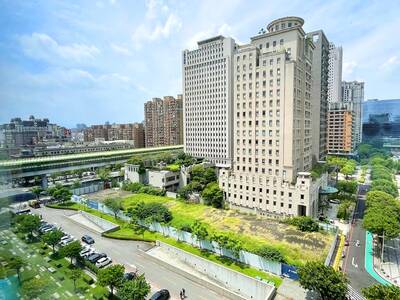
Taichung reported the steepest fall in completed home prices among the six special municipalities in the first quarter of this year, data compiled by Taiwan Realty Co (台灣房屋) showed yesterday. From January through last month, the average transaction price for completed homes in Taichung fell 8 percent from a year earlier to NT$299,000 (US$9,483) per ping (3.3m²), said Taiwan Realty, which compiled the data based on the government’s price registration platform. The decline could be attributed to many home buyers choosing relatively affordable used homes to live in themselves, instead of newly built homes in the city’s prime property market, Taiwan Realty
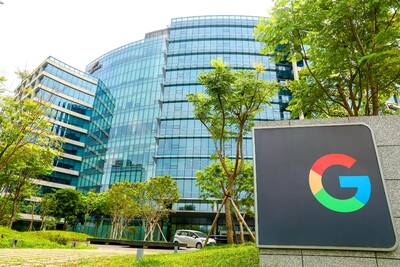
The government yesterday approved applications by Alphabet Inc’s Google to invest NT$27.08 billion (US$859.98 million) in Taiwan, the Ministry of Economic Affairs said in a statement. The Department of Investment Review approved two investments proposed by Google, with much of the funds to be used for data processing and electronic information supply services, as well as inventory procurement businesses in the semiconductor field, the ministry said. It marks the second consecutive year that Google has applied to increase its investment in Taiwan. Google plans to infuse NT$25.34 billion into Charter Investments Ltd (特許投資顧問) through its Singapore-based subsidiary Fructan Holdings Singapore Pte Ltd, and

JET JUICE: The war on Iran’s secondary effects have seen fuel prices skyrocket, knocking flight schedules down to earth in return as airlines struggle with costs Airline passengers should brace for more irritation in the next few months as carriers worldwide cancel flights and ground planes to cope with stratospheric increases in jet-fuel prices. Dutch flag carrier KLM is the latest company to cut its schedule, saying on Thursday that it would scrap 80 return flights at Amsterdam’s Schiphol Airport in the coming month. That puts it in the same league as United Airlines Holdings Inc, Deutsche Lufthansa AG and Cathay Pacific Airways Ltd, which have all pruned itineraries to mitigate costs. Global capacity for next month has been reduced by about 3 percentage points, with all

FORESEEABLE CONSEQUENCES: New technology always comes with new innovations by the iniquitous in exploiting users for financial gain or more nefarious ends Artificial intelligence (AI) “agents” say they can save users time and energy by automating tasks, but the growing power of systems such as OpenClaw is putting cybersecurity experts on edge. Powered by a wave of hype, OpenClaw today says it has more than three million users worldwide. The system allows users to create so-called agents, tools based on a large language model (LLM) such as OpenAI’s ChatGPT or Anthropic PBC’s Claude, that can carry out online tasks. “We’ve moved from an AI you could talk with via a chatbot to an agentic AI, which can take action... the threat and the risks are


 RSS
RSS