


Moore Threads Technology Co (摩爾線程) introduced a new generation of chips aimed at reducing artificial intelligence (AI) developers’ dependence on Nvidia Corp’s hardware, just weeks after pulling off one of the most successful Chinese initial public offerings (IPOs) in years.
“These products will significantly enhance world-class computing speed and capabilities that all developers aspire to,” Moore Threads CEO Zhang Jianzhong (張建中), a former Nvidia executive, said on Saturday at a company event in Beijing. “We hope they can meet the needs of more developers in China so that you no longer need to wait for advanced foreign products.”
Chinese chipmakers are in the spotlight as Beijing authorities push forward with efforts to develop a world-class semiconductor sector. Investors are betting that national champions would emerge to challenge Nvidia, whose most-advanced chips are blocked by the US from being sold to China.

Photo: Bloomberg
Moore Threads’ architecture, named Huagang (花港), would elevate computational density by 50 percent and improve energy efficiency by 10 times, Zhang said.
Chips based on the new architecture would be named Huashan and be positioned to compete with Nvidia’s Hopper and Blackwell products, he said.
The new technology, slated for mass production from next year, would enable clusters connecting more than 100,000 chips for AI training at data centers, Zhang added.
Zhang founded his own company in 2020 after spending 14 years at Nvidia. Moore Threads started out earning revenue from gaming and visual rendering chips before pivoting to the accelerators vital to developing and running AI software.
The chipmaker also announced an update to its proprietary computing platform, MUSA, at the event, positioning it as an equivalent to Nvidia’s CUDA.
Moore Threads, which was blacklisted by the US in 2023, unveiled servers capable of linking tens of thousands of AI chips.
Its announcement comes the same month it quintupled on its debut in Shanghai. Days later, domestic rival MetaX Integrated Circuits Co (沐曦) also rose several-fold on its first day.

Shares of contract chipmaker Taiwan Semiconductor Manufacturing Co (TSMC, 台積電) came under pressure yesterday after a report that Apple Inc is looking to shift some orders from the Taiwanese company to Intel Corp. TSMC shares fell NT$55, or 2.4 percent, to close at NT$2,235 on the local main board, Taiwan Stock Exchange data showed. Despite the losses, TSMC is expected to continue to benefit from sound fundamentals, as it maintains a lead over its peers in high-end process development, analysts said. “The selling was a knee-jerk reaction to an Intel-Apple report over the weekend,” Mega International Investment Services Corp (兆豐國際投顧) analyst Alex Huang
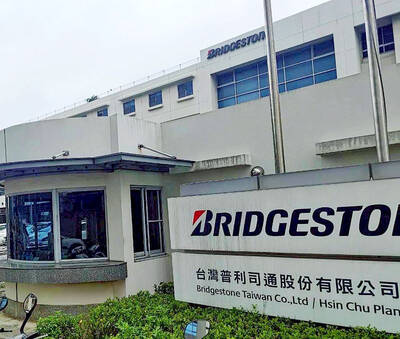
TRANSITION: With the closure, the company would reorganize its Taiwanese unit to a sales and service-focused model, Bridgestone said Bridgestone Corp yesterday announced it would cease manufacturing operations at its tire plant in Hsinchu County’s Hukou Township (湖口), affecting more than 500 workers. Bridgestone Taiwan Co (台灣普利司通) said in a statement that the decision was based on the Tokyo-based tire maker’s adjustments to its global operational strategy and long-term market development considerations. The Taiwanese unit would be reorganized as part of the closure, effective yesterday, and all related production activities would be concluded, the statement said. Under the plan, Bridgestone would continue to deepen its presence in the Taiwanese market, while transitioning to a sales and service-focused business model, it added. The Hsinchu
Taiwan Semiconductor Manufacturing Co (TSMC, 台積電) has approved a capital budget of US$31.28 billion for production expansion to meet long-term development needs during the artificial intelligence (AI) boom. The company’s board meeting yesterday approved the capital appropriation plan for purposes such as the installation of advanced technology capacity and fab construction, the world’s largest contract chipmaker said in a statement. At an earnings conference last month, TSMC forecast that its capital expenditure for this year would be at the higher end of the US$52 billion to US$56 billion range it forecast in January in response to robust demand for 5G, AI and

Taiwan Semiconductor Manufacturing Co’s (TSMC, 台積電) investment project in Arizona has progressed better than expected, but it still faces challenges such as water and labor shortages, National Development Council (NDC) Minister Yeh Chun-hsien (葉俊顯) said yesterday. Speaking with reporters after visiting TSMC’s Arizona hub and attending the SelectUSA Investment Summit in Maryland last week, Yeh said TSMC’s Arizona site turned a profit of NT$16.14 billion (US$514 million) last year in its first full year of mass production. “TSMC told me it was surprised by the smooth trial run of the first fab, which has left the company optimistic about the project’s outlook,”


 RSS
RSS