


Charming US President Donald Trump one week, angering China the next, Japanese Prime Minister Sanae Takaichi has had a busy start and is riding high in the polls, all on a few hours of sleep a night.
However, the honeymoon might end soon for the Margaret Thatcher-admiring leader if a spat with China escalates further and she fails to keep inflation in check.
“I believe Prime Minister Takaichi will surely do what she needs to do, so I trust her,” Kozue Otsuka, 50, told reporters at a festival this week for business owners seeking good fortune.
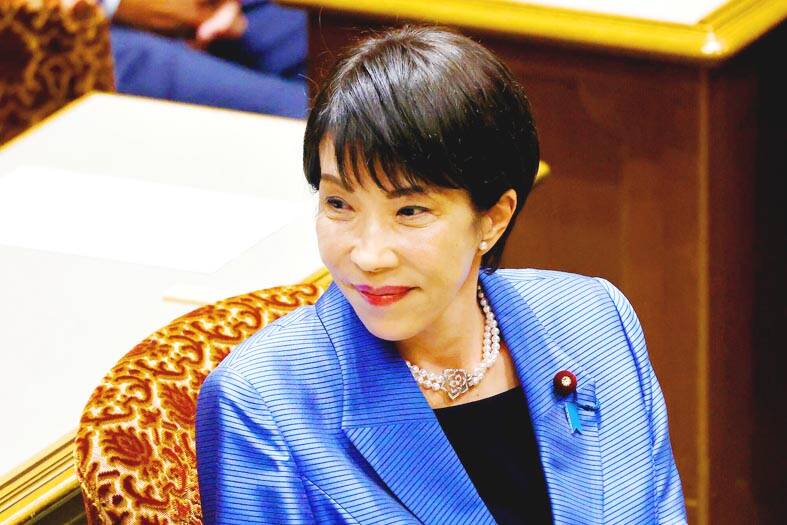
Photo: Bloomberg
While buying a lucky kumade rake featuring a smiling goddess of mirth, Otsuka, a housewife, added: “I hope that Japan-China relations will gradually move in a better direction.”
“What I am worried about, most of all, is the [prime] minister’s remarks. China got really agitated because of that,” echoed Shigeru Fujita, 78, who runs a gardening company.
Takaichi has admitted only sleeping two to four hours a night.

Photo: Reuters
Trump arrived a week into her term and Takaichi won plaudits for pulling out all the stops to pacify the US president.
“I was very impressed and inspired by you,” Takaichi gushed, gifting him a golf club used by slain former Japanese prime minister Shinzo Abe, a common friend.
Trump said that Takaichi would become “one of the greatest prime ministers.”
Days before Takaichi was at an ASEAN summit in Malaysia and then at an APEC gathering in South Korea, where she met with Chinese President Xi Jinping (習近平).
All seemed cordial, but Takaichi — long seen as a China hawk — kicked up a hornet’s nest a week later.
She told parliament — apparently in unplanned remarks — that a Taiwan “emergency” could threaten Japan’s existence, implying that Japan would intervene militarily.
With one diplomat threatening to sever Takaichi’s “dirty neck,” a livid Chinese government advised citizens to avoid Japan.
With big-spending Chinese tourists the biggest cohort, this was a blow. China then also reportedly reimposed a ban on Japanese seafood imports.
Margarita Estevez-Abe, an analyst at Syracuse University’s Maxwell School in New York, said that China still holds “so many economic cards to punish Japan, but Japan has none.”
These could include China restricting exports of rare earths to Japan or curbs on Japanese exports to China.
Takaichi’s appointment “was a very risky choice for the China-Japan relationship at a very delicate economic moment for Japan,” Estevez-Abe told reporters.
“Starting a fight against someone stronger with no prior planning is no leadership,” she said.
STIMULUS
Takaichi last week unveiled an economic stimulus package worth US$135 billion, including cash handouts to parents and energy subsidies.
She hopes to avoid the fate of her predecessor, former Japanese prime minister Shigeru Ishiba, who suffered a string of election debacles in part because of anger over rising prices.
Despite the creation of a government cost-cutting initiative and promises of a “responsible” fiscal policy, concerns abound that the stimulus would add to Japan’s colossal debt.
This has contributed to a slide in the yen — which would increase Japan’s hefty import bill and push up inflation.
“Ordinary people are having it tough these days,” financial services employee Kazuo Kaitsuka, 75, told reporters.
“I worry future generations might have to deal with the consequences” of the debt, Kaitsuka said.
VIRAL HANDBAG
One Yomiuri survey this week gave Takaichi’s Cabinet an approval rating of 72 percent.
Even her handbag has gone viral, with its 145-year-old Japanese leather goods maker flooded with orders, reports said.
Takaichi’s popularity has raised speculation that she might even call snap elections.
However, Tobias Harris, an analyst at Washington-based Japan Foresight, told reported that he wonders how “durable” her ratings are.
A key factor could be how successful Takaichi is in halting a rise in backing for the Sanseito party.
Her “strong support has not necessarily translated into stronger support for the LDP itself,” Harris said, referring to the ruling Liberal Democratic Party.
“My sense has been that in the near term the tensions with China have helped her — or haven’t hurt — but I feel like there are signs that some in the LDP are wondering that if it drags on, it could weigh on her,” Harris said.
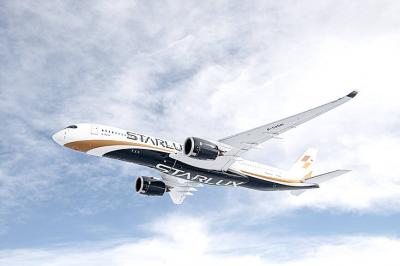
Starlux Airlines Co (星宇航空) today unveiled a long-haul network expansion plan at a shareholders’ meeting in Taipei, including direct flights to Barcelona, Spain, and Zurich, Switzerland, as well as a service connecting Taipei, Sydney and New Zealand. Starlux is to become the first Taiwanese carrier to offer non-stop services to the two European cities, while the inaugural oceanic route is expected to expand transit opportunities within the Australia-New Zealand market, Starlux said. Flight services to Chicago, Dallas, Washington and New York are under evaluation, the airline added. Prior to the shareholders’ meeting, the airline earlier this year announced that it would be
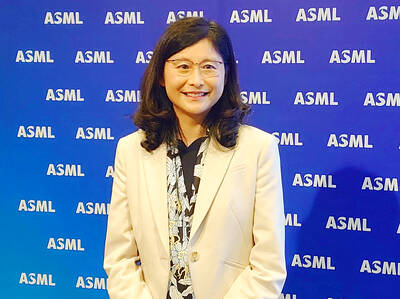
Netherlands-based semiconductor equipment supplier ASML Holding NV yesterday said that it is planning to hire an additional 1,000 people in Taiwan this year in response to growing demand from clients. ASML had previously planned to recruit 600 people this year, but that the plan has been adjusted upward, ASML vice president and ASML Taiwan general manager Grace Wang (汪佳慧) told reporters. ASML has a workforce of more than 4,500 in Taiwan, accounting for about 10 percent of its global total, Wang said. This year’s recruitment campaign would focus on adding people in the customer support, manufacturing and supply chain domains to assist ASML
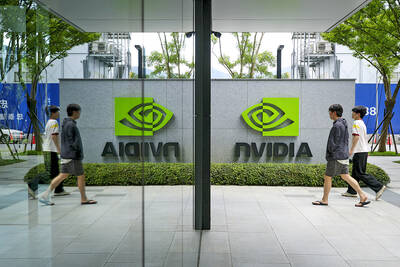
UNDER MICROSCOPE: Taiwan detained three people who allegedly conspired to buy servers in Taiwan and export them using fraudulent documentation, prosecutors said Nvidia Corp chief executive officer Jensen Huang (黃仁勳) on Saturday urged Super Micro Computer Inc to tighten up on compliance after Taiwan detained three people this week for allegedly making fraudulent declarations about artificial intelligence (AI) servers made by its US partner. The development marked the nation’s first crackdown on semiconductor smuggling, which grew after the US slapped restrictions on exports of high-end chips such as Nvidia AI accelerators to China. Nvidia is “rigorous” in explaining regulations to all of its partners, Huang told reporters after arriving in Taipei. “Ultimately Super Micro has to run their own company,” he said in response to
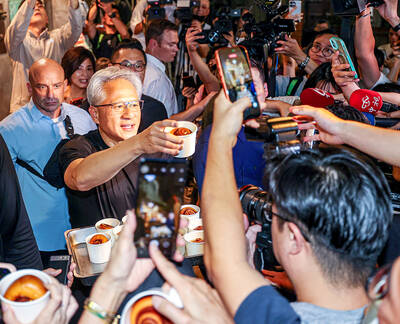
Nvidia Corp yesterday announced that CEO Jensen Huang (黃仁勳) would attend an employee meeting in Taipei tomorrow to celebrate the launch of the company’s Taiwan headquarters project. Huang would attend a gathering at the site of Nvidia’s planned headquarters in Beitou Shilin Technology Park (北投士林科技園區), the company said in a statement. After arriving in Taiwan on Saturday last week, Huang told reporters that he plans to meet with Quanta Computer Inc (廣達) chairman Barry Lam (林百里) and Taiwan Semiconductor Manufacturing Co (TSMC, 台積電) chairman C.C. Wei (魏哲家), and would attend the groundbreaking ceremony for Nvidia’s Taiwan headquarters tomorrow. Nvidia has not yet applied


 RSS
RSS