


China Vanke Co (萬科), China’s last major developer to have so far avoided default amid an unprecedented property crisis, has been left with little time to keep debt failure at bay after creditors spurned its proposal to push back a looming bond payment.
Once China’s biggest homebuilder by sales, Vanke failed to obtain sufficient support for its plan to delay paying the 2 billion yuan (US$283.51 million) note due today, a filing to the National Association of Financial Market Institutional Investors showed late on Saturday.
The proposal, along with two others on the ballot, would have allowed a one-year extension. All three fell short of the more than 90 percent support required for passage.
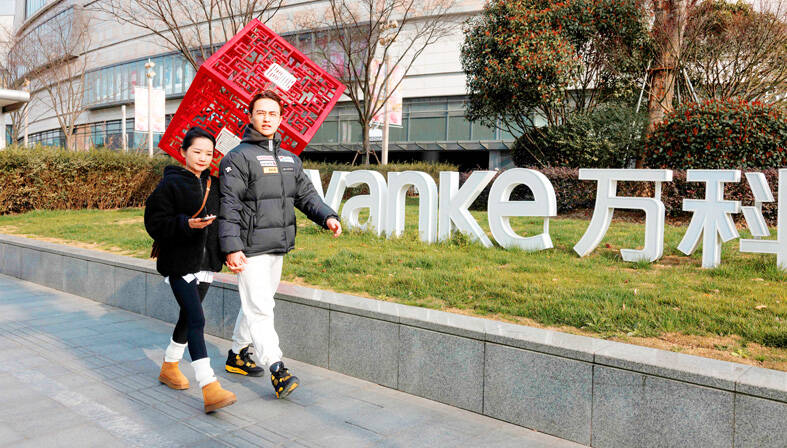
Photo: EPA-EFE
That leaves Vanke in a situation that underscores the broader challenges China faces in extricating itself from a real-estate debt crisis now entering its fifth year. The slump has sparked record defaults and liquidations or restructurings at property giants such as Country Garden Holdings Co (碧桂園) and China Evergrande Group (恒大).
Vanke must find money to pay the bond by the end of today or within a grace period of five business days, or come to some separate agreement to push back the deadlines. If the grace period passes with no payment and no other agreement, creditors could call default — once an unthinkable outcome.
Vanke had long benefited from a perception held by many investors that authorities would help keep it afloat. That belief was based on the company’s largest shareholder being state-owned Shenzhen Metro Group Co (深鐵集團).
Indeed, more than 30 billion yuan in shareholder loans from Shenzhen Metro provided a critical lifeline, helping the cash-strapped builder avoid defaults this year.
However, the support came under scrutiny in the past few months after Shenzhen Metro signaled plans to tighten borrowing terms. That shift sparked a drop in Vanke’s securities to deeply distressed levels.
A week ago, financial and state asset regulators from Shenzhen asked for bondholders’ understanding of Vanke’s current financial stress.
“The voting results indicated that the regulatory guidance hadn’t changed anything, making it very difficult for Vanke to reach a consensus with investors,” said Yao Yu (姚煜), founder of credit research firm RatingDog Information Technology Co (瑞霆狗). “It is quite likely that Vanke will propose another motion to extend the five-business-day grace period to 30 business days, thus leaving room for all parties.”
No creditors voted in favor of Vanke’s original plan to postpone its local bond, which was a 12-month delay on principal and interest due without any upfront cash payments or installments.
The other two proposals, which were announced later and required the developer to add credit enhancements and make an interest payment on time, received backing from investors holding 83.4 percent and 18.95 percent of the bond’s outstanding amount respectively.
Some market watchers, including Forest Capital Hong Kong Ltd (森林資本) cofounder Li Huan (李歡), have said that a full-scale debt restructuring is inevitable as extensions — even if Vanke could get them passed — would not address the underlying issues.

Netherlands-based semiconductor equipment supplier ASML Holding NV yesterday said that it is planning to hire an additional 1,000 people in Taiwan this year in response to growing demand from clients. ASML had previously planned to recruit 600 people this year, but that the plan has been adjusted upward, ASML vice president and ASML Taiwan general manager Grace Wang (汪佳慧) told reporters. ASML has a workforce of more than 4,500 in Taiwan, accounting for about 10 percent of its global total, Wang said. This year’s recruitment campaign would focus on adding people in the customer support, manufacturing and supply chain domains to assist ASML

UNDER MICROSCOPE: Taiwan detained three people who allegedly conspired to buy servers in Taiwan and export them using fraudulent documentation, prosecutors said Nvidia Corp chief executive officer Jensen Huang (黃仁勳) on Saturday urged Super Micro Computer Inc to tighten up on compliance after Taiwan detained three people this week for allegedly making fraudulent declarations about artificial intelligence (AI) servers made by its US partner. The development marked the nation’s first crackdown on semiconductor smuggling, which grew after the US slapped restrictions on exports of high-end chips such as Nvidia AI accelerators to China. Nvidia is “rigorous” in explaining regulations to all of its partners, Huang told reporters after arriving in Taipei. “Ultimately Super Micro has to run their own company,” he said in response to

Nvidia Corp yesterday announced that CEO Jensen Huang (黃仁勳) would attend an employee meeting in Taipei tomorrow to celebrate the launch of the company’s Taiwan headquarters project. Huang would attend a gathering at the site of Nvidia’s planned headquarters in Beitou Shilin Technology Park (北投士林科技園區), the company said in a statement. After arriving in Taiwan on Saturday last week, Huang told reporters that he plans to meet with Quanta Computer Inc (廣達) chairman Barry Lam (林百里) and Taiwan Semiconductor Manufacturing Co (TSMC, 台積電) chairman C.C. Wei (魏哲家), and would attend the groundbreaking ceremony for Nvidia’s Taiwan headquarters tomorrow. Nvidia has not yet applied

Huawei Technologies Co (華為) said it has come up with a new pathway to shorten its gap with industry leader Taiwan Semiconductor Manufacturing Co (TSMC, 台積電), potentially achieving a breakthrough in making advanced semiconductors without cutting-edge equipment. Right now there is about a five-year gap between what TSMC is capable of and what Huawei, together with its manufacturing partner Semiconductor Manufacturing International Corp (中芯), can produce. Huawei is to start making 1.4-nanometer chips by 2031 with its own “LogicFolding” technology, Huawei semiconductor chief He Tingbo (何庭波) said in a rare public appearance during a chip conference yesterday, while TSMC has


 RSS
RSS