


The 30th United Nations Climate Change Conference (COP30), held for the first time in the Amazon rainforest city of Belem in Brazil, featured E.Sun Financial Holding Co (玉山金控) chairman Joseph N.C. Huang (黃男州) representing Taiwan’s financial industry for the fourth consecutive year.
During the World Climate Summit, a key COP30 side event, Huang delivered an opening address titled “Reimagining Climate Action: Weave a web of harmony between justice, nature and community.”
He announced that E.Sun joined the Nature Investment Coalition, underscoring Asia’s growing leadership in connecting natural ecosystems with financial capital.
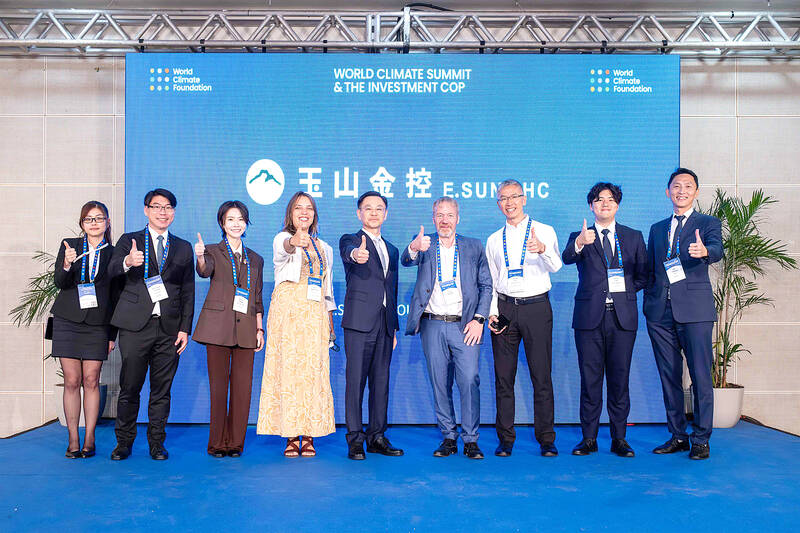
Photo courtesy of E.Sun Financial Holding Co
E.Sun also signed a strategic partnership with the World Climate Foundation (WCF) to jointly advance nature-based solutions investment and biodiversity across Asia.
Under E.Sun’s leadership, the coalition will bring together financial institutions, industry leaders, policymakers, and academia to accelerate investment in biodiversity conservation, natural capital, and biodiversity credit mechanisms.
WCF chairman Jens Nielsen noted: “E.Sun’s leadership will amplify the coalition’s impact in Asia and share science-based practices with the world, demonstrating integrity and innovation in nature finance.”
Huang emphasized that COP30 marks a turning point for climate action — shifting from carbon metrics toward climate adaptation, resilience, and improved quality of life.
Citing Taiwan’s unique geography and recent extreme weather events, he called for urgent and inclusive climate measures.
E.Sun has partnered with 18 major hospitals to establish memoranda of understanding on sustainable healthcare, enhancing medical resilience and protecting vulnerable communities.
To address the impacts of climate change on rural and Indigenous regions, E.Sun launched the “Malavi Project” over a decade ago in Hualien’s Nanan community. The initiative promotes organic transition and integrates Bunun traditional farming practices, reintroducing native crops to improve biodiversity and ecosystem resilience. The spirit of “Malavi” — which means “everyone together” in the local Indigenous language — also echoes the COP30 theme of Global Mutirao, emphasizing collective action and community-driven solutions for a nature-positive future.
“Indigenous peoples are not just participants,” Huang said. “They are leaders and guardians of the land in our shared climate journey.”
E.Sun continues to provide nature-based financial products, such as biodiversity-linked and other effective area-based conservation measures (OECM)-linked loans, and organizes its annual environmental, social and governance (ESG) initiative to promote cross-sector collaboration.
By integrating financial innovation with community and environmental stewardship, E.Sun aims to create a nature-positive, resilient and inclusive future.
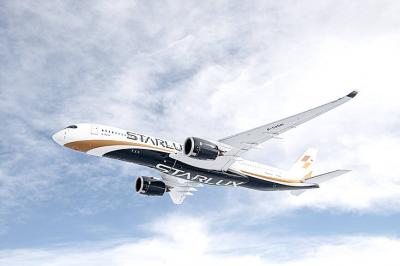
Starlux Airlines Co (星宇航空) today unveiled a long-haul network expansion plan at a shareholders’ meeting in Taipei, including direct flights to Barcelona, Spain, and Zurich, Switzerland, as well as a service connecting Taipei, Sydney and New Zealand. Starlux is to become the first Taiwanese carrier to offer non-stop services to the two European cities, while the inaugural oceanic route is expected to expand transit opportunities within the Australia-New Zealand market, Starlux said. Flight services to Chicago, Dallas, Washington and New York are under evaluation, the airline added. Prior to the shareholders’ meeting, the airline earlier this year announced that it would be

Netherlands-based semiconductor equipment supplier ASML Holding NV yesterday said that it is planning to hire an additional 1,000 people in Taiwan this year in response to growing demand from clients. ASML had previously planned to recruit 600 people this year, but that the plan has been adjusted upward, ASML vice president and ASML Taiwan general manager Grace Wang (汪佳慧) told reporters. ASML has a workforce of more than 4,500 in Taiwan, accounting for about 10 percent of its global total, Wang said. This year’s recruitment campaign would focus on adding people in the customer support, manufacturing and supply chain domains to assist ASML

UNDER MICROSCOPE: Taiwan detained three people who allegedly conspired to buy servers in Taiwan and export them using fraudulent documentation, prosecutors said Nvidia Corp chief executive officer Jensen Huang (黃仁勳) on Saturday urged Super Micro Computer Inc to tighten up on compliance after Taiwan detained three people this week for allegedly making fraudulent declarations about artificial intelligence (AI) servers made by its US partner. The development marked the nation’s first crackdown on semiconductor smuggling, which grew after the US slapped restrictions on exports of high-end chips such as Nvidia AI accelerators to China. Nvidia is “rigorous” in explaining regulations to all of its partners, Huang told reporters after arriving in Taipei. “Ultimately Super Micro has to run their own company,” he said in response to

Nvidia Corp yesterday announced that CEO Jensen Huang (黃仁勳) would attend an employee meeting in Taipei tomorrow to celebrate the launch of the company’s Taiwan headquarters project. Huang would attend a gathering at the site of Nvidia’s planned headquarters in Beitou Shilin Technology Park (北投士林科技園區), the company said in a statement. After arriving in Taiwan on Saturday last week, Huang told reporters that he plans to meet with Quanta Computer Inc (廣達) chairman Barry Lam (林百里) and Taiwan Semiconductor Manufacturing Co (TSMC, 台積電) chairman C.C. Wei (魏哲家), and would attend the groundbreaking ceremony for Nvidia’s Taiwan headquarters tomorrow. Nvidia has not yet applied


 RSS
RSS