


Hon Hai Precision Industry Co (鴻海精密) has signed a memorandum of understanding (MOU) with Mitsubishi Electric Corp for the development of artificial intelligence (AI) data center solutions, the iPhone assembler said in a statement on Thursday.
Hon Hai, also known as Foxconn Technology Group (富士康科技集團), said that the cooperation with Mitsubishi is intended to bring together the know-how and networks of both companies to facilitate the global supply of energy-efficient and highly reliable AI data center solutions.
“In the future, the two companies aim to jointly create new values, solutions and business models outside the AI data center field by leveraging their knowledge assets in the process of addressing social issues such as sustainability,” Hon Hai said.
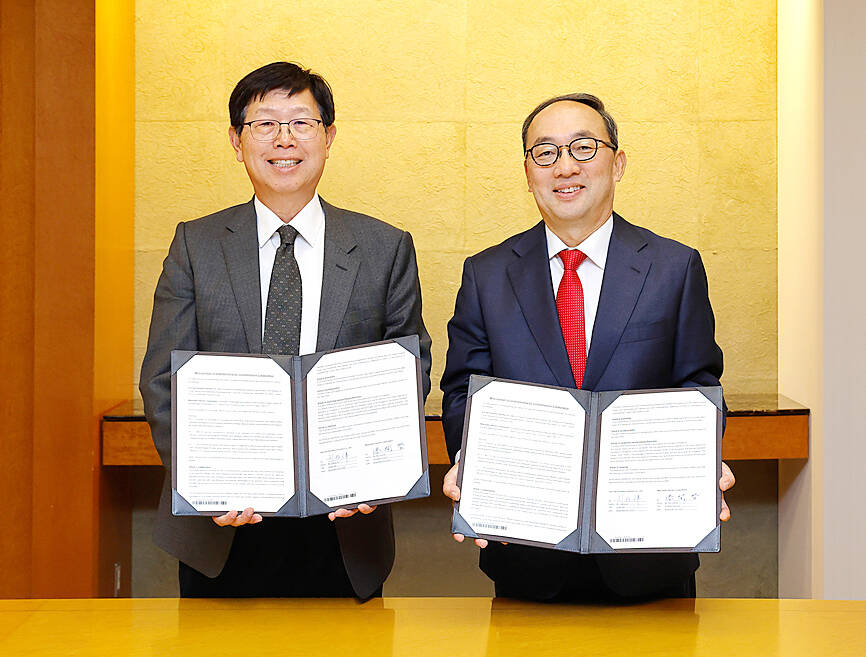
Photo: Hon Hai Precision Industry Co
The Taiwanese company is expected to take advantage of the strength of the Japanese firm in power module supply for the development of AI data center solutions, analysts said.
Mitsubishi ranks second globally in market share in power modules, according to statistics released by market information advisory firm OMDIA.
The Japanese firm takes the first spot in market share in the high voltage direct current technology that uses voltage source converters, OMDIA data showed.
Hon Hai has intensified its efforts in AI development in recent years to diversify its product portfolio.
The company’s consolidated sales grew 15.55 percent from a year earlier to NT$6.39 trillion (US$206.2 billion) in the first 10 months of this year. Hon Hai is scheduled to hold an investor conference on Wednesday to detail its third quarter results and give more guidance for the fourth quarter and beyond.

Netherlands-based semiconductor equipment supplier ASML Holding NV yesterday said that it is planning to hire an additional 1,000 people in Taiwan this year in response to growing demand from clients. ASML had previously planned to recruit 600 people this year, but that the plan has been adjusted upward, ASML vice president and ASML Taiwan general manager Grace Wang (汪佳慧) told reporters. ASML has a workforce of more than 4,500 in Taiwan, accounting for about 10 percent of its global total, Wang said. This year’s recruitment campaign would focus on adding people in the customer support, manufacturing and supply chain domains to assist ASML
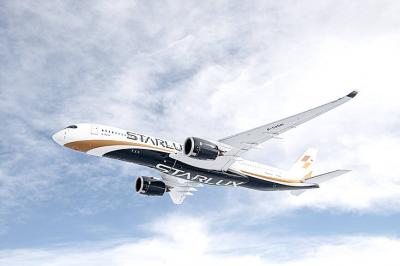
Starlux Airlines Co (星宇航空) today unveiled a long-haul network expansion plan at a shareholders’ meeting in Taipei, including direct flights to Barcelona, Spain, and Zurich, Switzerland, as well as a service connecting Taipei, Sydney and New Zealand. Starlux is to become the first Taiwanese carrier to offer non-stop services to the two European cities, while the inaugural oceanic route is expected to expand transit opportunities within the Australia-New Zealand market, Starlux said. Flight services to Chicago, Dallas, Washington and New York are under evaluation, the airline added. Prior to the shareholders’ meeting, the airline earlier this year announced that it would be

UNDER MICROSCOPE: Taiwan detained three people who allegedly conspired to buy servers in Taiwan and export them using fraudulent documentation, prosecutors said Nvidia Corp chief executive officer Jensen Huang (黃仁勳) on Saturday urged Super Micro Computer Inc to tighten up on compliance after Taiwan detained three people this week for allegedly making fraudulent declarations about artificial intelligence (AI) servers made by its US partner. The development marked the nation’s first crackdown on semiconductor smuggling, which grew after the US slapped restrictions on exports of high-end chips such as Nvidia AI accelerators to China. Nvidia is “rigorous” in explaining regulations to all of its partners, Huang told reporters after arriving in Taipei. “Ultimately Super Micro has to run their own company,” he said in response to

Nvidia Corp yesterday announced that CEO Jensen Huang (黃仁勳) would attend an employee meeting in Taipei tomorrow to celebrate the launch of the company’s Taiwan headquarters project. Huang would attend a gathering at the site of Nvidia’s planned headquarters in Beitou Shilin Technology Park (北投士林科技園區), the company said in a statement. After arriving in Taiwan on Saturday last week, Huang told reporters that he plans to meet with Quanta Computer Inc (廣達) chairman Barry Lam (林百里) and Taiwan Semiconductor Manufacturing Co (TSMC, 台積電) chairman C.C. Wei (魏哲家), and would attend the groundbreaking ceremony for Nvidia’s Taiwan headquarters tomorrow. Nvidia has not yet applied


 RSS
RSS