


France is developing domestic production of electric vehicle (EV) batteries with an eye on industrial independence, but Asian experts are proving key in launching operations.
In the Verkor factory outside the northern city of Dunkirk, which was inaugurated on Thursday, foreign specialists, notably from South Korea and Malaysia, are training the local staff.
Verkor is the third battery gigafactory to open in northern France in a region that has become known as “Battery Valley.”
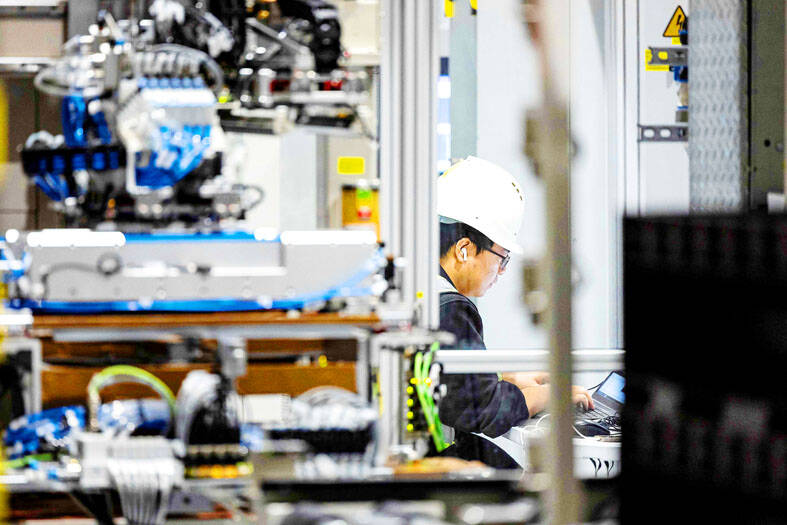
Photo: AFP
At the Automotive Energy Supply Corp (AESC) factory near the city of Douai, where production has been under way for several months, Chinese engineers and technicians supervise French recruits.
“They are the ones who train us on the equipment, how to operate it, how to fix problems,” said Ericka Redjimi, 39.
Redjimi arrived at AESC in May without any experience in the sector.
“I sold clothes at open-air markets,” she said.
Communication can prove complicated.
“We use Google Translate often. I still need them, much less than at the beginning,” but “it’s reassuring that they are still here,” said Redjimi, who works in the section of the factory that makes battery cells.
Once finished, autonomous robotic sleds transport the cells to another section of the factory where they are assembled into battery modules that are used to power Renault’s R4 and R5 models, as well as the Nissan Micra.
By the end of next quarter, the factory should be running at full speed, turning out batteries to equip 150,000 to 200,000 vehicles per year, said Ayumi Kurose, who heads operations at AESC France.
The first few months of production had gone pretty much as expected, Kurose said.
“What’s always complicated is gaining mastery of the equipment” which often comes from Asia, and the training of staff, he said.
Founded in Japan, but now owned by China’s Envision, AESC has been manufacturing EV batteries in Asia for 15 years.
The group can rely on its in-house know-how to ensure “good practices from beginning” at its new factories elsewhere in the world, Kurose said.
There are nearly 150 Chinese experts working at the Douai facility, directing 800 local staff, he said.
They include experts in vision-based control of industrial machinery and cutting-edge soldering techniques.
“The goal is really the transfer of skills,” Kurose said.
The experts “come for between six months and two years, but they aren’t meant to stay,” he added.
The Douai factory should be ready to operate on its own by the end of next year, he said.
One of the Chinese engineers also expressed confidence.
“I have to say, my French colleagues, they are always working hard,” said He Xiaoming, 36.
If they acquire the necessary knowledge and gain additional experience “they will go quite fast,” he added.
The nearby ACC factory, the first battery gigafactory to open in France, with operations launching last year, is also scaling up production after a difficult start.
“What we manufacture in a day now took us a month to do at the beginning of the year,” ACC chief executive officer Yann Vincent said.
“We’re not yet where we want to be,” but in terms of the rate of defective cells and volumes “we’ve made significant improvement,” Vincent said.
A joint venture of automakers Stellantis and Mercedes-Benz plus energy firm TotalEnergies, ACC earlier this year struck a temporary partnership with a Chinese battery manufacturer.
The company, the name of which ACC has not disclosed, would manage one of its three production lines from A to Z until the middle of next year.
Vincent said the Chinese have learned an enormous amount in two decades of manufacturing EV batteries, while France began from zero five years ago.
So “it’s better to rely on the people who know best” to speed up learning a “really delicate” manufacturing process, he said.
ACC, which employs 1,200 people at its Billy-Berclau factory, aims to manufacture batteries for 250,000 EVs next year, against 10,000 to date.

Cairo’s new monorail slices across the city skyline, running above the familiar chaos of blaring horns and aging buses’ exhaust fumes that mark rush hour below. The US$4.5 billion monorail, opened this month, is among Egypt’s most prominent new transport projects, part of a debt-funded infrastructure drive criticized for sapping state finances while bringing limited benefits to most of the country’s 109 million people. “It feels like you’re in a different country,” said Ramy Sayed, a restaurant manager, aboard a driverless Innovia 300 train. “No noise, no traffic, we’re not used to this.” The eastern line runs 56km from the bustling middle-class

Taiwanese firms have increased investment in the Philippines in recent years as Manila’s ties with Washington deepen and global supply chains continue to shift away from China, an expert at the Chung-Hua Institution for Economic Research (CIER, 中華經濟研究院) said yesterday. The Philippines had not been among Taiwanese investors’ top choices in Southeast Asia, CIER Taiwan ASEAN Studies Center director Kristy Hsu (徐遵慈) said at a seminar in Taipei. However, Taiwan’s investment in the country has grown significantly since the COVID-19 pandemic, reaching US $257 million last year, a high in recent years, she said. Although Taiwan’s total investment in the Philippines still lags

Intel Corp regards Taiwan Semiconductor Manufacturing Co (TSMC, 台積電) as a longstanding partner, as the US chipmaker would continue outsourcing production of advanced chips to TSMC, Intel chief executive officer Lip-Bu Tan (陳立武) said yesterday. “I don’t look at people as competitors. I look at the collaboration... Nvidia is also, you know, a good friend,” Tan told a news conference following his keynote speech at the Computex trade show in Taipei. “It’s a very trusted partnership for us... We are a big, top customer for them, and we’re going to continue doing that,” he said, referring to TSMC, the world’s largest foundry

Artificial intelligence (AI) agents would supplant smartphones as the center of people’s digital lives, fundamentally reshaping personal devices and driving a major computing upgrade cycle, Qualcomm Inc CEO Cristiano Amon said yesterday. In his keynote speech for this year’s Computex trade show in Taipei, Amon said that the rise of "agentic AI" — AI systems capable of reasoning, planning and carrying out tasks autonomously — would transform how people interact with technology across phones, PCs, vehicles and wearable devices. Describing the technology as the next major evolution in computing, Amon said that "2026 is the year of agents.” For decades, smartphones have sat


 RSS
RSS