


It is challenging to build infrastructure in much of Europe. Constrained budgets and polarized politics tend to undermine long-term projects, forcing officials to react to emergencies rather than plan for the future.
Not in Austria.
Today, the country is to officially open its Koralmbahn tunnel, the 5.9 billion euro (US$6.9 billion) centerpiece of a groundbreaking new railway that will eventually run from Poland’s Baltic coast to the Adriatic Sea, transforming travel within Austria and positioning the Alpine nation at the forefront of logistics in Europe.
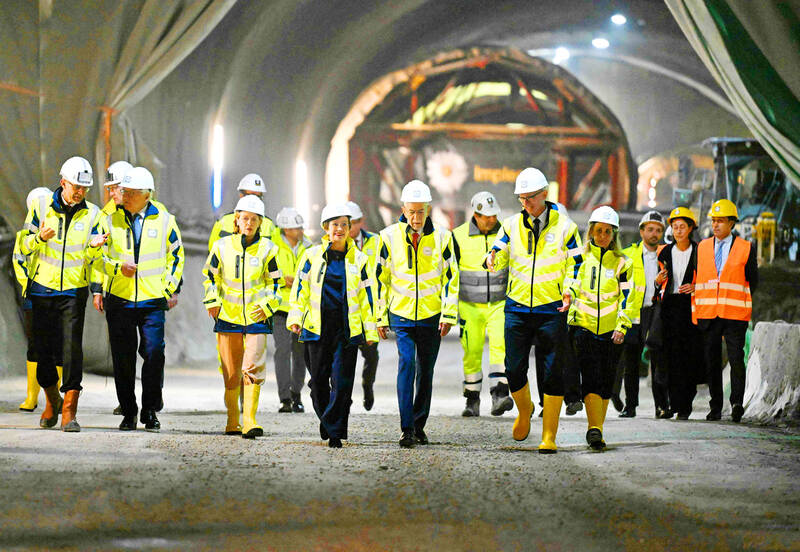
Photo: AFP
“It is Austria’s biggest socio-economic experiment in over a century,” said Eric Kirschner, an economist at Graz-based Joanneum Research, who expects the project to help stem rural flight and aid industry in the country’s southeastern provinces.
The Koralmtunnel is the first of three planned rail mega-projects expected to be completed in the next decade. At 33km, it is one of the world’s longest railway tunnels.
By cutting through the Alps, it will reduce travel time between the country’s second and fifth-biggest cities, Graz and Klagenfurt, from three hours to 45 minutes. It has also catalyzed other kinds of construction: more than 260km of new track and 23 train stations have been built as part of the scheme.
For people like Ralf Kaiser, a physicist who commutes weekly between Vienna and Trieste, the new Koralmbahn connection is “a game changer.” His train-travel time has suddenly been reduced by almost one-third, from nine to about six hours.
The new route will mean “lots of people will take the train instead of the car,” Kaiser said.
For the southern Austrian states of Styria and Carinthia, it represents nothing less than a new economic map.
“We found labor-market interconnections could rise 40 percent,” Kirschner said. “You get a new urban agglomeration of 1.1 million people. In Austria, that’s huge.”
Housing markets near the new stations have already taken notice, with prices in rural districts along the line surging as buyers gamble on a future in which pastoral villages transform into commuter towns. Some families have begun relocating back to small Carinthian communities they left years ago.
Austrian researchers estimate that municipalities with train stations could see their populations grow nearly three percentage points higher than average. Even those within a 20-minute drive might grow up to two points more. In southern Austria, where demographic decline has gnawed at small towns for a generation, such numbers are startling.
After years of shrugging at the construction, locals suddenly felt the scale of what was coming this autumn when test trains began running.
Since then, communities along the new line have been convening town hall meetings to discuss what these changes will mean. Plans are afoot to establish public transport routes between stations and tourism bureaus are launching campaigns to attract visitors.
The Koralmtunnel is only the beginning. Austria has committed about 20 billion euros to lay 100km of high-speed tracks beneath the Alps, while the planned Semmering Base Tunnel and Brenner Base Tunnel will add logistics capacity on trade routes running between the Mediterranean and North seas. The resulting new line will ultimately stretch from Poland to the Adriatic ports of Trieste and Koper, which are among Europe’s fastest-growing logistics hubs.
“Austria becomes a hinge in the north-south axis,” Kirschner said. “It’s already a logistics hub for companies like Lidl to distribute through eastern Europe. This strengthens that role.”
That could transform the region, said the University of Vienna’s Margareth Lanzinger, who is leading an EU project examining how logistical links have historically led to the accumulation of wealth.
Economic records show how successive Alpine-route improvements have lifted local economies for centuries, Lanzinger said.
Austria’s building prowess is all the more remarkable given the situations in neighboring countries. The nation has outpaced Germany and Italy in per capita infrastructure investment. Although Germany has taken steps to increase spending — such as by establishing a 500 billion euro infrastructure fund — that gap has nevertheless widened in the past decade, partly due to Vienna’s distinctive railway financing model.
Austrian projects are funded through six-year contracts backed by annuity-style repayments.
The government effectively “takes out a mortgage” to build a tunnel, said Franz Hammerschmid, head of strategic planning at Austrian Federal Railways.
As the money is repaid over decades, annual budgets show only the loan payments and not the total project cost.
“Germany has to fight every year for its rail budget,” Hammerschmid said. “We don’t.”
To be sure, Austria’s willingness to invest when others hesitate comes with some risk. In June, Fitch downgraded Austria’s sovereign credit to a record low, two steps below the top mark, in the wake of nearly three years of recession and ballooning government debt.
And as fiscal stress mounts, economist Klaus Weyerstrass at the Institute for Advanced Studies in Vienna anticipates that some projects will struggle — or even be postponed.
“It will definitely be a challenge,” Weyerstrass said.
Still, the cost of not investing is far higher, he added.
“You see in Germany what happens when infrastructure is neglected for too long,” he said. “Eventually, the repair costs explode.”
For now, spending on railway infrastructure is one of the few policy measures that still unites Austrians across the political spectrum.
The Koralmtunnel is already a symbol of national pride — and Austria’s ability to build at a scale unmatched almost anywhere in Europe.
“This didn’t happen overnight,” Hammerschmid said. “Our politicians decided 30 years ago that we would modernize and they kept investing. Most countries didn’t.”

Netherlands-based semiconductor equipment supplier ASML Holding NV yesterday said that it is planning to hire an additional 1,000 people in Taiwan this year in response to growing demand from clients. ASML had previously planned to recruit 600 people this year, but that the plan has been adjusted upward, ASML vice president and ASML Taiwan general manager Grace Wang (汪佳慧) told reporters. ASML has a workforce of more than 4,500 in Taiwan, accounting for about 10 percent of its global total, Wang said. This year’s recruitment campaign would focus on adding people in the customer support, manufacturing and supply chain domains to assist ASML

UNDER MICROSCOPE: Taiwan detained three people who allegedly conspired to buy servers in Taiwan and export them using fraudulent documentation, prosecutors said Nvidia Corp chief executive officer Jensen Huang (黃仁勳) on Saturday urged Super Micro Computer Inc to tighten up on compliance after Taiwan detained three people this week for allegedly making fraudulent declarations about artificial intelligence (AI) servers made by its US partner. The development marked the nation’s first crackdown on semiconductor smuggling, which grew after the US slapped restrictions on exports of high-end chips such as Nvidia AI accelerators to China. Nvidia is “rigorous” in explaining regulations to all of its partners, Huang told reporters after arriving in Taipei. “Ultimately Super Micro has to run their own company,” he said in response to

Nvidia Corp yesterday announced that CEO Jensen Huang (黃仁勳) would attend an employee meeting in Taipei tomorrow to celebrate the launch of the company’s Taiwan headquarters project. Huang would attend a gathering at the site of Nvidia’s planned headquarters in Beitou Shilin Technology Park (北投士林科技園區), the company said in a statement. After arriving in Taiwan on Saturday last week, Huang told reporters that he plans to meet with Quanta Computer Inc (廣達) chairman Barry Lam (林百里) and Taiwan Semiconductor Manufacturing Co (TSMC, 台積電) chairman C.C. Wei (魏哲家), and would attend the groundbreaking ceremony for Nvidia’s Taiwan headquarters tomorrow. Nvidia has not yet applied

Huawei Technologies Co (華為) said it has come up with a new pathway to shorten its gap with industry leader Taiwan Semiconductor Manufacturing Co (TSMC, 台積電), potentially achieving a breakthrough in making advanced semiconductors without cutting-edge equipment. Right now there is about a five-year gap between what TSMC is capable of and what Huawei, together with its manufacturing partner Semiconductor Manufacturing International Corp (中芯), can produce. Huawei is to start making 1.4-nanometer chips by 2031 with its own “LogicFolding” technology, Huawei semiconductor chief He Tingbo (何庭波) said in a rare public appearance during a chip conference yesterday, while TSMC has


 RSS
RSS