


The stock price of Macronix International Co (旺宏) yesterday took a nosedive after the memory chipmaker reported its ninth consecutive quarter of losses, dashing the company’s hopes of a turnaround amid a robust recovery in the memorychip industry.
The stock price tumbled by 10 percent, the daily limit, to NT$34.65 yesterday, ending a four-day winning streak and underperforming the TAIEX’s 0.03 percent decline.
Macronix, the world’s biggest supplier of NOR flash memory chips, said its losses narrowed to NT$862 million (US$28.06 million) during the quarter ending Sept. 30 from last quarter’s NT$1.28 billion. However, on an annual basis losses widened from NT$296 million.
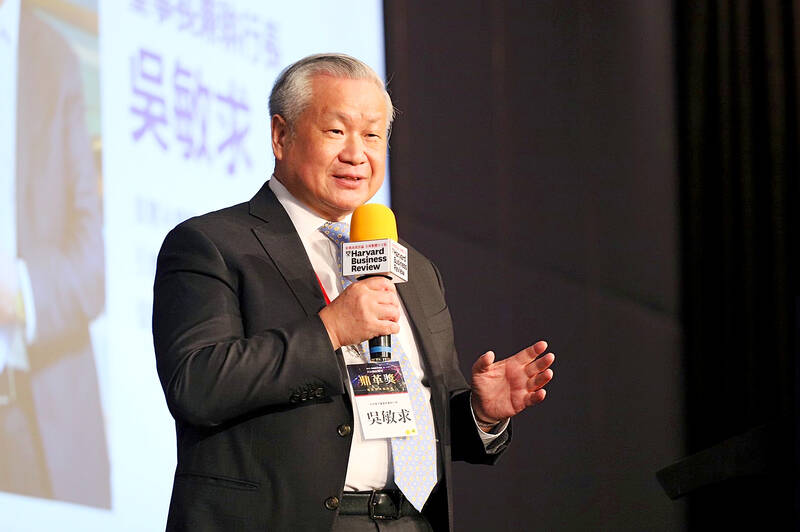
Photo: Grace Hung, Taipei Times
That translated into losses of NT$0.47 last quarter, compared with losses per share of NT$0.69 in the prior quarter and NT$0.16 in the same period last year.
“Personally, I am very disappointed about the company’s third-quarter financial results. That significantly fell short of our expectations,” Macronix chairman Miin Wu (吳敏求) told investors on Wednesday.
“I had thought we would have at least been able to eke out a profit in any one month of the third quarter, but we did not make it,” he said.
Wu apologized for the disappointing financial performance and said he would focus on turning around the company within the upcoming year.
He said he would focus on improving the operations of Macronix’s factories and reducing capacity idleness, as well as beefing up digestion of excessive inventories.
As Samsung Electronics Co has exited the low-density embedded multimediacard (eMMC) NAND flash memory chip market and caused supply constraints, Macronix has a good chance to fill the void left in its wake, Wu said, adding that he believes the memory chip market is full of growth potential in the next year or two.
“The current market changes are in favor of us,” Wu said.
Macronix aims to bring its gross margin back to 40 percent in the long term, just as in the past, he said.
Gross margin last quarter weakened to 13.5 percent from 15.6 percent in the second quarter and 28.9 percent in the third quarter last year, company data showed.
Macronix said unfavorable foreign exchange rates were behind the lower margin, along with lower factory usage and excessive inventory.
Revenue rose 21 percent sequentially, or 6 percent annually, to NT$8.21 billion last quarter from NT$6.8 billion.
The NOR flash memory chips accounted for 52 percent, with revenue shrinking 6 percent sequentially last quarter.
The read-only memory chips, primarily used in Nintendo Co’s Switch consoles, made up 26 percent.
The NAND flash memory chips, including eMMC NAND flash memory chips, made up 16 percent of the company’s total revenue last quarter, after surging 44 percent quarter-on-quarter.


Taiwanese firms have increased investment in the Philippines in recent years as Manila’s ties with Washington deepen and global supply chains continue to shift away from China, an expert at the Chung-Hua Institution for Economic Research (CIER, 中華經濟研究院) said yesterday. The Philippines had not been among Taiwanese investors’ top choices in Southeast Asia, CIER Taiwan ASEAN Studies Center director Kristy Hsu (徐遵慈) said at a seminar in Taipei. However, Taiwan’s investment in the country has grown significantly since the COVID-19 pandemic, reaching US $257 million last year, a high in recent years, she said. Although Taiwan’s total investment in the Philippines still lags

Intel Corp regards Taiwan Semiconductor Manufacturing Co (TSMC, 台積電) as a longstanding partner, as the US chipmaker would continue outsourcing production of advanced chips to TSMC, Intel chief executive officer Lip-Bu Tan (陳立武) said yesterday. “I don’t look at people as competitors. I look at the collaboration... Nvidia is also, you know, a good friend,” Tan told a news conference following his keynote speech at the Computex trade show in Taipei. “It’s a very trusted partnership for us... We are a big, top customer for them, and we’re going to continue doing that,” he said, referring to TSMC, the world’s largest foundry

Hon Hai Precision Industry Co (鴻海精密) yesterday said it would work with US chipmaker Intel Corp to jointly develop and deploy next-generation artificial intelligence (AI) infrastructure and intelligent computing platforms in a move to capture booming demand for AI computing systems. Hon Hai, also known as Foxconn Technology Group (富士康), said in a statement that the partnership would combine its global manufacturing scale, system integration expertise and AI data center deployment capabilities with Intel’s strengths in processor architecture, silicon technologies and software ecosystem. The companies said they plan to work on equipment used in AI data centers, including server racks powered by

Artificial intelligence (AI) agents would supplant smartphones as the center of people’s digital lives, fundamentally reshaping personal devices and driving a major computing upgrade cycle, Qualcomm Inc CEO Cristiano Amon said yesterday. In his keynote speech for this year’s Computex trade show in Taipei, Amon said that the rise of "agentic AI" — AI systems capable of reasoning, planning and carrying out tasks autonomously — would transform how people interact with technology across phones, PCs, vehicles and wearable devices. Describing the technology as the next major evolution in computing, Amon said that "2026 is the year of agents.” For decades, smartphones have sat


 RSS
RSS