


US President Donald Trump hailed a meeting with Chinese President Xi Jinping (習近平) as “amazing” and a “12” on a 10-point scale, but the agreement the two leaders reached appears to be no more than a fragile truce in a trade war with root causes still unresolved.The framework announced yesterday — that includes China resuming soybean purchases, suspending its rare earths export curbs for a year, and the US lowering tariffs on China by 10 percent — broadly rewinds ties to the status that existed before Trump’s “Liberation Day” offensive triggered mutual escalation.
The deal exposes the fundamental mismatch between what Washington wants and what Beijing is willing to offer. Absent from the talks were the big issues cited by Trump as he launched his tariffs in April — China’s industrial policies, manufacturing overcapacity and its export-led growth model.
“So what are we talking about? We are talking about de-escalation of the measures that both sides have taken since the start of the Trump administration in this kind of escalating trade war,” said Emily Kilcrease, director at the Center for a New American Security.
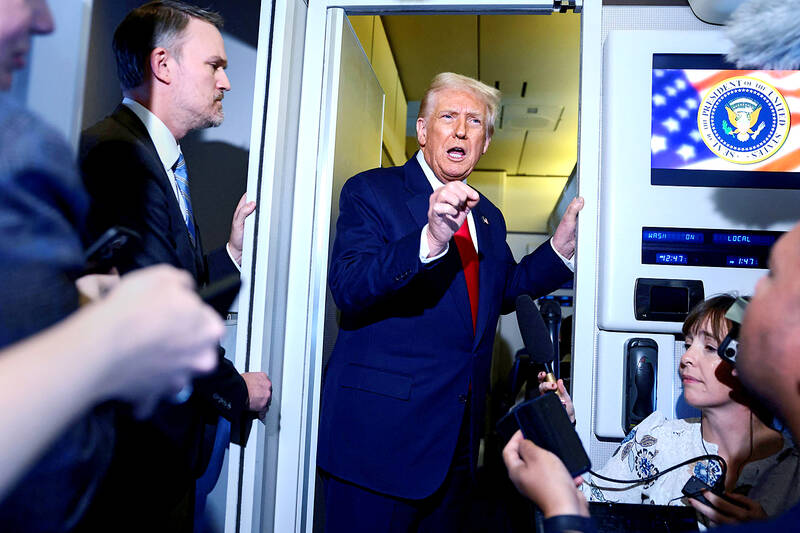
Photo: Reuters
The outcome underscores the robustness of Xi’s new approach to dealing with the US, which relies on a broad toolbox of measures like export controls, swiftly deployed in response to each move by the Trump administration.
An official briefed on the deliberations said the Chinese had a realistic set of expectations for this encounter — and those did not include a fundamental reset of two-way ties. Chinese officials were happy with Trump’s tone entering and his framing of the meeting as a “G2,” said the official, who declined to be named or further identified because he was not authorized to speak to the media.
China sees this as a stepping stone to a bigger meeting where they can stabilize the relationship, the official added.
Given the long-simmering tensions, the very fact that both leaders had a warm meeting — and agreed to two follow-up visits next year — offers rattled multinational corporations caught in the middle a much needed reprieve, analysts said.
Trump said tariffs on Chinese imports would be cut to 47 percent from about 57 percent by halving the rate of levies related to trade in fentanyl precursor chemicals to 10 percent from 20 percent.
The deal buys both sides maneuvering room: Trump gets a win before his planned visit to Beijing next year, Xi gets relief from elevated US tariffs that have put pressure on Chinese manufacturers.
Even this tactical victory is incomplete. China’s latest rare earths licensing curbs are delayed, not dismantled, but earlier restrictions on the critical minerals that have upended global trade remain, leaving US factories facing uncertainty in sourcing critical materials.
“I think that what we’ve seen this year has been a more or less total vindication of China’s strategy of never striking first, but always striking back,” said Joe Mazur, geopolitics analyst at Trivium China, a consultancy.
“It’s very clear that rare earths is the primary piece of leverage, the ace in the hole that China is able to wield over the US — it doesn’t look like the US has any comparable leverage or any way of breaking the stranglehold for the time being,” he said
The agreement highlights how dramatically the relationship between the world’s two biggest economies has deteriorated since Trump’s first term, when negotiators produced a comprehensive 96-page document covering intellectual property, banking and agriculture.
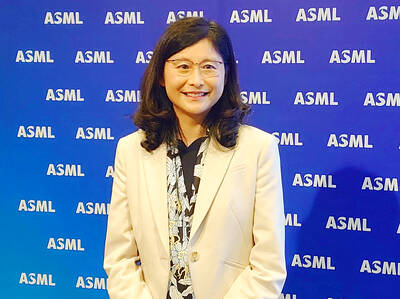
Netherlands-based semiconductor equipment supplier ASML Holding NV yesterday said that it is planning to hire an additional 1,000 people in Taiwan this year in response to growing demand from clients. ASML had previously planned to recruit 600 people this year, but that the plan has been adjusted upward, ASML vice president and ASML Taiwan general manager Grace Wang (汪佳慧) told reporters. ASML has a workforce of more than 4,500 in Taiwan, accounting for about 10 percent of its global total, Wang said. This year’s recruitment campaign would focus on adding people in the customer support, manufacturing and supply chain domains to assist ASML

UNDER MICROSCOPE: Taiwan detained three people who allegedly conspired to buy servers in Taiwan and export them using fraudulent documentation, prosecutors said Nvidia Corp chief executive officer Jensen Huang (黃仁勳) on Saturday urged Super Micro Computer Inc to tighten up on compliance after Taiwan detained three people this week for allegedly making fraudulent declarations about artificial intelligence (AI) servers made by its US partner. The development marked the nation’s first crackdown on semiconductor smuggling, which grew after the US slapped restrictions on exports of high-end chips such as Nvidia AI accelerators to China. Nvidia is “rigorous” in explaining regulations to all of its partners, Huang told reporters after arriving in Taipei. “Ultimately Super Micro has to run their own company,” he said in response to
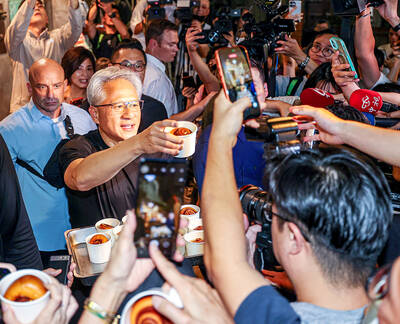
Nvidia Corp yesterday announced that CEO Jensen Huang (黃仁勳) would attend an employee meeting in Taipei tomorrow to celebrate the launch of the company’s Taiwan headquarters project. Huang would attend a gathering at the site of Nvidia’s planned headquarters in Beitou Shilin Technology Park (北投士林科技園區), the company said in a statement. After arriving in Taiwan on Saturday last week, Huang told reporters that he plans to meet with Quanta Computer Inc (廣達) chairman Barry Lam (林百里) and Taiwan Semiconductor Manufacturing Co (TSMC, 台積電) chairman C.C. Wei (魏哲家), and would attend the groundbreaking ceremony for Nvidia’s Taiwan headquarters tomorrow. Nvidia has not yet applied
Huawei Technologies Co (華為) said it has come up with a new pathway to shorten its gap with industry leader Taiwan Semiconductor Manufacturing Co (TSMC, 台積電), potentially achieving a breakthrough in making advanced semiconductors without cutting-edge equipment. Right now there is about a five-year gap between what TSMC is capable of and what Huawei, together with its manufacturing partner Semiconductor Manufacturing International Corp (中芯), can produce. Huawei is to start making 1.4-nanometer chips by 2031 with its own “LogicFolding” technology, Huawei semiconductor chief He Tingbo (何庭波) said in a rare public appearance during a chip conference yesterday, while TSMC has


 RSS
RSS