


Uber Technologies Inc yesterday warned that proposed restrictions on batching orders and minimum wages could prompt a NT$20 delivery fee increase in Taiwan, as lower efficiency would drive up costs.
Uber CEO Dara Khosrowshahi made the remarks yesterday during his visit to Taiwan. He is on a multileg trip to the region, which includes stops in South Korea and Japan. His visit coincided the release last month of the Ministry of Labor’s draft bill on the delivery sector, which aims to safeguard delivery workers’ rights and improve their welfare.
The ministry set the minimum pay for local food delivery drivers at NT$45 per trip, the draft states. The hourly pay should not be lower than NT$245, which is 1.25 times higher than the minimum hourly wage of NT$196.
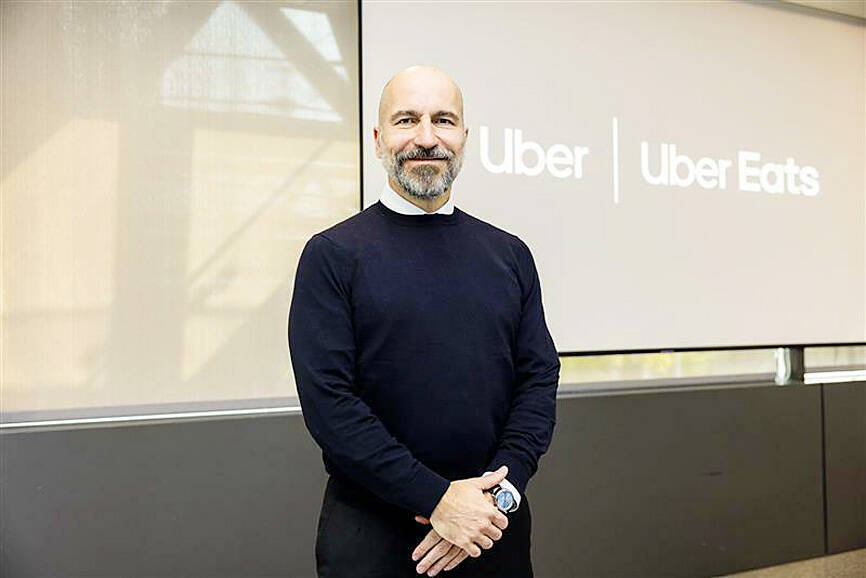
Photo courtesy of Uber Technologies Inc
Delivery workers should be paid for each trip, rather than paid at one go, it states.
Khosrowshahi said that Uber supports most of the draft bill, but is concerned about some parts, such as rules linked to batching orders, which consolidate multiple orders into a single delivery for efficient processing.
“The proposed rules will reduce the benefit of batching and will force us to pass on the incremental costs to consumers, resulting in additional delivery fees, tentatively at NT$20 per delivery, which is significant,” Khosrowshahi said. “Even though on-demand delivery is very popular around the world, it is subject to the laws of supply and demand. Higher prices mean lower delivery, fewer trips for delivery partners, and less business for merchants.”
Uber can provide higher earnings for batch trips than a standalone trip, if the incentives for batching orders are not removed entirely, he said.
Batching orders is essential in Taiwan, particularly in Taipei, given the market’s population density, Khosrowshahi said, adding that batching is important to the growth of businesses and allows Uber to make delivery more affordable.
The delivery sector is a highly price-sensitive market, with a 5 percent price hike likely resulting in a loss of 34 percent of overall delivery service users, a survey released last year by the Fair Trade Commission showed.
The National Delivery Union yesterday wrote on Facebook that batching order payments tend to be less than one-third of standard standalone trip payments if those orders were divided into several trips.
In some extreme cases, the payment even dipped to a mere NT$45, it added.
The union said it would hold a news conference today to rebut Uber’s claims and clarify the issue.

Netherlands-based semiconductor equipment supplier ASML Holding NV yesterday said that it is planning to hire an additional 1,000 people in Taiwan this year in response to growing demand from clients. ASML had previously planned to recruit 600 people this year, but that the plan has been adjusted upward, ASML vice president and ASML Taiwan general manager Grace Wang (汪佳慧) told reporters. ASML has a workforce of more than 4,500 in Taiwan, accounting for about 10 percent of its global total, Wang said. This year’s recruitment campaign would focus on adding people in the customer support, manufacturing and supply chain domains to assist ASML
UNDER MICROSCOPE: Taiwan detained three people who allegedly conspired to buy servers in Taiwan and export them using fraudulent documentation, prosecutors said Nvidia Corp chief executive officer Jensen Huang (黃仁勳) on Saturday urged Super Micro Computer Inc to tighten up on compliance after Taiwan detained three people this week for allegedly making fraudulent declarations about artificial intelligence (AI) servers made by its US partner. The development marked the nation’s first crackdown on semiconductor smuggling, which grew after the US slapped restrictions on exports of high-end chips such as Nvidia AI accelerators to China. Nvidia is “rigorous” in explaining regulations to all of its partners, Huang told reporters after arriving in Taipei. “Ultimately Super Micro has to run their own company,” he said in response to
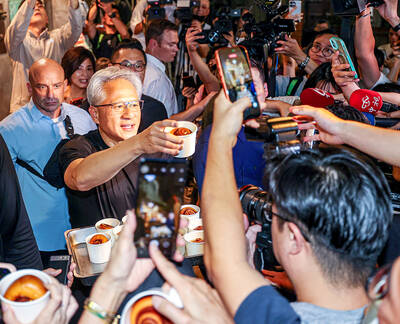
Nvidia Corp yesterday announced that CEO Jensen Huang (黃仁勳) would attend an employee meeting in Taipei tomorrow to celebrate the launch of the company’s Taiwan headquarters project. Huang would attend a gathering at the site of Nvidia’s planned headquarters in Beitou Shilin Technology Park (北投士林科技園區), the company said in a statement. After arriving in Taiwan on Saturday last week, Huang told reporters that he plans to meet with Quanta Computer Inc (廣達) chairman Barry Lam (林百里) and Taiwan Semiconductor Manufacturing Co (TSMC, 台積電) chairman C.C. Wei (魏哲家), and would attend the groundbreaking ceremony for Nvidia’s Taiwan headquarters tomorrow. Nvidia has not yet applied

Huawei Technologies Co (華為) said it has come up with a new pathway to shorten its gap with industry leader Taiwan Semiconductor Manufacturing Co (TSMC, 台積電), potentially achieving a breakthrough in making advanced semiconductors without cutting-edge equipment. Right now there is about a five-year gap between what TSMC is capable of and what Huawei, together with its manufacturing partner Semiconductor Manufacturing International Corp (中芯), can produce. Huawei is to start making 1.4-nanometer chips by 2031 with its own “LogicFolding” technology, Huawei semiconductor chief He Tingbo (何庭波) said in a rare public appearance during a chip conference yesterday, while TSMC has


 RSS
RSS