


Amazon.com Inc said yesterday that it would reduce its global corporate workforce by about 14,000 people, with more cuts expected next year, in a major shakeup driven in part by adoption of artificial intelligence (AI) at the tech giant.
The online retailer began laying off employees across multiple divisions as part of a plan, first reported on Monday by Reuters, to cut as many as 30,000 employees. Amazon is working to compensate for over-hiring during the peak demand of the COVID-19 pandemic and limit costs.
The layoffs offer an early look at the broad effects that AI could have on workforces. Amazon CEO Andy Jassy flagged the possibility of such losses in June, saying increased use of AI tools and agents would lead to more corporate job cuts, particularly through automating routine tasks.
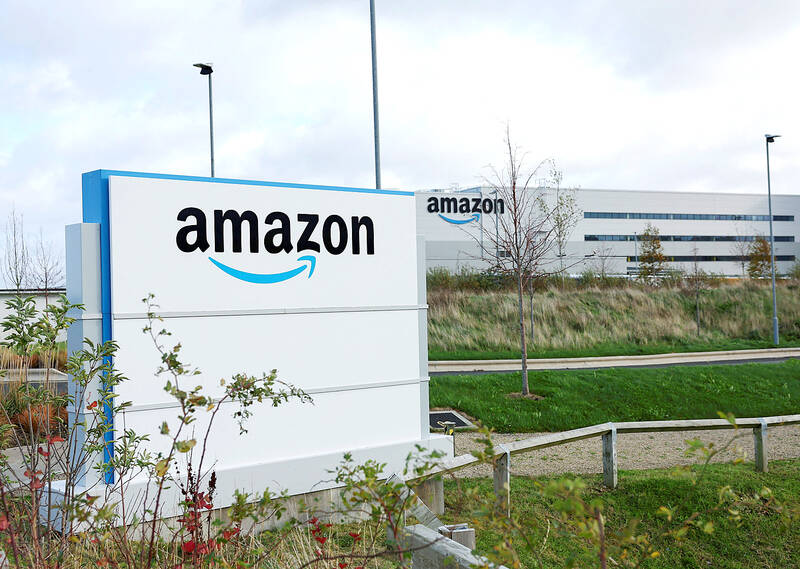
Photo: Damien Eagers, Reuters
Amazon had about 1.56 million full-time and part-time employees at the end of last year. Its corporate workforce includes roughly 350,000 employees.
Workers told Reuters they learned their jobs were eliminated from letters sent to their personal email addresses early yesterday morning.
"You are no longer required to perform work on Amazon’s behalf," reads the email from Beth Galetti, senior vice president of People Experience and Technology, that was sent to impacted employees and seen by Reuters.
She said those workers would be given the option to meet with a human resources employee over video call. "Unfortunately, your role is being eliminated and your employment will end after a non-working period."
Amazon will offer most affected workers 90 days to look for a new role internally and said its recruiting teams would prioritize those candidates.
Departments affected by the job cuts include devices, advertising, Prime Video, HR and Amazon’s cloud computing unit Amazon Web Services (AWS), employees told Reuters.
It was not immediately clear over what period the full target of 30,000 job cuts will take place, but Galetti said in the note Amazon would continue hiring in certain areas and reducing headcount in other divisions heading into next year.
Over the past two years, the company has been carrying out piecemeal job cuts across divisions including books, devices and its Wondery podcast business. The layoffs so far have already helped teams move faster, Galetti said.
Galetti’s note reiterated Jassy’s push to reduce management layers and lean more on AI.
Corporations are increasingly using the technology to write code for their software and adopting AI agents to automate routine tasks, as they look to save costs and cut reliance on people.
"This generation of AI is the most transformative technology we’ve seen since the Internet, and it’s enabling companies to innovate much faster than ever before," Galetti said.
Amazon is expected to shell out roughly US$118 billion in capital expenditures for the year, with much of it going towards building AI and cloud infrastructure. The company will report its third-quarter earnings on Thursday.

Cairo’s new monorail slices across the city skyline, running above the familiar chaos of blaring horns and aging buses’ exhaust fumes that mark rush hour below. The US$4.5 billion monorail, opened this month, is among Egypt’s most prominent new transport projects, part of a debt-funded infrastructure drive criticized for sapping state finances while bringing limited benefits to most of the country’s 109 million people. “It feels like you’re in a different country,” said Ramy Sayed, a restaurant manager, aboard a driverless Innovia 300 train. “No noise, no traffic, we’re not used to this.” The eastern line runs 56km from the bustling middle-class

Taiwanese firms have increased investment in the Philippines in recent years as Manila’s ties with Washington deepen and global supply chains continue to shift away from China, an expert at the Chung-Hua Institution for Economic Research (CIER, 中華經濟研究院) said yesterday. The Philippines had not been among Taiwanese investors’ top choices in Southeast Asia, CIER Taiwan ASEAN Studies Center director Kristy Hsu (徐遵慈) said at a seminar in Taipei. However, Taiwan’s investment in the country has grown significantly since the COVID-19 pandemic, reaching US $257 million last year, a high in recent years, she said. Although Taiwan’s total investment in the Philippines still lags

Intel Corp regards Taiwan Semiconductor Manufacturing Co (TSMC, 台積電) as a longstanding partner, as the US chipmaker would continue outsourcing production of advanced chips to TSMC, Intel chief executive officer Lip-Bu Tan (陳立武) said yesterday. “I don’t look at people as competitors. I look at the collaboration... Nvidia is also, you know, a good friend,” Tan told a news conference following his keynote speech at the Computex trade show in Taipei. “It’s a very trusted partnership for us... We are a big, top customer for them, and we’re going to continue doing that,” he said, referring to TSMC, the world’s largest foundry

Artificial intelligence (AI) agents would supplant smartphones as the center of people’s digital lives, fundamentally reshaping personal devices and driving a major computing upgrade cycle, Qualcomm Inc CEO Cristiano Amon said yesterday. In his keynote speech for this year’s Computex trade show in Taipei, Amon said that the rise of "agentic AI" — AI systems capable of reasoning, planning and carrying out tasks autonomously — would transform how people interact with technology across phones, PCs, vehicles and wearable devices. Describing the technology as the next major evolution in computing, Amon said that "2026 is the year of agents.” For decades, smartphones have sat


 RSS
RSS