

Taiwanese shares yesterday closed sharply higher at a new record, lifted by optimism over progress in US-China trade talks and expectations of an interest rate cut by the US Federal Reserve this week.
Shares elsewhere in Asia also rallied, with Japan’s benchmark Nikkei 225 breaching 50,000 for the first time and South Korea’s KOSPI closing at a new high.
“Like other Asian markets, local investors were encouraged by the upbeat mood over US-China trade talks to raise their holdings today,” MasterLink Securities Corp (元富證券) analyst Tom Tang (湯忠謙) said.
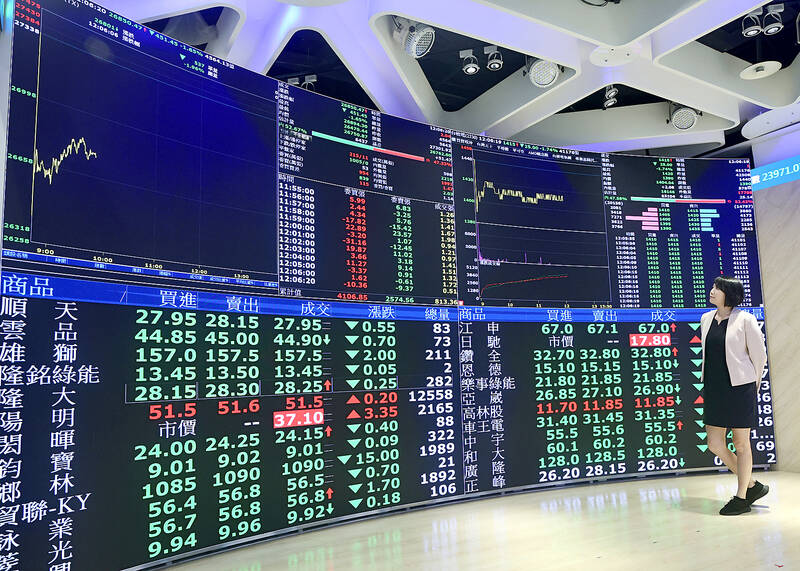
Photo: CNA
“Buying focused on tech stocks, as many investors were hoping for a rate cut by the Fed after Washington reported cooler than expected inflation in September,” Tang said. “Lower interest rates will no doubt make tech stocks dividend yields more attractive.”
On Sunday, US and Chinese negotiators agreed on a framework for a trade deal ahead of a meeting between US President Donald Trump and Chinese President Xi Jinping (習近平) in South Korea on Thursday, on the sidelines of the APEC summit — their first face-to-face encounter since Trump returned to office in January.
US Secretary of the Treasury Scott Bessent told CBS’ Face the Nation on Sunday that the threat of additional tariffs on China was “effectively off the table.”
In a series of US television interviews, Bessent said the discussions produced initial agreements for Beijing to curb exports of precursor chemicals used in fentanyl production and to make “substantial” purchases of soybeans and other agricultural products, while delaying new export controls on rare earths.
Chinese Vice Premier He Lifeng (何立峰) said the two sides reached a “preliminary consensus” on tariffs, export controls and fentanyl cooperation, describing the talks as “candid, in-depth and constructive.”
The breakthrough came after months of escalating tensions, with Trump threatening a massive tariff hike in response to China’s expansion of rare earth export controls early this month — a move Washington called “economic coercion.”
“Despite the framework agreed upon by US and Chinese negotiators, investors need to watch closely how the Trump-Xi meeting proceeds as uncertainties remain before a formal deal is cut,” Tang said.
The TAIEX rose 461.37 points, or 1.68 percent, to close at 27,993.63, retreating slightly from 28,000 after contract chipmaker Taiwan Semiconductor Manufacturing Co (台積電) pared early gains on profit-taking. TSMC closed up 2.07 percent at NT$1,480.
In Japan, opinion polls showed newly installed Prime Minister Sanae Takaichi had public support for her market-friendly policies and confident debut at the regional summit.
The Nikkei 225 gained 2.5 percent to finish at a record 50,512.32.
Seoul’s KOSPI also advanced more than 2 percent to break 4,000 for the first time, boosted by a 3 percent rise in Samsung Electronics Co and a nearly 5 percent jump in chipmaker SK Hynix Inc.
Hong Kong, Shanghai, Singapore and Sydney also made gains, while Jakarta and Manila fell.
Additional reporting by AP and AFP
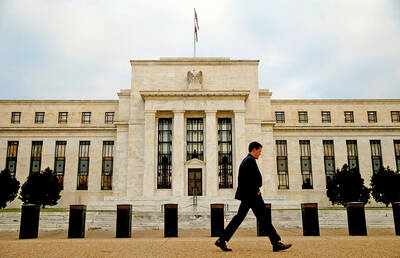
Federal Reserve Bank of Philadelphia President Anna Paulson on Thursday joined the chorus of policymakers saying additional interest-rate increases may be needed to ensure inflation returns to the central bank’s 2 percent goal. “Looking ahead, if conditions evolve as I expect, some modest further tightening may be warranted,” Paulson said on Thursday at an event in Philadelphia. Earlier on Thursday, New York Fed President John Williams said he and his colleagues “still have a lot of work to do” in dealing with lingering inflation risks. Several other officials have aired similar comments, in line with the signal given last week when policymakers voted
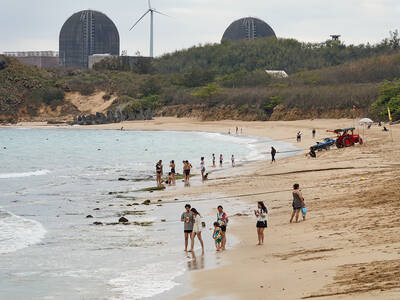
COURSE CHANGE: The shift comes amid pressure from chipmakers for stable, low-carbon electricity. Officials said Ma-anshan could be restarted as early as 2028 Taiwan has approved a preliminary plan to restart an idled atomic power plant, marking a reversal of the ruling party’s anti-nuclear stance as the nation pursues greater energy security. The Nuclear Safety Commission has cleared its review of an initial proposal to restart the Ma-anshan Nuclear Power Plant, it said in a statement on Thursday. Taiwan Power Co (台電) will still need to carry out follow-up work including safety inspections, before submitting another report on implementation for review, the commission said. The earliest the plant could resume operations is 2028, according to previous reports in local media, citing Minister of Economic Affairs
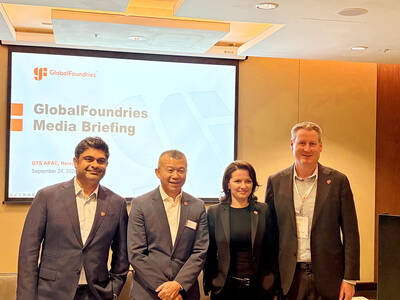
GlobalFoundries Inc yesterday said it plans to accelerate global capacity optimization and expansion to accommodate exponential growth in radio frequency (RF) and other chips driven by the artificial intelligence (AI) boom. Singapore will pay a vital role in the company’s capacity expansion, alongside production line optimizations across its manufacturing sites, GlobalFoundries Asia Pacific head Vincent Feng (范曾文) told a news conference in Hsinchu City. “Many might be surprised to hear that the RF market is thriving now. We are gearing up for a massive capacity expansion, and it is all being driven by AI,” Feng said. He declined to disclose details of the

MORE DATA CENTERS: Microsoft’s Taiwan-area general manager said the corporation is looking to add two more data centers in northern Taiwan over the next few years Microsoft Corp plans to double its data centers in Taiwan from two facilities to four, Microsoft Taiwan general manager Sean Pien (卞志祥) said yesterday. “Over the past two to three years, we have consistently seen demand outstrip supply, and we expect that situation to continue over the next two to three years,” Pien said on the sidelines of a news conference in Taipei. The data center sites would mainly be in northern Taiwan to meet customer demand and reduce the risk of operational disruptions caused by a single event, he said, without saying their exact locations. Microsoft enabled the first phase of


 RSS
RSS