


Profits at China’s industrial firms last month declined at a faster pace than a month earlier, as deflationary pressures sap the strength of corporate finances.
Last month’s industrial profits at large Chinese companies fell 27.1 percent from a year earlier, after a 17.8 percent plunge in August, the National Bureau of Statistics said in a statement yesterday. Profits decreased 3.5 percent in the first nine months from the same period last year.
The data was “affected by factors such as high base in the same period last year” the bureau said in a statement.

Photo: AFP
Industrial profits provide a key measure of the financial health of factories, mines and utilities that can affect their investment decisions in the months to come.
Weaker profits became emblematic of the challenges facing China’s US$18 trillion economy, prompting measures such as interest rate cuts since late last month.
The country’s top legislative body is to hold a highly anticipated session in Beijing on Nov. 4 to 8, as investors watch for any approval of further fiscal stimulus to revive growth.
Economists expect the meeting to confirm a plan to refinance local governments’ debt and issuance of sovereign bonds to inject capital into banks.
Investors have been on the lookout for fresh stimulus in the form of greater public borrowing and spending, but opinions differ over whether it would materialize this year.
Deepening deflation in producer prices was likely a drag on company earnings despite faster growth in industrial output, Bloomberg Economics said before the release. Factory-gate prices extended declines for a 24th straight month last month, with the recent drop accelerating, reflecting weak domestic demand.
The economy expanded 4.6 percent in the July-to-September period from a year earlier, the slowest pace since March last year.
The growth of the high-technology sector has offered signs of hope for the economy, with profit for the industry’s manufacturers climbing 6.3 percent in the first nine months, according to the statistics bureau.

Cairo’s new monorail slices across the city skyline, running above the familiar chaos of blaring horns and aging buses’ exhaust fumes that mark rush hour below. The US$4.5 billion monorail, opened this month, is among Egypt’s most prominent new transport projects, part of a debt-funded infrastructure drive criticized for sapping state finances while bringing limited benefits to most of the country’s 109 million people. “It feels like you’re in a different country,” said Ramy Sayed, a restaurant manager, aboard a driverless Innovia 300 train. “No noise, no traffic, we’re not used to this.” The eastern line runs 56km from the bustling middle-class
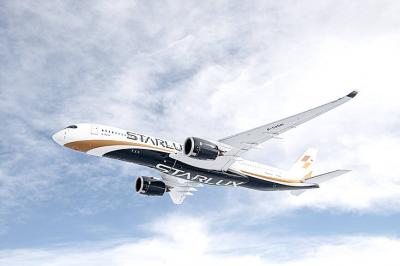
Starlux Airlines Co (星宇航空) today unveiled a long-haul network expansion plan at a shareholders’ meeting in Taipei, including direct flights to Barcelona, Spain, and Zurich, Switzerland, as well as a service connecting Taipei, Sydney and New Zealand. Starlux is to become the first Taiwanese carrier to offer non-stop services to the two European cities, while the inaugural oceanic route is expected to expand transit opportunities within the Australia-New Zealand market, Starlux said. Flight services to Chicago, Dallas, Washington and New York are under evaluation, the airline added. Prior to the shareholders’ meeting, the airline earlier this year announced that it would be
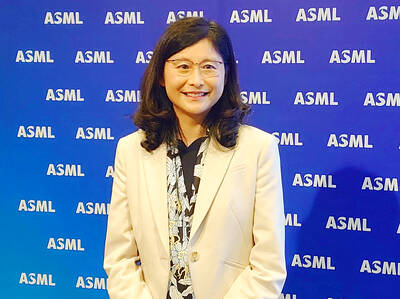
Netherlands-based semiconductor equipment supplier ASML Holding NV yesterday said that it is planning to hire an additional 1,000 people in Taiwan this year in response to growing demand from clients. ASML had previously planned to recruit 600 people this year, but that the plan has been adjusted upward, ASML vice president and ASML Taiwan general manager Grace Wang (汪佳慧) told reporters. ASML has a workforce of more than 4,500 in Taiwan, accounting for about 10 percent of its global total, Wang said. This year’s recruitment campaign would focus on adding people in the customer support, manufacturing and supply chain domains to assist ASML

Nvidia Corp yesterday announced that CEO Jensen Huang (黃仁勳) would attend an employee meeting in Taipei tomorrow to celebrate the launch of the company’s Taiwan headquarters project. Huang would attend a gathering at the site of Nvidia’s planned headquarters in Beitou Shilin Technology Park (北投士林科技園區), the company said in a statement. After arriving in Taiwan on Saturday last week, Huang told reporters that he plans to meet with Quanta Computer Inc (廣達) chairman Barry Lam (林百里) and Taiwan Semiconductor Manufacturing Co (TSMC, 台積電) chairman C.C. Wei (魏哲家), and would attend the groundbreaking ceremony for Nvidia’s Taiwan headquarters tomorrow. Nvidia has not yet applied


 RSS
RSS